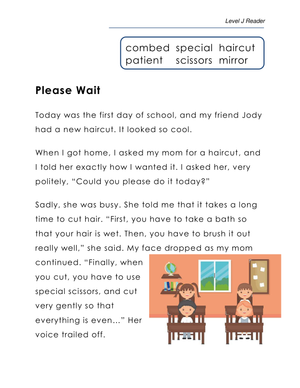
Reading level j worksheets work best as one piece of a guided reading rotation rather than as standalone seatwork. During a typical small-group lesson, you introduce the text, support students through a tricky section together, then send them to practice comprehension or vocabulary skills independently while you meet with another group. Worksheets tied to Level J texts should extend the guided reading conversation: a retelling organizer, a cause-and-effect chart, or short-answer questions that mirror what you just discussed with the group.
This distinction matters because the F&P system separates Instructional Level, where a student reads with teacher support, from Independent Level, where the same student reads fluently without help. A worksheet meant for guided reading time can include more challenging vocabulary questions since you are there to scaffold, while a worksheet meant for an independent center should stick to skills the student has already mastered at an easier level.
Comparing Level J to Levels I and K
Teachers often ask whether a student belongs at Level I, J, or K, and the differences show up in specific text features rather than just overall difficulty. Level I texts tend to use shorter sentences, simpler vocabulary, and stronger illustration support, while Level K texts introduce longer stretches of text without pictures, more complex sentence structures, and a higher density of multisyllabic words. Level J sits between these, with sentences that carry more than one clause and a vocabulary load that requires some inferencing but still benefits from picture cues.
When you're deciding whether reading level j worksheets are the right fit, look at how a student handles multi-clause sentences and whether they can track a simple plot across several pages. A student who reads Level J text accurately but struggles with retelling the sequence of events likely needs more comprehension-focused practice at the same level before moving up, while a student who reads fluently and retells with detail is ready for Level K material.
Using Level J Worksheets for Formative Assessment and Intervention
Level J worksheets double as quick formative assessment tools during guided reading blocks. A short comprehension worksheet completed after a guided reading session gives you a fast read on whether the group grasped the text, without needing a separate quiz. For students in a Response to Intervention (RTI) framework, these worksheets also generate the kind of data points, accuracy rates, comprehension scores, and observed strategies, that intervention teams look for when documenting progress or adjusting a support plan.
When you're cross-referencing F&P, DRA, and Lexile data for an intervention file, keep worksheet results alongside your running records so the full picture of a student's reading behavior is in one place. This is especially useful when a student's DRA score and F&P level appear slightly out of sync, since worksheet performance can help clarify whether the gap is about accuracy, comprehension, or fluency.
Teacher Tips for Managing Level J Materials
Organize your Level J worksheets by skill focus, such as retelling, vocabulary, and inferencing, rather than by text title, so you can quickly pull the right practice sheet for whatever a group needs that day. Laminate a few reusable graphic organizers for retelling and sequencing so students can practice with dry-erase markers before you assign a written worksheet, which builds confidence before the independent task.
Pair students who are solidly at Level J with a peer partner for a quick oral retell before they start a written worksheet. This gives struggling students a chance to rehearse their answer verbally, which often improves the quality of their written response and gives you a quick informal check on comprehension before they even pick up a pencil.
Frequently Asked Questions
1. What grade level is reading Level J typically associated with?
Level J most commonly aligns with early-to-mid second-grade reading expectations, though some students reach this level in late first grade or early third grade depending on their individual progress.
2. How does Level J compare to DRA and Lexile scores when selecting worksheets?
Level J correlates to roughly DRA Level 18 and sits near a Lexile measure of 400L, so worksheets built for this level should feature short passages with moderate sentence complexity that match both of these benchmarks.
3. How can teachers tell if a student is ready to move from Level I to Level J or from Level J to Level K?
Look at reading accuracy alongside comprehension: a student reading with strong accuracy and detailed retelling at their current level, along with the ability to handle slightly longer sentences and less picture support, is typically ready to advance.
4. What skills should Level J worksheets reinforce during guided reading groups?
Worksheets at this level should target retelling with sequence and detail, vocabulary in context, and short-response comprehension questions that go beyond simple recall.
5. How often should teachers reassess a student's reading level while using Level J materials?
Most classrooms reassess every four to six weeks using a running record or benchmark assessment, adjusting sooner if worksheet performance suggests the text is too easy or too difficult.