Understanding the Nuances of Irony in Literary Analysis
Irony involves a contrast between expectations and reality. This tension between what is said and what is meant, or what happens and what was expected, provides the depth that makes literature engaging. Teachers find that teaching irony requires direct instruction paired with interactive practice. By utilizing high-quality irony printable worksheets for middle and high school students, teachers provide the structured repetition necessary to master this concept.
Mastery of this device allows students to move beyond literal interpretations of text into higher-order thinking. Our collection of resources focuses on providing diverse examples that challenge students to think critically about underlying meaning. Whether exploring character development or thematic shifts, identifying irony is a core skill.
According to the analysis of Literary Devices: Irony (https://literarydevices.net/irony/), irony serves to engage the reader's interest and compel them to think more deeply about the text. By recognizing the 3 main types of irony, students improve their critical thinking skills and literary comprehension scores significantly. This data point underscores why teachers prioritize irony instruction during the development of analytical reading skills. Providing students with a variety of contexts ensures they can recognize these patterns wherever they appear.
Breaking Down Verbal Irony: When Words Mean the Opposite
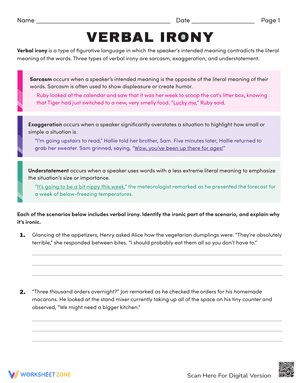
Verbal irony occurs when a speaker says something that contrasts with their actual intent. This is often the most accessible form of irony for students because they encounter it frequently. However, distinguishing verbal irony from simple lying or sarcasm is a vital step. While sarcasm is a form of verbal irony intended to mock, not all verbal irony is sarcastic. Sometimes, a character might use verbal irony to be polite or humorous. Identifying these subtleties is a core objective of many ELA lesson plans.
When using irony printable worksheets, it is helpful to provide examples ranging from the obvious to the subtle. A character saying "Lovely weather" during a downpour is a classic, easy-to-spot example. More complex instances might involve a character expressing confidence in a plan they secretly know will fail. These examples encourage students to look for context clues and consider the speaker's perspective. By practicing with these materials, students learn to ask: What is the speaker's true intent? This level of inquiry is essential for deep reading.
Situational Irony: Navigating Unexpected Outcomes
Situational irony occurs when there is a significant discrepancy between what is expected to happen and what actually occurs. This is not simply a surprise; it is a reversal of expectations that often carries a deeper meaning. For example, a fire station burning down is situationally ironic because the very place intended to prevent fires is destroyed by one. This type of irony is a powerful tool for authors to create tension or humor within a story.
Teaching situational irony involves helping students identify the initial expectation and then explaining why the outcome is the opposite. Many students struggle with the difference between irony and bad luck. A professional bus driver who gets lost on his way to work is an example of situational irony, whereas missing the bus is just bad luck. Our irony printable worksheets include specific exercises designed to help students make this distinction. By analyzing various scenarios, students learn to look for the inherent contradiction that defines situational irony.
Expert ELA instructors note that situational irony often functions as a vehicle for social critique. When an author constructs a world where efforts to achieve a goal lead to the opposite result, they are often making a statement about the human condition or the limitations of logic. For instance, in O. Henry's "The Gift of the Magi," the characters' sacrifices render their gifts useless, highlighting the value of love over possessions. Analyzing these instances allows students to connect literary techniques to broader human experiences and ethical dilemmas.
Dramatic Irony: Giving the Audience the Inside Edge
Dramatic irony occurs when the audience knows something that the characters in the story do not. This creates a dynamic where the audience can anticipate future events or understand the true significance of actions while the character remains in the dark. This technique is frequently used in drama and suspenseful literature to build engagement. In a classic horror movie, when a character walks into a room where the audience knows a monster is hiding, the resulting tension is a direct product of dramatic irony.
Because dramatic irony relies on information distribution, it is an excellent way to teach perspective. When students use irony printable worksheets focusing on dramatic irony, they are asked to identify the "secret" information known only to the reader. They then analyze how this knowledge affects their perception of the characters' dialogue. This helps students appreciate the craftsmanship involved in storytelling and understand how authors manipulate information to elicit emotional responses.
In Shakespearean tragedies, dramatic irony emphasizes the inevitability of a character's downfall. When Romeo believes Juliet is dead, the audience's knowledge that she is merely sleeping creates a profound sense of tragedy. By exploring these examples, students learn how irony enhances the emotional weight of a narrative. Our resources provide excerpts that allow students to practice identifying dramatic irony in different genres, from lighthearted comedies to intense dramas.
Differentiating Irony from Sarcasm and Coincidence
One persistent challenge is helping students distinguish irony from sarcasm and coincidence. Sarcasm is a specific type of verbal irony intended to be hurtful or mocking. If someone trips and another says, "Nice move," that is sarcasm. It is ironic because the move was not nice, but the intent is specifically to make fun of the person. Understanding this distinction helps students analyze character motivations and tone.
Effective instruction requires students to explain the "why" behind their identification. It is not enough to simply label something as ironic; students must articulate the specific expectation and the corresponding reality. This ensures they have grasped the concept rather than just memorized definitions. By using structured irony printable worksheets, teachers guide students through this process, providing scaffolding as they develop analytical skills essential for advanced studies in rhetoric.
Teacher Tips for Implementing Irony Lessons
When introducing irony, start with visual examples like political cartoons or short film clips to illustrate the different types in a relatable way. Once students have a basic understanding, transition to short texts that feature clear ironic elements. Using irony printable worksheets can provide the necessary practice to reinforce these concepts before moving on to complex literary works. This step-by-step approach ensures all students achieve mastery.
Another strategy is to encourage students to create their own examples. Ask them to write short skits that incorporate verbal, situational, and dramatic irony. This application-based learning solidifies their understanding and shows the creative potential of these devices. You can also integrate irony into daily routines by pointing out ironic situations in school news. This helps students realize that irony is a common feature of human communication, not just a literary term.
Frequently Asked Questions
1. What is the most common type of irony students encounter?
Verbal irony is usually the first type students recognize because it is so prevalent in speech. Sarcasm, a sub-type of verbal irony, is particularly familiar to students. However, situational irony is frequently used to drive plots in the stories they consume. Providing irony printable worksheets that cover all three types ensures a comprehensive understanding of how these devices function in different narrative contexts.
2. How can I tell if a situation is ironic or just a coincidence?
The key difference lies in the reversal of expectations. A coincidence is just two things happening at once by chance. Irony requires a specific expectation to be overturned in a way that feels meaningful. For example, if a weather forecaster's outdoor wedding is ruined by an unpredicted storm, that is situational irony because we expect a forecaster to know when it will rain, creating a clear contradiction.
3. Why is it important for students to learn about irony?
Understanding irony is essential for critical thinking. It allows students to look beneath the surface of a text to find the author's true meaning and tone. This skill is vital for academic success in ELA and for navigating real-world communication where intent and literal meaning often diverge. High-quality irony printable worksheets offer the practice needed to develop these essential skills.
4. At what grade level should irony be introduced?
Basic concepts of irony can be introduced as early as upper elementary school. However, more in-depth study usually begins in middle school and continues through high school. The irony printable worksheets in our collection are designed to be adaptable for various grade levels, providing appropriate challenges for students at different stages of their academic journey as they encounter increasingly sophisticated texts.
5. Can these worksheets be used for remote or hybrid learning?
Yes, irony printable worksheets are excellent resources for both in-person and remote instruction. They can be distributed digitally for home use, providing consistent practice regardless of the learning environment. Teachers can use these materials to facilitate online discussions or as part of formative assessments to track student progress throughout the unit.















 Interactive Worksheet Maker
 Quiz Maker
 Word Search Maker
 Crossword Puzzle Maker
 Word Scramble Generator
 Sentence Scramble Generator
 Handwriting Worksheet Generator
 Name Tracing Generator
 Fill In The Blank Generator