




























1 / 2
0
Views
0
Downloads


0.0
0
Save
0 Likes
Share
Recognizing Irony in Context: Practice Sheet
0 Views
0 Downloads

Paste this activity's link or code into your existing LMS (Google Classroom, Canvas, Teams, Schoology, Moodle, etc.).
Students can open and work on the activity right away, with no student login required.
You'll still be able to track student progress and results from your teacher account.
Information
Description
What It Is:
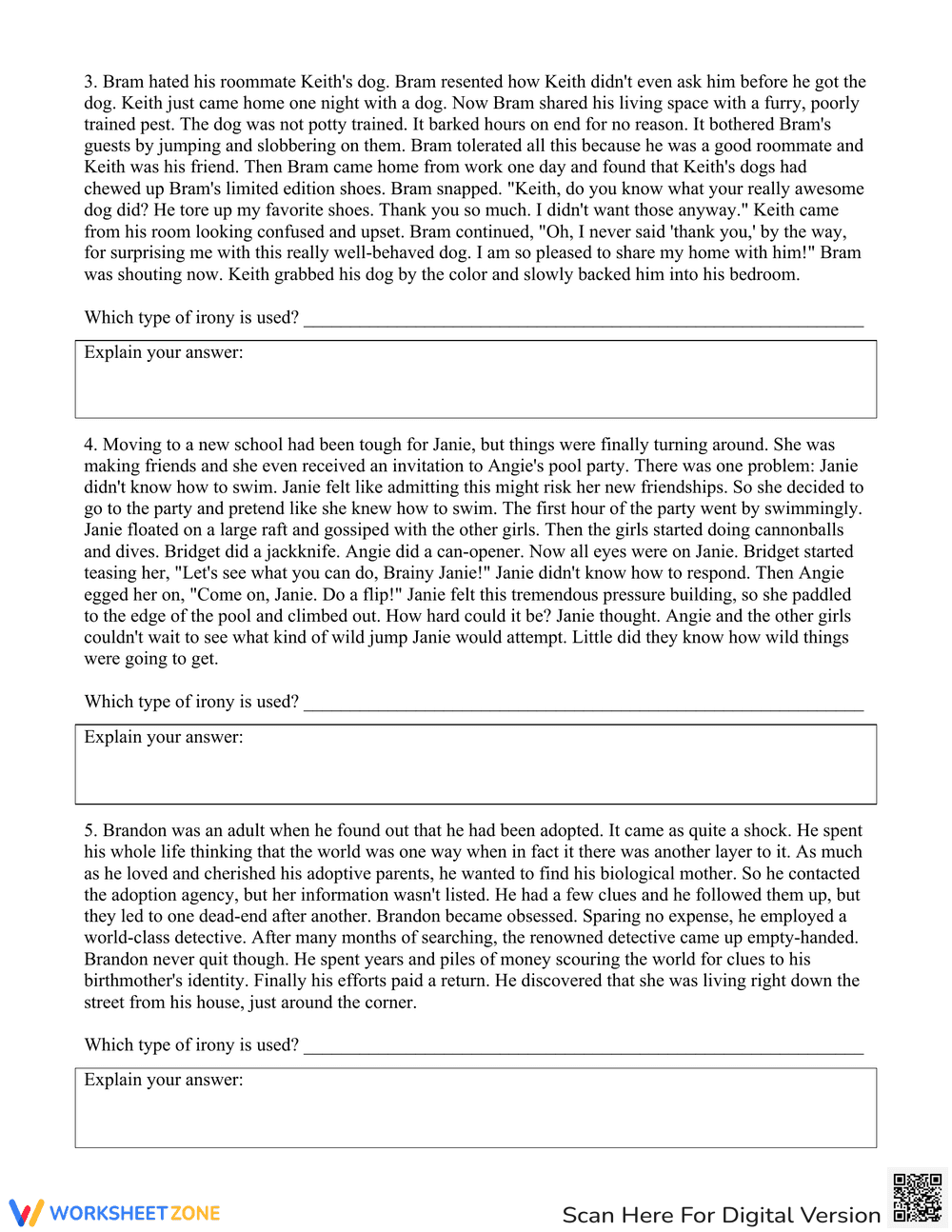
This is an educational worksheet titled 'Identifying Irony 4.' It presents two short stories or scenarios. For each scenario, students are asked to identify which type of irony is being used (Dramatic, Situational, or Verbal) and then explain their answer. The worksheet provides brief definitions of the three types of irony.
Grade Level Suitability:
This worksheet is suitable for grades 7-10. The concepts of dramatic, situational, and verbal irony are typically introduced in middle school and reinforced in high school English classes. The complexity of the stories requires a good reading comprehension level.
Why Use It:
This worksheet helps students develop critical thinking skills by analyzing text and identifying literary devices. It reinforces understanding of the different types of irony and encourages students to provide evidence from the text to support their claims.
How to Use It:
Students should read the definitions of dramatic, situational, and verbal irony provided at the beginning of the worksheet. Then, they should carefully read each scenario and determine which type of irony is present. Finally, they should write a brief explanation justifying their answer, referencing specific details from the text.
Target Users:
This worksheet is designed for middle school and high school students who are learning about literary devices, specifically irony. It's useful for English teachers looking for practice activities or assessments related to irony.
This is an educational worksheet titled 'Identifying Irony 4.' It presents two short stories or scenarios. For each scenario, students are asked to identify which type of irony is being used (Dramatic, Situational, or Verbal) and then explain their answer. The worksheet provides brief definitions of the three types of irony.
Grade Level Suitability:
This worksheet is suitable for grades 7-10. The concepts of dramatic, situational, and verbal irony are typically introduced in middle school and reinforced in high school English classes. The complexity of the stories requires a good reading comprehension level.
Why Use It:
This worksheet helps students develop critical thinking skills by analyzing text and identifying literary devices. It reinforces understanding of the different types of irony and encourages students to provide evidence from the text to support their claims.
How to Use It:
Students should read the definitions of dramatic, situational, and verbal irony provided at the beginning of the worksheet. Then, they should carefully read each scenario and determine which type of irony is present. Finally, they should write a brief explanation justifying their answer, referencing specific details from the text.
Target Users:
This worksheet is designed for middle school and high school students who are learning about literary devices, specifically irony. It's useful for English teachers looking for practice activities or assessments related to irony.


