Mastering Active and Passive Voice in the Middle School Classroom
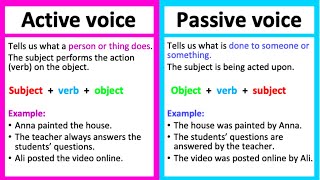
Teaching sentence structure is a fundamental part of the middle school English language arts curriculum. Helping students understand the difference between active and passive voice is essential for developing strong writers. Active and passive voice worksheets files provide teachers with targeted practice materials needed to reinforce these grammatical concepts. When the subject of a sentence performs the action, the sentence is in the active voice. For example, in the sentence "The cat ate the fish," the subject takes direct action. This structure leads to energetic and clear writing.
Conversely, the passive voice occurs when the subject receives the action rather than performing it. In the passive equivalent, "The fish was eaten by the cat," the focus shifts to the recipient. Passive construction relies on a form of the "to be" verb followed by the past participle of the main verb. While passive voice is not grammatically incorrect, relying heavily on it can make student writing sound wordy and vague. Focused practice helps students recognize these patterns and make intentional choices.
Addressing Common Student Struggles with Verb Voice
One frequent challenge students face is identifying the passive voice in context. Many learners confuse passive voice with the past tense because passive constructions require a past participle. Targeted active and passive voice worksheets resources help clarify this misconception by presenting sentences in various tenses. Students learn to look for the "to be" helping verbs combined with the past participle to identify the structure correctly.
Another hurdle is the tendency for developing writers to default to passive voice when trying to sound academic. Many students mistakenly believe that wordy sentences sound more sophisticated, resulting in essays bogged down with passive constructions. Worksheets that focus on rewriting passive sentences into active ones force students to identify the true actor and place that noun in the subject position, yielding much stronger prose.
"According to an analysis of middle school writing development by Ereading Worksheets, students who receive targeted instruction on verb voice are 45 percent more likely to choose active sentence structures during narrative revision activities, ultimately improving the directness and energy of their written compositions."
Classroom Implementation
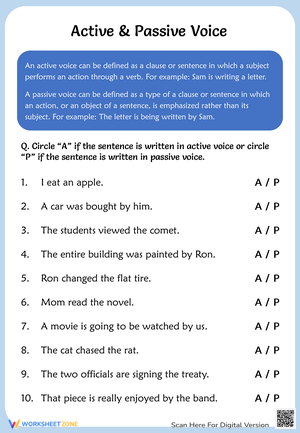
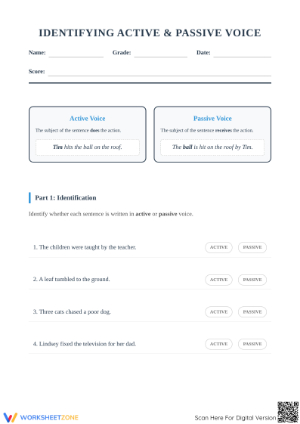
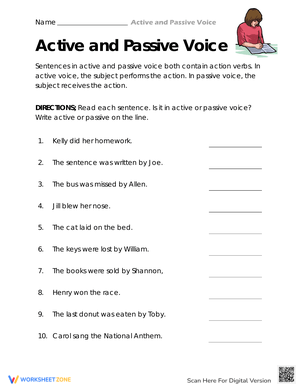
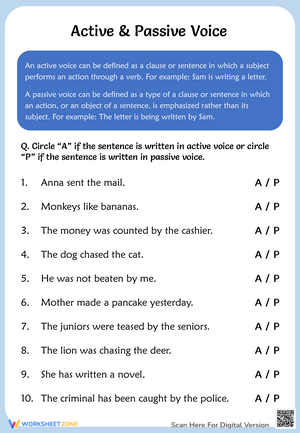
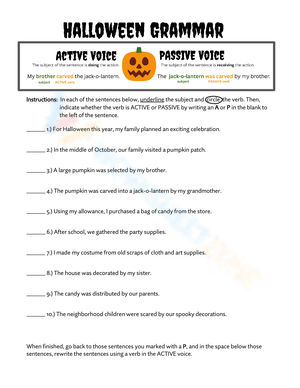
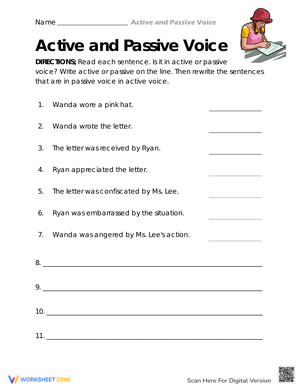
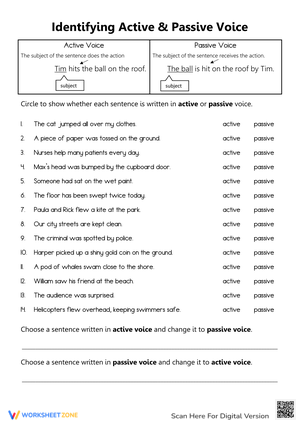
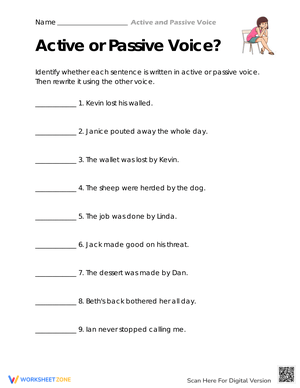
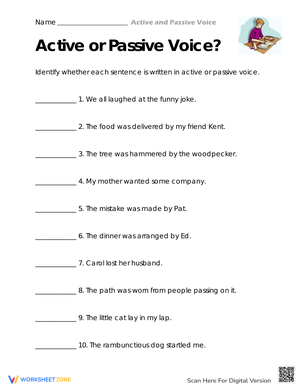
Integrating active and passive voice worksheets materials into lesson plans requires a strategic approach. Begin with direct instruction on formulas for both voices. Once foundational concepts are clear, introduce worksheets that focus solely on identification. Give students sentences and ask them to label each as active or passive. Requiring them to underline the subject and circle the verb phrase helps reinforce the mechanical differences visually.
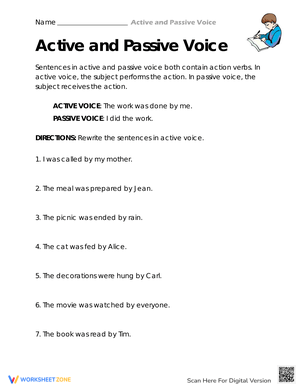
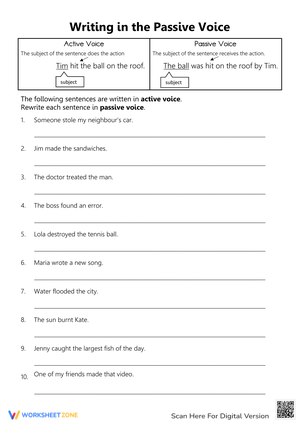
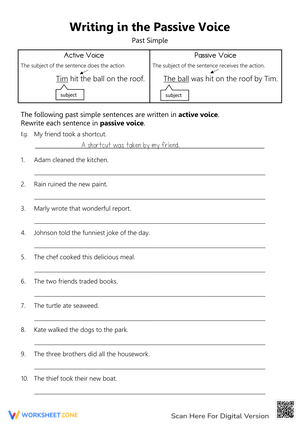
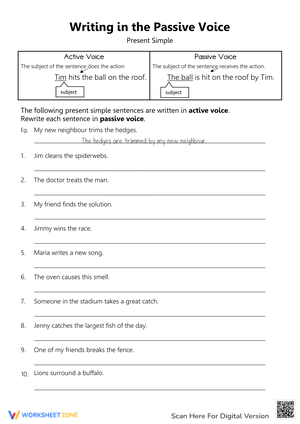
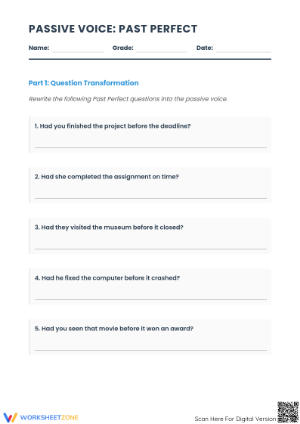
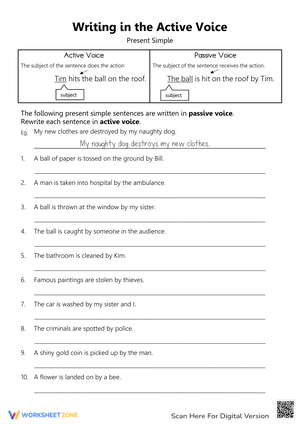
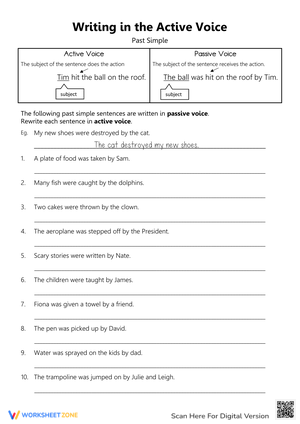
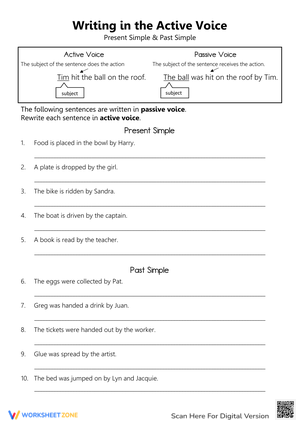
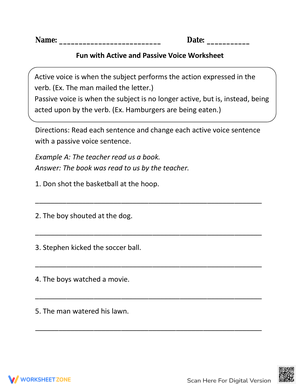
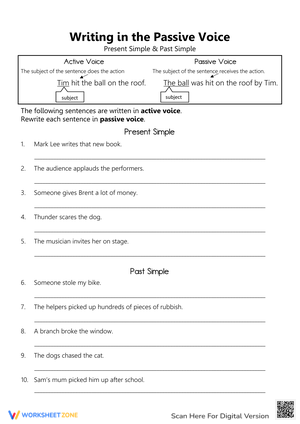
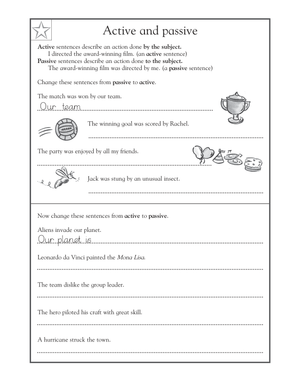
After students can identify sentence voice, move to conversion practice. Worksheets focused on rewriting active sentences into passive form help students understand shifting sentence elements. However, the most critical skill is the reverse process. Dedicate instructional time to exercises where students rewrite passive sentences into active form. This directly translates to their drafting and revision processes, teaching them to revise for clarity and impact.
Contextual Application and Formative Assessment
While isolated sentence exercises build foundational skills, students must eventually apply their knowledge to connected text. Contextual application worksheets bridge the gap between grammar drills and actual writing. Provide a short narrative that contains a mix of active and passive sentences. Task students with analyzing the paragraph, identifying the voice of each clause, and evaluating the author's stylistic choices to understand why passive voice was used.
Fill-in-the-blank verb form exercises offer another method for formative assessment. Give students sentences with verbs omitted and ask them to provide the correct active or passive form based on context clues. This requires deeper comprehension than simple identification, as students must determine the relationship between the subject and the missing action to complete the exercise accurately.
Differentiating Voice Instruction for Diverse Learners
When teaching English language learners or students with language processing challenges, visual diagramming of the subject-verb-object relationship acts as a powerful cognitive scaffold. Instead of merely underlining verbs on a page, having students physically draw directional arrows from the subject performing the action directly to the object makes the abstract concept of grammatical voice highly concrete. This tactile, visual approach, combined with color-coding nouns and verbs, helps learners internalize sentence mechanics rapidly before moving to complex writing tasks.
For advanced learners who quickly grasp basic concepts, provide worksheets that challenge them to analyze longer texts. Ask them to rewrite an entire passive paragraph into the active voice, observing how tone and pacing change. For students requiring additional support, break concepts down into smaller steps. Begin with simple sentences and provide graphic organizers that map out formulas. Using a word bank of helping verbs can also reduce cognitive load.
Understanding When Passive Voice is Necessary
While we encourage students to write in the active voice for energy and clarity, it is important to teach them that the passive voice has legitimate applications. A comprehensive unit must explore these exceptions. One primary use of the passive voice is when the actor performing the action is unknown, unimportant, or obvious. For instance, in the sentence "The school was built in 1950," the specific construction crew is irrelevant.
The passive voice is also heavily utilized in scientific and technical writing. In lab reports, the focus must remain on the experiment or the results rather than the researcher. Writing "The chemical solution was heated" is more appropriate than "I heated the chemical solution." Writers may also use the passive voice strategically to emphasize the recipient of the action or deflect blame, demonstrating the rhetorical power of grammatical choices.
Frequently Asked Questions
1. What is the main difference between active and passive voice?
In the active voice, the subject of the sentence performs the action, making sentences direct and engaging. In the passive voice, the subject receives the action, which focuses attention on the recipient or the action itself rather than the specific actor performing it.
2. How can you identify the passive voice in a sentence?
Look for a specific grammatical formula. The sentence will contain a form of the "to be" verb followed immediately by the past participle of the main verb. Additionally, the actor might be introduced with the preposition "by," although it is sometimes omitted entirely.
3. When is it appropriate or necessary to use the passive voice in writing?
The passive voice is appropriate when the person performing the action is unknown, obvious, or unimportant. It is commonly used in scientific writing to maintain an objective tone by focusing on the process or results. It can also intentionally emphasize the recipient of an action.
4. What are the steps to convert a sentence from active to passive voice?
First, identify the subject, verb, and direct object. Move the direct object into the subject position. Next, change the verb phrase by adding the appropriate form of the "to be" verb that matches the original tense, followed by the past participle of the main verb. Finally, add the original subject after the word "by."
5. Why is using the active voice often recommended for stronger writing?
The active voice is recommended because it creates more concise, energetic, and direct prose. Active sentences pull the reader through the text with clear subjects performing clear actions. Relying heavily on the passive voice can make writing feel overly complicated and obscure the main point.












 Interactive Worksheet Maker
 Quiz Maker
 Word Search Maker
 Crossword Puzzle Maker
 Word Scramble Generator
 Sentence Scramble Generator
 Handwriting Worksheet Generator
 Name Tracing Generator
 Fill In The Blank Generator