


























Views
Downloads
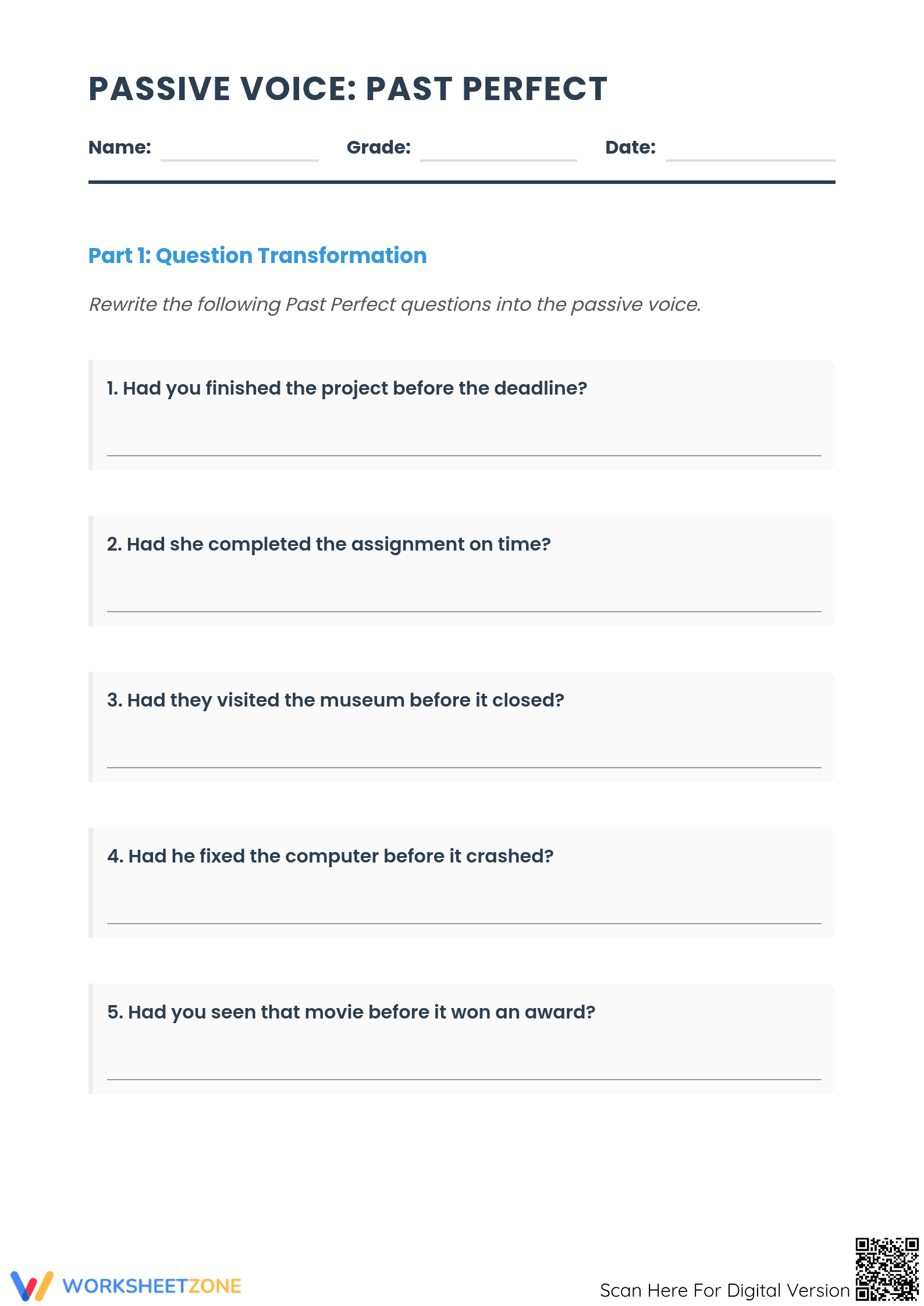


Passive Voice Questions Worksheet | Grade 6 ELA Printable
Paste this activity's link or code into your existing LMS (Google Classroom, Canvas, Teams, Schoology, Moodle, etc.).
Students can open and work on the activity right away, with no student login required.
You'll still be able to track student progress and results from your teacher account.
This focused grammar worksheet helps sixth-grade students master the transformation of active voice questions into the passive voice. By practicing with past perfect and present perfect tenses, learners develop a stronger command of sentence structure and verb phrasing, ultimately improving their overall writing clarity and grammatical precision.
At a Glance
- Grade: 6 · Subject: ELA
- Standard:
CCSS.ELA-LITERACY.L.6.1— Demonstrate command of standard English grammar conventions.- Skill Focus: Passive Voice Questions
- Format: 3 pages · 13 problems · Answer key included · PDF
- Best For: Independent practice and grammar review
- Time: 15–20 minutes
This comprehensive resource features three pages of targeted grammar exercises. The main section provides ten past perfect questions for students to rewrite into the passive voice. An extension practice section challenges learners with three additional present perfect questions to transform. The clean, spacious layout offers plenty of room for handwriting, while the included three-page answer key allows for quick grading or self-assessment.
- Guided practice: The worksheet begins with straightforward past perfect questions, allowing students to apply the passive voice formula to familiar sentence structures.
- Supported practice: As students progress through the first ten questions, they encounter varying subjects and objects, reinforcing their understanding of verb agreement and participle usage.
- Independent practice: The final extension section challenges students to apply the same passive voice rules to a new tense (present perfect), testing their adaptability and deep comprehension.
This structured approach follows a gradual-release model, ensuring students build confidence before tackling more complex tense transformations.
This resource is aligned to CCSS.ELA-LITERACY.L.6.1: "Demonstrate command of the conventions of standard English grammar and usage when writing or speaking." It specifically targets the ability to manipulate verb voices and tenses accurately. Both standard codes can be copied directly into lesson plans, IEP goals, or district curriculum mapping tools.
Teachers can deploy this worksheet during a dedicated grammar block after direct instruction on the passive voice. It serves as an excellent independent practice activity or homework assignment to solidify understanding. As a formative assessment tip, educators should review the first three questions with the class to ensure students are correctly identifying the object of the active sentence before they complete the remaining 10 problems independently. The entire activity should take approximately 15 to 20 minutes to complete.
This worksheet is designed for sixth-grade ELA students who are refining their understanding of complex sentence structures. It is particularly helpful for English Language Learners (ELLs) who need explicit practice with verb tenses and voice transformations. For a complete lesson, pair this activity with an anchor chart detailing the differences between active and passive voice formulas.
Mastering grammatical structures like the passive voice is essential for developing sophisticated writing skills. According to Fisher & Frey (2014), explicit grammar instruction combined with targeted, independent practice significantly improves students' ability to manipulate language for different purposes and audiences. This worksheet supports that instructional model by providing focused repetition on a specific skill. By aligning with CCSS.ELA-LITERACY.L.6.1, the activity ensures students can demonstrate command of standard English grammar conventions. When learners practice transforming sentences, they not only memorize rules but also internalize the syntactic flexibility required for advanced reading comprehension and effective communication. Providing structured opportunities to rewrite sentences builds the foundational mechanics necessary for success in middle school ELA and beyond, giving educators a reliable tool for measuring grammatical proficiency.


