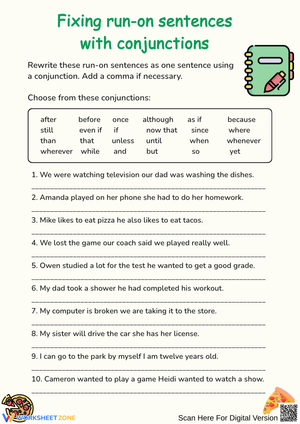
Identifying the Mechanics of Run-on Sentences in Student Writing
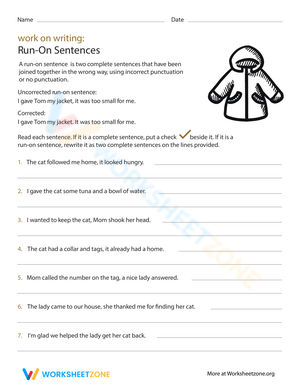
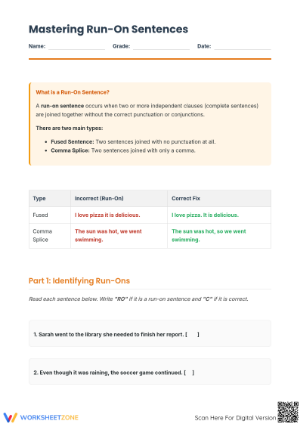
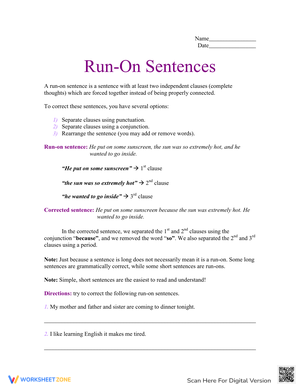
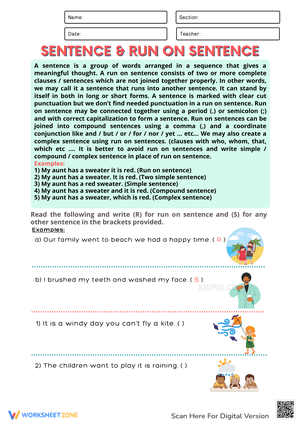
A run-on sentence occurs when two or more independent clauses are joined together without appropriate punctuation or conjunctions. In the classroom, this often manifests in two distinct forms: fused sentences and comma splices. A fused sentence happens when independent clauses run together with no punctuation at all, while a comma splice occurs when a writer incorrectly uses only a comma to separate two complete thoughts. Understanding these structural errors is a fundamental step for developing clear, grammatically correct writing. Teachers often find that students struggle to recognize these errors because their internal voice naturally adds the pauses that the written punctuation lacks. By providing structured practice through printable materials, teachers can help students visualize where one thought ends and the next begins.
The Core Types of Sentence Boundary Errors: Fused and Spliced
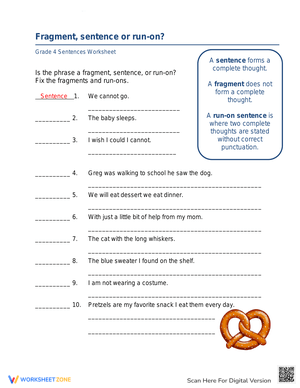
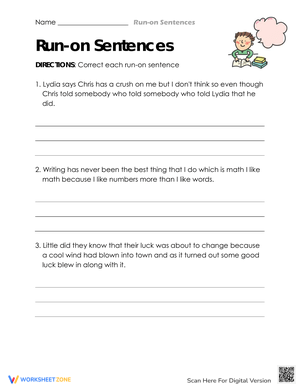
To effectively teach sentence correction, teachers must distinguish between the common types of run-on sentences. A fused sentence is perhaps the most basic error, where the writer simply omits any punctuation between two independent clauses. For example, 'The bell rang the students left' is a fused sentence that requires a clear delimiter to be readable. On the other hand, the comma splice is a more nuanced error often seen in the work of students who know they need punctuation but aren't sure which kind to use. They use a comma where a stronger mark, like a period or semicolon, is required. Identifying these errors in a controlled environment, such as a worksheet, allows students to develop the analytical eye needed to catch these mistakes during the proofreading phase of their own compositions.
Effective Strategies for Correcting Run-on Sentences
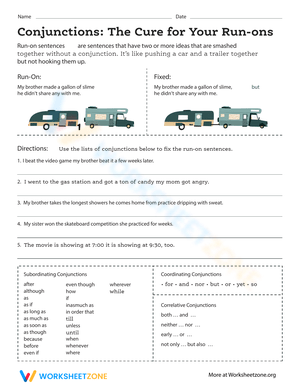
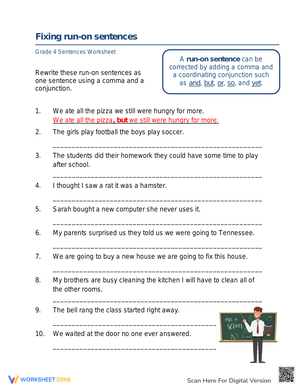
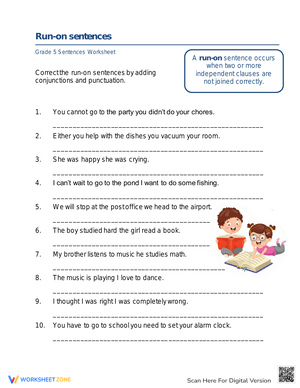
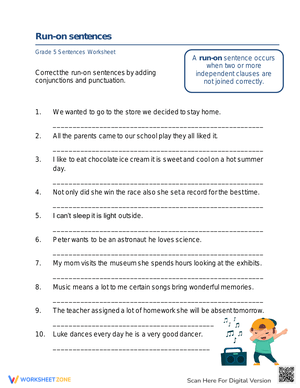
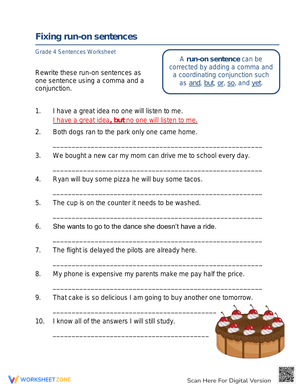
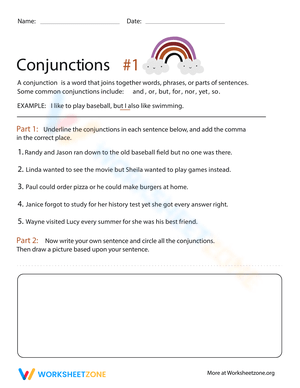
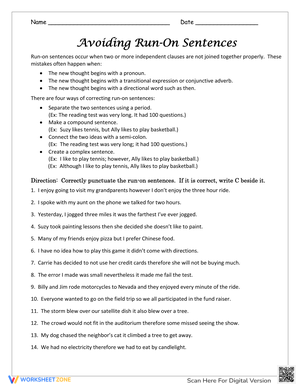
Once students can identify a run-on sentence, they need a toolkit of strategies to fix them. There are four primary methods to correct these errors, and each serves a different stylistic purpose. The simplest method is to use a period to create two separate sentences. This is often the best choice for younger writers or for emphasizing distinct ideas. Another method is the use of a semicolon, which is appropriate when the two independent clauses are closely related and the writer wants to maintain a smooth transition between them. A third strategy involves using a coordinating conjunction (for, and, nor, but, or, yet, so) preceded by a comma. Finally, students can use subordinating conjunctions to turn one of the independent clauses into a dependent clause, thereby creating a complex sentence.
Understanding when to use each method is part of developing a sophisticated writing style. For instance, using too many short, simple sentences can make writing feel choppy, while overusing semicolons can make it feel overly formal. Worksheets that provide practice in all four methods allow students to experiment with sentence variety and understand how punctuation choices affect the rhythm and flow of their writing. By providing examples of both the error and the various possible corrections, teachers can guide students toward making more intentional choices in their own work.
Classroom Implementation for Writing Mastery
Integrating run-on sentence practice into a daily or weekly routine is essential for long-term retention. Teachers can use these printable worksheets as part of a 'Grammar Minute' at the start of class or as a focused intervention for students who struggle with sentence boundaries. A successful implementation strategy involves first modeling the identification and correction process on the board, followed by guided practice where students work through a few examples together. Independent practice on the worksheets then allows students to apply what they have learned at their own pace. Collecting and reviewing these worksheets provides immediate formative assessment data, allowing teachers to see which students have mastered the concept and which need further small-group support.
Another effective implementation method is to use these worksheets as a peer-review tool. Students can work in pairs to identify and correct run-on sentences in provided examples, explaining their reasoning to each other. Additionally, these materials are perfect for differentiated instruction. Teachers can provide more basic identification tasks for students who are just starting to grasp the concept, while offering more complex sentence-combining exercises for those who are ready for a greater challenge. By making grammar practice a regular, interactive part of the curriculum, teachers can ensure that these skills become second nature for their students.
The Role of Standards in Teaching Sentence Structure
Understanding and correcting run-on sentences is a core component of many English Language Arts curricula. As noted in the Grammar and Mechanics: Correcting Run-On Sentences resource from the Purdue Online Writing Lab (OWL), 'A run-on is a sentence in which two or more independent clauses (i.e., complete sentences) are joined without an appropriate punctuation mark or conjunction' (OWL, 2024). This fundamental definition serves as the basis for instruction across various grade levels. Aligning classroom activities with established frameworks ensures that students are developing the skills they need for academic success. For example, the Common Core State Standards for English Language Arts emphasize the importance of using knowledge of language and its conventions when writing, speaking, reading, or listening. This includes the ability to produce complete sentences and recognize and correct inappropriate fragments and run-ons.
Furthermore, the National Assessment of Educational Progress (NAEP) Writing Framework highlights the necessity of grammatical precision in effective communication. The framework assesses students' ability to control sentence structure and use punctuation correctly to convey meaning. By focusing on run-on sentences, teachers are directly addressing these higher-level expectations. Using evidence-based practices and high-quality resources, such as those provided by Worksheetzone, helps bridge the gap between theoretical knowledge and practical application. When students practice with materials that reflect the standards they will be measured against, they gain the confidence and competence needed to excel in all areas of their academic life.
Teacher Tips for Engaging Grammar Instruction
Teaching grammar can sometimes feel like a dry subject, but there are many ways to make it engaging and relevant for students. One tip is to use 'mentor texts' from books or articles students are currently reading. Find examples of long, complex sentences that are grammatically correct and compare them to run-on versions of the same ideas. This helps students see that long sentences aren't inherently bad; they just need the right structure. Another tip is to turn run-on sentence correction into a game. Students can compete in teams to see who can find and fix the most errors in a provided paragraph. This gamification of grammar can increase motivation and make the learning process more enjoyable for everyone involved.
Analysis of student writing samples indicates that sentence boundary errors often peak during the transition from middle to high school as students attempt to incorporate more complex academic vocabulary without having fully mastered the requisite syntactical scaffolding. This 'syntactic overload' suggests that grammar instruction should not be isolated but rather integrated into the writing process at every stage. By providing students with the tools they need to manage this complexity, such as clear guides and practice exercises, teachers can help them avoid common pitfalls and produce more sophisticated work.
Frequently Asked Questions
1. What is the difference between a run-on sentence, a comma splice, and a fused sentence?
A run-on sentence is a general term for any sentence where two or more independent clauses are joined without appropriate punctuation or conjunctions. A fused sentence is a specific type of run-on where no punctuation is used at all between the clauses. A comma splice is another type of run-on where a writer uses only a comma to join two independent clauses, which is grammatically incorrect without an accompanying coordinating conjunction.
2. Why do students often struggle to identify run-on sentences in their own writing?
Students often struggle because they 'hear' the correct pauses in their heads as they read their own work, which masks the lack of physical punctuation on the page. Additionally, as students try to express more complex ideas, they may become overwhelmed by the structure of the sentence and lose track of where one independent clause ends and another begins. Focused practice with worksheets helps them develop the visual recognition skills needed to spot these errors.
3. How do Common Core State Standards address the teaching of sentence structure?
The Common Core State Standards for English Language Arts (ELA) specifically target sentence structure within the 'Language' strand. Standards like L.6.1 require students to demonstrate command of the conventions of standard English grammar and usage when writing or speaking. This includes recognizing and correcting inappropriate fragments and run-on sentences, ensuring that students can produce clear and effective communication at every grade level.
4. What are the best methods for correcting a run-on sentence?
There are four main ways to fix a run-on: use a period to create two separate sentences, use a semicolon to separate closely related clauses, use a comma followed by a coordinating conjunction (and, but, for, or, nor, so, yet), or use a subordinating conjunction to turn one clause into a dependent clause. The choice depends on the desired flow and relationship between the ideas being expressed.
5. How can Worksheetzone materials help in the classroom?
Worksheetzone provides a wide variety of printable, standards-aligned worksheets that offer targeted practice for identifying and correcting run-on sentences. These materials are designed for ease of use in the classroom, providing clear examples, engaging exercises, and varying levels of difficulty to meet the needs of all learners. They serve as an excellent resource for whole-class instruction, small-group intervention, or independent student work.












 Interactive Worksheet Maker
 Quiz Maker
 Word Search Maker
 Crossword Puzzle Maker
 Word Scramble Generator
 Sentence Scramble Generator
 Handwriting Worksheet Generator
 Name Tracing Generator
 Fill In The Blank Generator