Why Are Commas So Tricky for Students?
Punctuation often feels like an abstract concept to young writers. Many students learn early on that a comma simply means to take a breath, which can lead to over-punctuation or placing marks in the wrong spots based on their natural speaking rhythm. Providing a structured commas worksheets gives learners the concrete rules they need to move beyond guessing. When teachers use targeted practice materials, students can begin to see punctuation as a tool for clarity rather than a confusing hurdle. Our resources are designed to help teachers address these common misconceptions through clear, repeated practice.
As students progress through their educational journey, the sentences they are expected to read and write become increasingly complex. Without a solid understanding of how punctuation divides and organizes these longer sentences, reading comprehension and writing clarity will inevitably suffer. Consistent comma practice builds stronger foundational grammar skills for students working with complex sentence structures. By transitioning away from the "take a breath" method and moving toward concrete grammatical rules, teachers can empower their students to write with confidence and precision.
Breaking Down the Core Comma Rules
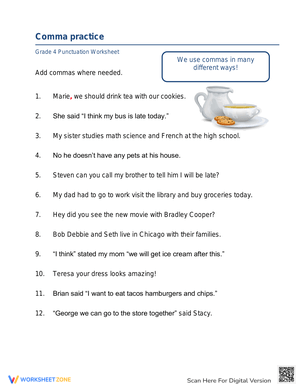
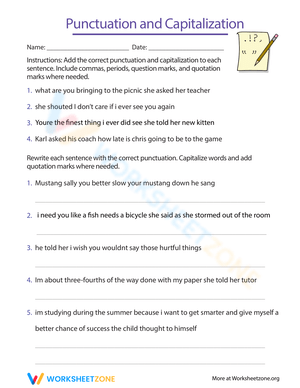
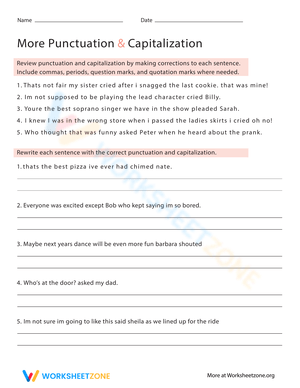
Before handing out a mixed practice commas worksheets, it helps to review the foundational rules of punctuation. Students must understand that commas serve specific grammatical functions, from separating items to isolating extra information. We focus on six primary rules that cover the vast majority of writing situations students will encounter in elementary and middle school. These include separating words in a series, joining independent clauses, and setting off introductory elements.
By isolating each rule first, teachers can ensure students are not overwhelmed. Once the individual concepts are mastered, students can move on to comprehensive review sheets that require them to identify which rule applies to a given sentence. Teaching these rules sequentially allows students to build upon their prior knowledge. For example, understanding how to identify an independent clause is a prerequisite for understanding how to join two of them with a conjunction. Our worksheets are designed to follow this logical progression, ensuring that no student is left behind as the grammatical concepts become more advanced.
Structured Practice with Commas in a Series
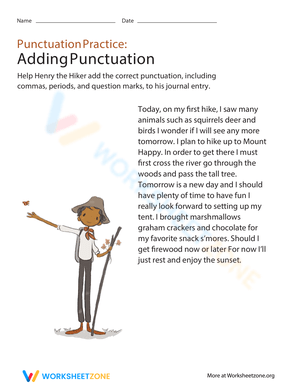
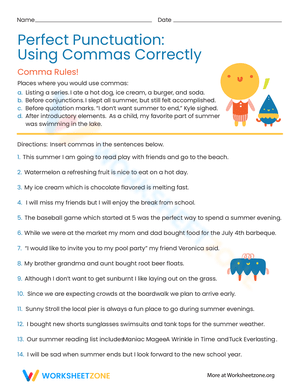
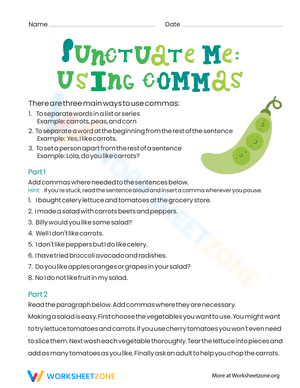
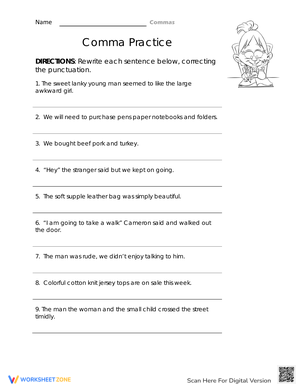
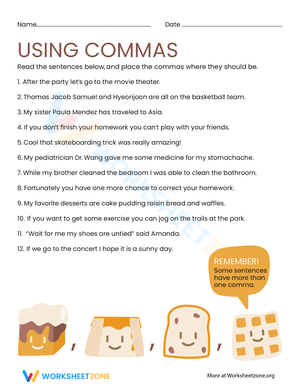
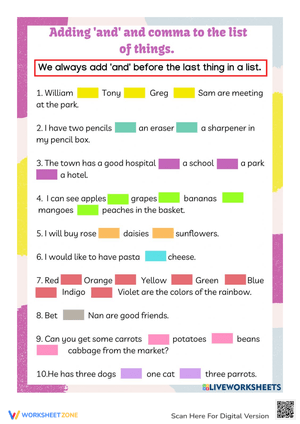
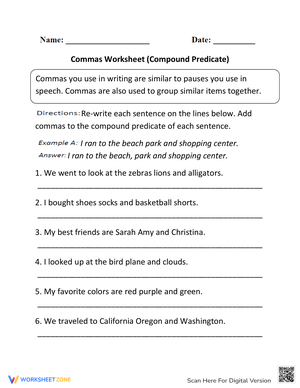
One of the first rules introduced in the classroom is using commas to separate three or more words, phrases, or clauses in a series. This is often the most intuitive rule for students to grasp, as they naturally understand the concept of listing items. A focused commas worksheets on this topic will ask students to punctuate lists of nouns, action verbs, or descriptive phrases.
Many students struggle when the series involves longer phrases rather than single words. Providing exercises that mix simple noun lists with complex clause lists challenges students to recognize the underlying structure of the sentence, preventing them from simply placing commas after every third word they read.
Teachers can use these specific worksheets to introduce the concept of the Oxford comma, explaining its role in preventing ambiguity before the final conjunction. According to English Worksheets Land, providing clear examples of how a missing serial comma changes a sentence's meaning is highly effective for retention. When students can visually see how the absence of a comma alters the narrative, they are far more likely to remember to include it in their own original compositions.
Joining Independent Clauses with Coordinating Conjunctions
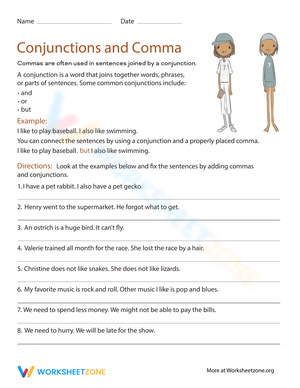
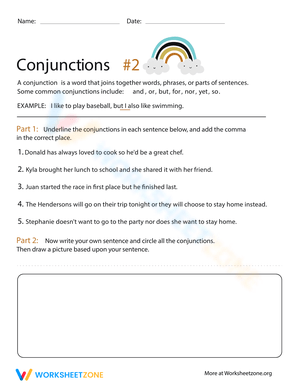
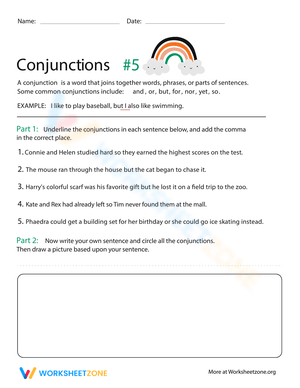
As student writing matures, they begin to combine simple sentences into compound sentences to add variety to their writing. Commas are used to separate independent clauses when they are joined by a coordinating conjunction such as for, and, nor, but, or, yet, and so. A dedicated commas worksheets targeting compound sentences helps students identify the subject and verb in both halves of the sentence. Often, students will place a comma before any conjunction they see, even if it only connects a compound predicate.
These practice sheets train them to verify that a complete thought exists on both sides of the conjunction before placing their punctuation mark. This analytical approach to sentence structure pays dividends in both their reading comprehension and their independent writing tasks. When students understand that the conjunction and the comma work together as a bridge between two complete ideas, they are less likely to create run-on sentences or comma splices in their own essays and creative writing assignments.
Setting Off Introductory and Nonessential Elements
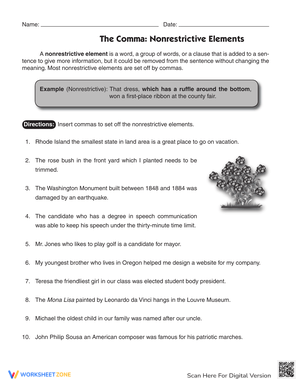
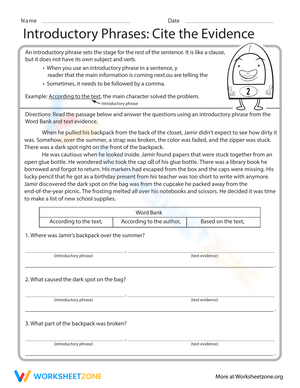
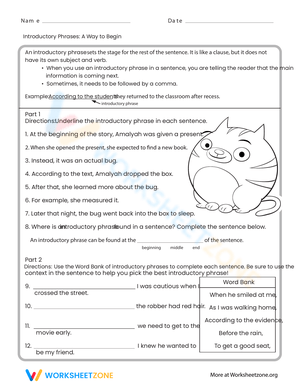
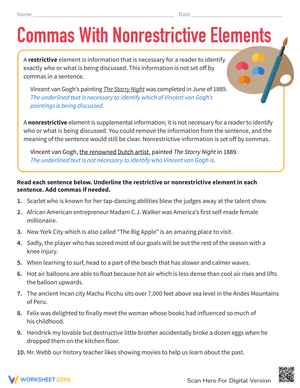
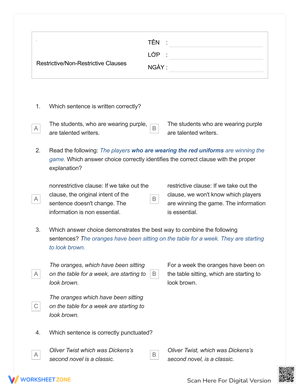
Introductory words, phrases, and clauses set the stage for the main action of a sentence. Commas are used to set off these introductory elements, signaling to the reader that the core message is about to begin. Additionally, commas are used to set off nonessential clauses and phrases, also called nonrestrictive elements. If the information can be removed without changing the basic meaning of the sentence, it needs to be bracketed by commas. This is a higher-level skill that requires strong reading comprehension. A commas worksheets focusing on nonessential elements will often ask students to physically cross out the extra information to prove the sentence still makes sense. This tactile strategy helps solidify the abstract grammar rule. Teaching students to identify the main subject and the main verb of the sentence first is a highly effective strategy for determining whether the surrounding phrases are essential or nonessential to the overall meaning of the text.
Formatting Dates, Addresses, and Coordinate Adjectives
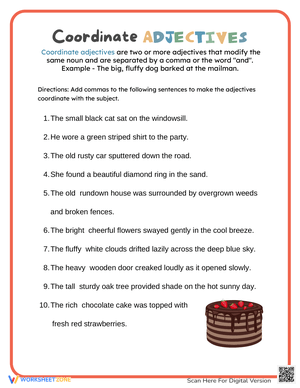
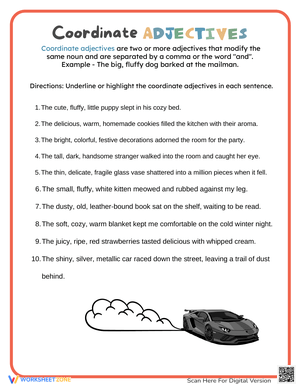
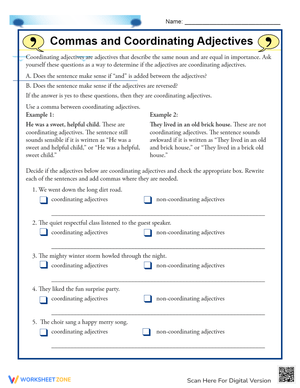
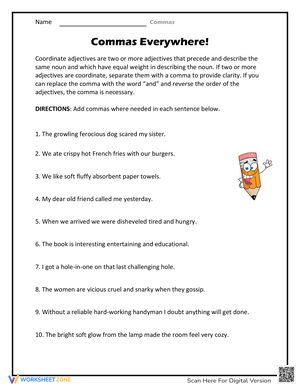
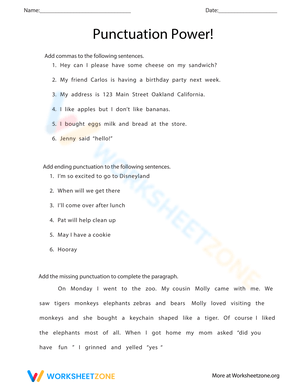
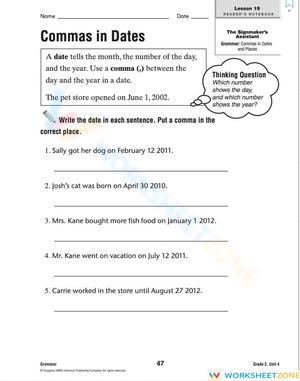
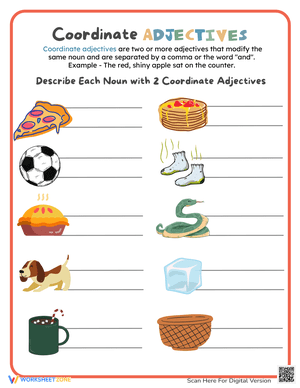
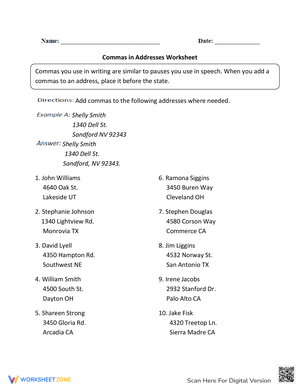
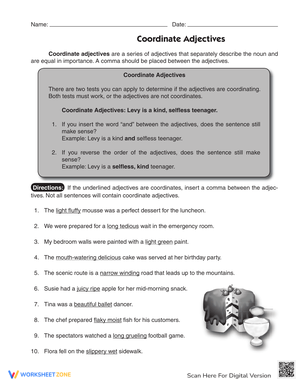
Practical, everyday writing requires specific comma formatting that students must memorize. Commas are used to separate items in dates and addresses, a skill students need for everything from writing formal letters to formatting historical essays. A commas worksheets covering this topic provides realistic scenarios, such as addressing envelopes, writing out full birth dates, or formatting the heading of a business letter. Another specific application is separating coordinate adjectives that describe the same noun. Students learn the trick of placing the word "and" between the adjectives or reversing their order; if the sentence still sounds correct, a comma is needed. These highly specific rules are perfect for targeted worksheet practice, as they rely on clear, testable logic rather than stylistic interpretation. By repeatedly exposing students to these specific formatting requirements, teachers can ensure that their students' future writing projects maintain a professional and polished appearance.
Classroom Implementation
Begin by using a single worksheet as a whole-class anchor activity, modeling the thought process required to identify the correct comma rule. According to English Worksheets Land, 85 percent of students retain punctuation rules better when guided practice precedes independent work. Providing a structured commas worksheets during whole-class instruction allows teachers to model the exact thought process needed to identify correct punctuation before releasing students to work independently.
After modeling, provide differentiated worksheets based on student readiness. Offer a cheat sheet or anchor chart outlining the six key rules for students to reference while they work. These printables can be utilized in literacy centers, as morning bell work, or as formative assessments at the end of a grammar unit. The goal is to provide enough varied repetition that the rules become second nature during their independent writing blocks. Furthermore, teachers can encourage peer review sessions where students use the worksheets as a rubric to check their partners' writing, reinforcing the rules through collaborative learning.
Frequently Asked Questions
1. What are the basic comma rules covered in these printables?
Our materials cover the essential rules: separating items in a series, joining independent clauses with a conjunction, setting off introductory elements, isolating nonessential phrases, separating coordinate adjectives, and formatting dates and addresses. Mastery of these areas ensures a strong punctuation foundation.
2. How do you explain comma rules to a younger child?
Instead of telling them to listen for a breath, explain that commas are traffic signals for reading. They group related ideas together and keep different parts of a sentence from crashing into one another, making the writer's exact meaning clear and easy to understand.
3. What is the Oxford comma and when should it be used?
The Oxford comma is the final comma placed before the coordinating conjunction in a list of three or more items. We recommend teaching it as a tool for clarity, ensuring the last two items in a series are not mistakenly read as a single grouped item.
4. Where can I find comma worksheets with answer keys?
Every commas worksheets we provide includes a comprehensive and easy-to-read answer key. This allows for quick teacher grading or enables older students to self-assess their work accurately during independent literacy center rotations.
5. Can these worksheets be used for mixed review practice?
Yes. While we offer focused sheets for individual rules, we also provide mixed practice worksheets that require students to analyze a sentence and determine which of the multiple comma rules applies, mimicking real-world editing and revision tasks.












 Interactive Worksheet Maker
 Quiz Maker
 Word Search Maker
 Crossword Puzzle Maker
 Word Scramble Generator
 Sentence Scramble Generator
 Handwriting Worksheet Generator
 Name Tracing Generator
 Fill In The Blank Generator