Teaching Commas After Introductory Phrases in ELA
A comma is used after an introductory phrase to separate it from the main clause, establishing clear boundaries within the sentence. These commas help readers distinguish between the introduction and the main subject, preventing confusion and guiding the rhythm of the text. For elementary to middle school students, mastering this specific punctuation rule is a significant step toward writing varied, engaging paragraphs.
By utilizing targeted commas after introductory phrase worksheets, teachers provide the direct practice required for students to map sentence structures accurately. Instead of relying solely on simple subject-verb constructions, young writers learn to move modifying elements to the beginning of their sentences, which necessitates proper punctuation.
Teachers and homeschool parents looking for effective grammar resources often prioritize printable practice materials that break down these structural components into manageable, recognizable patterns. Consistent exposure to these conventions allows students to improve both their narrative pacing and the clarity of their informational texts.
Identifying Prepositional, Participial, and Infinitive Phrases
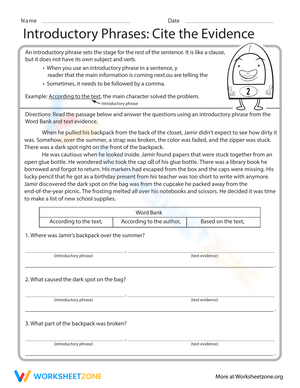
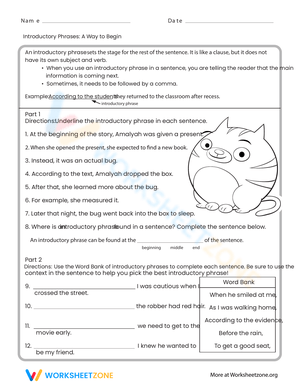
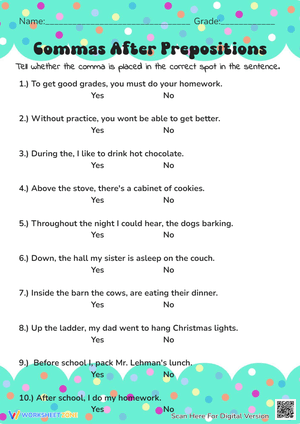
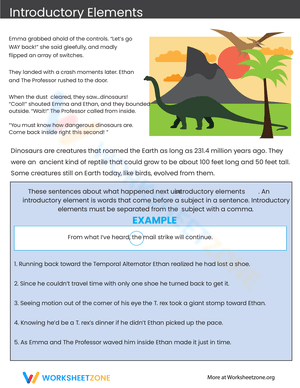
Introductory commas are usually required after long prepositional phrases containing four or more words, as well as after participial phrases and infinitive phrases. Prepositional phrases start with directional or temporal words like "under," "before," or "through," setting the scene before the main action occurs. Participial phrases employ verb forms ending in "ing" or "ed" to modify the subject immediately, such as "Running through the heavy rain," which demands a comma before revealing who is actually running. Infinitive phrases begin with "to" plus a verb, establishing a purpose or goal, such as "To understand the complex lesson," followed by the main independent clause.
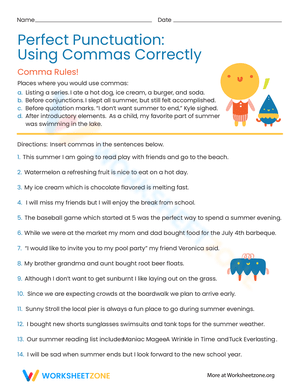
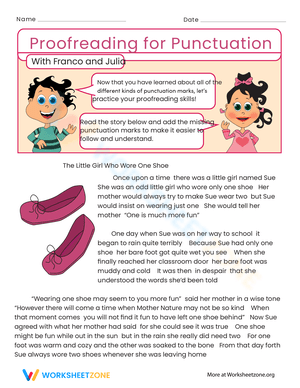
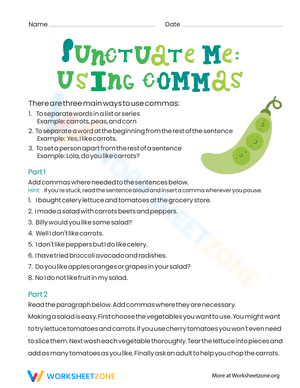
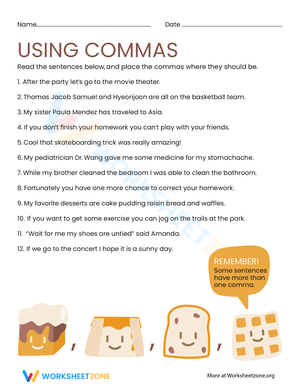
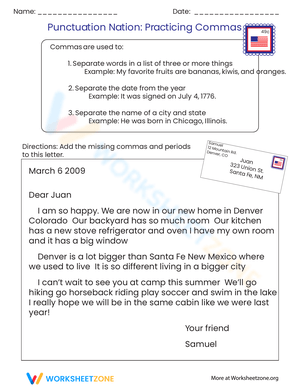
Providing varied sentence types in practice exercises allows students to apply the comma rule across these different grammatical contexts. Interactive comma fix worksheets, where learners add missing punctuation to provided texts, are highly effective tools. When students learn to recognize these three distinct phrase categories, they become much better at anticipating where the boundary punctuation belongs, building a foundational awareness that transfers directly into their independent drafting and editing processes.
Classroom Implementation
Teachers can effectively use commas after introductory phrase worksheets during morning work or as a focused warm-up activity before a larger writing block begins. In small group instruction or intervention centers, teachers can have students sort sentences based on whether they require an introductory comma, encouraging active discussion about sentence boundaries.
Peer review sessions are also highly beneficial; students can compare sentences written with and without introductory commas to analyze flow and clarity. When a learner compares the two variations, the necessity of the punctuation becomes visually obvious. Furthermore, teachers can model sentence diagramming or phrase highlighting on the board before students complete their independent printables.
Differentiating these materials is essential for meeting diverse learner needs. Teachers might offer shorter, simpler sentences for students requiring intervention, while providing longer, highly complex sentences with multiple modifying phrases for enrichment groups. Consistent classroom implementation of these targeted grammar activities establishes a routine where punctuation is viewed as a tool for clear communication rather than an arbitrary academic requirement.
Analyzing Sentence Flow and Natural Pauses
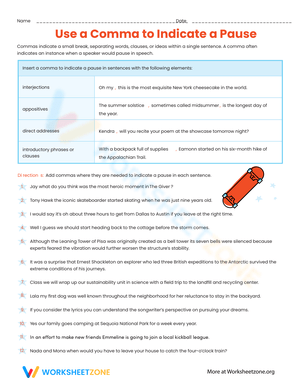
If a natural pause occurs when reading aloud, a comma is usually needed to separate the introductory element from the main clause. Teachers can instruct students to read their draft sentences aloud to a partner. If they naturally stop to take a breath before identifying the main subject, they likely need to insert a comma at that exact location. This auditory technique helps visual learners translate the sound of language into structural mechanics.
When students read aloud, the introductory phrase acts as a ramp leading up to the main idea, and the comma serves as the yield sign telling the reader to prepare for the core message. Worksheets that prompt students to read out loud and place a mark where they pause can successfully bridge the gap between abstract grammar rules and intuitive language processing.
An analysis of standard middle school writing conventions reveals that omitting the comma after a prepositional phrase of four or more words leads to misread sentences in a high percentage of peer-reviewed drafts. Teachers who integrate read-aloud activities consistently report that the auditory cue of a natural speech pause remains the most reliable diagnostic tool for young writers struggling to identify main clause boundaries.
The Four-Word Guideline for Introductory Elements
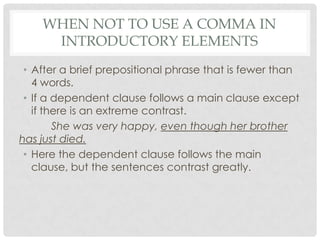
While many introductory phrases demand punctuation, commas are often optional after very short introductory phrases if the sentence meaning remains perfectly clear. Teaching students the difference between a one-word transition, like "Today," and a lengthy phrase, like "In the middle of the dark night," is an important instructional step.
According to the Purdue OWL guidelines on introductory clauses and phrases, writers should routinely place commas after introductory elements of four or more words. This structural punctuation strategy prevents reader confusion and misreading, particularly when long prepositional or participial phrases significantly delay the sentence's main subject and action.
Teachers can elaborate on this four-word guideline by providing specific contrasting examples. A short phrase might not need a comma, as in "In 2020 we moved," whereas it becomes absolutely necessary for clarity in a sentence like "In 2020, 300 students graduated." While the four-word guideline provides a strong starting point for middle school students, the ultimate test must always be reader clarity. Worksheets can present contrast pairs—sentences where the comma is optional and sentences where omitting the comma changes the meaning entirely. This challenges students to think critically about reader comprehension rather than just counting words mechanically. Teaching the flexibility of this rule helps advanced students develop a more sophisticated understanding of authorial voice and stylistic choice in their independent writing assignments.
Addressing Common Grammar Misconceptions
When introducing new punctuation rules, teachers must proactively address common student misconceptions to prevent bad habits from forming. A frequent point of confusion is whether introductory words like "However" or "Therefore" count as introductory phrases. Clarify for students that while these transitional adverbs do require a comma, they function differently than multi-word phrases. Another widespread misconception is the belief that every preposition automatically requires a comma. This misunderstanding leads to students incorrectly separating prepositional phrases that appear at the end of the sentence, breaking up the natural flow of the independent clause.
Practice materials (like resources served on Worksheetzone) must specifically include distractor sentences—examples that contain phrases at the end rather than the beginning—to ensure students are analyzing the actual structure and not just blindly dropping commas near prepositions. Worksheets that require students to justify their comma placement by physically underlining the introductory phrase help eliminate this guesswork, reducing instances of comma splicing and building long-term grammatical confidence.
Aligning with ELA Standards and Formative Assessment
Teaching punctuation effectively requires strong alignment with standard educational frameworks, such as the Common Core Language Standards for ELA. Specifically, these lessons support standards related to demonstrating command of the conventions of standard English punctuation and capitalization. Formative assessment becomes highly efficient when using targeted commas after introductory phrase worksheets. Teachers can quickly scan a completed printable to determine if a student understands the boundary between the dependent phrase and the independent clause.
Using these materials as exit tickets or brief morning quizzes provides actionable, real-time data for the educator. If a large portion of the class struggles to punctuate participial phrases but succeeds with prepositional phrases, the teacher knows exactly where to direct the subsequent mini-lesson. Building these brief assessments into the regular curriculum ensures that punctuation is continuously reviewed throughout the academic year, preventing the typical skill regression often observed after isolated grammar units. Mastery of introductory elements directly supports higher-level writing rubrics by promoting sentence variety and overall syntactic complexity.
Frequently Asked Questions
1. Is the comma always necessary after an introductory phrase?
While commas are generally required after long introductory phrases to separate them from the main clause, they are often optional after very short phrases of one to three words, provided the sentence meaning remains clear. However, if omitting the punctuation causes the reader to stumble or misinterpret the subject, the comma must be included regardless of the phrase's length.
2. How can I tell if an introductory phrase is long enough to need a comma?
A standard educational guideline is to use a comma if the phrase contains four or more words. Additionally, teachers highly recommend the read-aloud test: if a natural pause occurs when reading the sentence aloud to separate the introduction from the main action, a comma is almost certainly required to guide the reader visually.
3. Do introductory words like "However" or "Therefore" count as introductory phrases?
No, words like "However," "Therefore," and "Meanwhile" are classified as introductory transitional adverbs rather than phrases. While they still require a comma immediately following them to separate them from the main clause, they function differently than multi-word prepositional, participial, or infinitive phrases. Grammar worksheets often include both to test a student's ability to recognize various introductory elements.












 Interactive Worksheet Maker
 Quiz Maker
 Word Search Maker
 Crossword Puzzle Maker
 Word Scramble Generator
 Sentence Scramble Generator
 Handwriting Worksheet Generator
 Name Tracing Generator
 Fill In The Blank Generator