Understanding Coordinate Adjectives in the Classroom
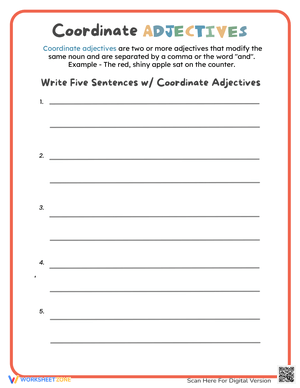
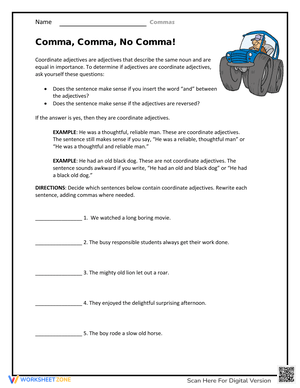
Teaching punctuation often feels like navigating a maze of exceptions, but few rules are as consistently applicable as those governing coordinate adjectives. In the context of middle and high school English Language Arts, understanding when to place a comma between two descriptive words is a hallmark of sophisticated writing. Coordinate adjectives are two or more adjectives that work together to modify the same noun independently. Because they carry equal weight in the sentence, they require a comma to separate them, acting much like a list of items would. For teachers, the challenge lies in helping students distinguish these from cumulative adjectives, which build upon each other in a specific order and do not take commas.
The "And" and Reversal Tests for Punctuation
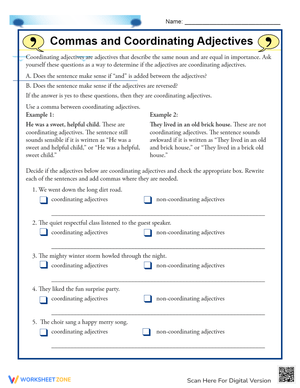
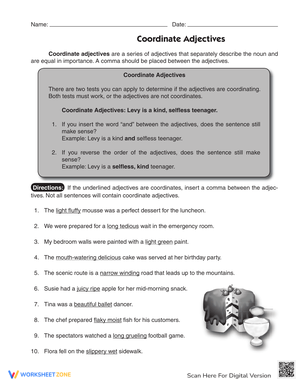
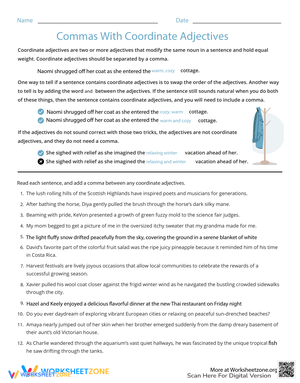
To simplify the identification process, two reliable diagnostic tools are commonly taught: the "And" test and the Reversal test. These tests provide students with an immediate, objective way to check their work without relying on intuition alone. The "And" test asks students to insert the word "and" between the adjectives. If the sentence still sounds natural and retains its original meaning, the adjectives are coordinate. For example, in the phrase "the long, winding road," we can say "the long and winding road." Because this works, a comma is required. This simple check empowers students to take ownership of their editing process, transforming a vague feeling into a concrete rule.
The Reversal test operates on a similar principle of equality. If the order of the adjectives can be flipped without changing the meaning of the phrase, they are coordinate. Taking our previous example, "the winding, long road" makes just as much sense as the original. If a student encounters "the bright blue sky" and tries to flip it to "the blue bright sky," the awkwardness of the second phrase immediately signals that these are cumulative adjectives, and therefore, no comma is needed. By providing worksheets that specifically ask students to apply these tests, teachers can reinforce the underlying logic of coordinate punctuation until it becomes second nature.
Coordinate vs. Cumulative Adjectives: Identifying the Difference
One of the most frequent hurdles in grammar instruction is the distinction between coordinate and cumulative adjectives. While coordinate adjectives are independent, cumulative adjectives follow a strict, often unspoken hierarchical order in English. This order typically moves from opinion to size, age, shape, color, origin, material, and finally, purpose. Because each adjective in a cumulative sequence modifies the entire following phrase rather than just the noun, they are not separated by commas. For instance, in "the three old stone houses," "three" modifies "old stone houses," and "old" modifies "stone houses." Reversing them results in a nonsensical string of words.
Students often struggle with this because the cumulative order is something native speakers often do instinctively. For English Language Learners (ELLs), this hierarchy must be taught explicitly. Worksheets that categorize adjectives into these types can be immensely helpful. By breaking down phrases into their component parts, students learn to see the structural differences between a "noisy, crowded cafeteria" (coordinate) and a "large rectangular wooden table" (cumulative). This level of granular analysis is where true grammatical literacy begins, allowing students to construct more complex and precise sentences.
Teacher Tips for Effective Instruction
When introducing commas with coordinate adjectives, it is helpful to start with visual aids. Create a two-column anchor chart on the board: one for coordinate and one for cumulative. Use high-interest examples that relate to your students' daily lives. For example, describe a popular video game or a local sports team. This makes the abstract rules feel more relevant and grounded. Another effective strategy is to use "sentence strips" where adjectives can be physically moved or replaced with an "and" card. This tactile approach is particularly beneficial for kinesthetic learners who might find traditional paper-and-pencil tasks less engaging.
Teacher Tips: Consistency is the most important factor when reinforcing punctuation rules. Incorporate a "sentence of the day" that features either coordinate or cumulative adjectives and ask students to justify the presence or absence of a comma using the tests they have learned. Additionally, provide immediate feedback during independent practice. If a student is consistently missing commas, sit with them and walk through the Reversal test aloud. Hearing the awkwardness of a reversed cumulative phrase often provides the "aha" moment that a written correction cannot. Finally, encourage students to find examples of coordinate adjectives in their independent reading books, bridging the gap between isolated grammar exercises and real-world literature.
Common Punctuation Pitfalls and Solutions
Even after learning the basic rules, students often encounter edge cases that lead to confusion. A common pitfall is the use of a comma between the final adjective and the noun it modifies. Students might write "the tall, dark, man" instead of "the tall, dark man." It is vital to emphasize that the comma's job is to separate equal modifiers, not to separate the modifier from the object. Another frequent error occurs when students treat a compound noun as two separate adjectives. In the phrase "the expensive gold watch," "gold watch" is often treated as a single unit, making "expensive" a lone modifier that does not require a comma.
According to research in cognitive load theory, students are more likely to master complex punctuation when rules are presented as logical patterns rather than isolated facts. When we teach coordinate adjectives through the lens of equality and independence, we reduce the mental effort required to recall the rule. By framing the comma as a substitute for the word "and," we tap into the student's existing linguistic knowledge, making the new concept an extension of what they already understand about lists and conjunctions. This pedagogical shift from rote memorization to pattern recognition is what leads to long-term retention and application in diverse writing contexts.
Using Worksheets for Formative Assessment
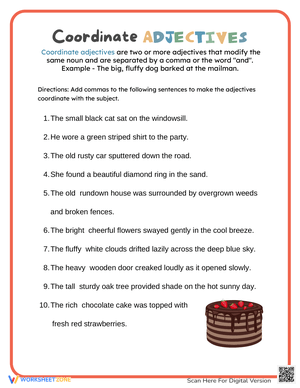
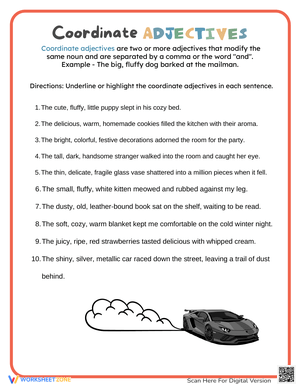
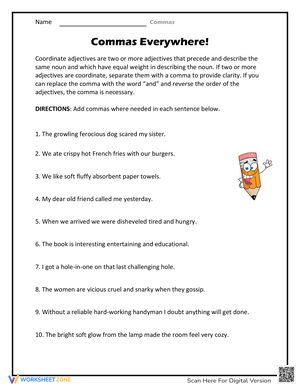
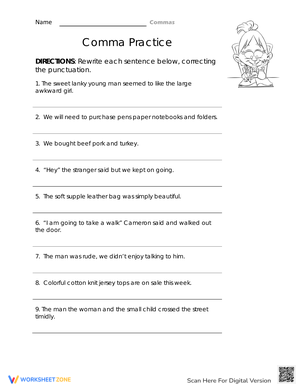
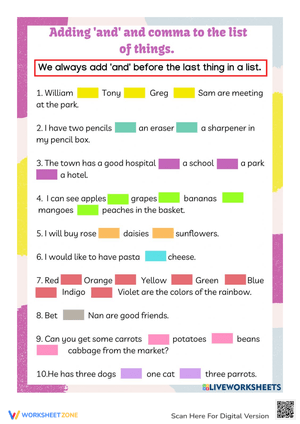
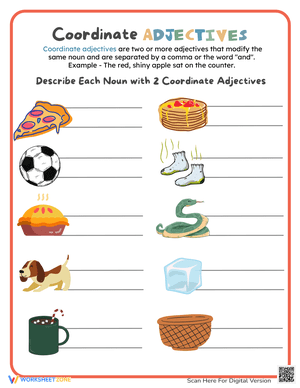
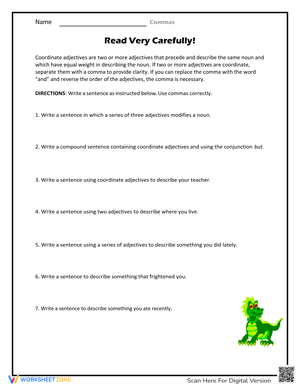
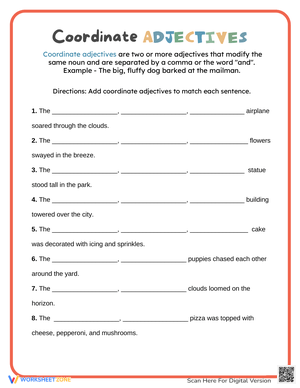
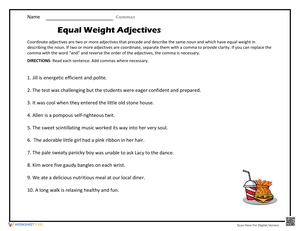
Worksheets serve as an excellent tool for formative assessment, providing a snapshot of student understanding at any given point in a unit. Unlike a high-stakes summative test, a well-designed worksheet allows for low-stakes practice and immediate correction. Look for worksheets that offer a variety of task types: identifying coordinate adjectives in a paragraph, inserting commas into unpunctuated sentences, and even creating original sentences based on a set of provided adjectives. This variety ensures that students are not just identifying the rule but are also applying it creatively and analytically.
In secondary education, the focus shifts from basic identification to the rhetorical effect of adjective placement. A writer might choose to use coordinate adjectives to slow down the pace of a sentence or to emphasize a particular quality of the subject. In a citation capsule from a prominent writing resource, the relationship between punctuation and clarity is highlighted: "Effective punctuation in academic writing ensures that the reader correctly identifies the weight of each modifier. Purdue OWL (2023) notes that coordinate adjectives must be separated by commas to avoid ambiguity, and approximately 95% of standard style guides agree that this clarity is essential for technical descriptions." This kind of high-level justification helps students see grammar as a toolkit for clearer communication.
Frequently Asked Questions
1. What is the difference between coordinate and cumulative adjectives?
Coordinate adjectives are independent and carry equal weight, requiring a comma for separation. Cumulative adjectives follow a specific hierarchical order and modify the entire following phrase, meaning they do not take commas. You can test for coordinate adjectives by seeing if you can put "and" between them or reverse their order.
2. Why do I need to know the difference for my students?
Understanding this distinction helps students avoid common punctuation errors that can lead to ambiguity or awkwardness in their writing. It provides them with a logical framework for editing their own work and improves the overall flow and professional quality of their compositions across all subjects.
3. Can three adjectives be coordinate?
Yes, any number of adjectives can be coordinate as long as they all modify the same noun independently and carry equal importance. In such cases, you would place a comma after each coordinate adjective except for the last one before the noun, such as in "the cold, dark, damp cellar."
4. Do the "And" and Reversal tests always work?
In the vast majority of cases, yes. These tests are the gold standard for identifying coordinate adjectives in English. If a phrase passes both the "And" test and the Reversal test, it is almost certainly a coordinate structure that requires a comma. They are reliable tools for students of all levels.
5. How can I differentiate this instruction for ELL students?
For ELL students, it is often helpful to explicitly teach the adjective order hierarchy (size, age, color, etc.) used for cumulative adjectives. Providing them with a reference chart and using plenty of visual examples can help them understand the 'why' behind the comma rules more clearly than just learning the rule in isolation.












 Interactive Worksheet Maker
 Quiz Maker
 Word Search Maker
 Crossword Puzzle Maker
 Word Scramble Generator
 Sentence Scramble Generator
 Handwriting Worksheet Generator
 Name Tracing Generator
 Fill In The Blank Generator