Effective Commas in a Series Worksheets for Classroom Practice
Mastering Punctuation with Commas in a Series Worksheets
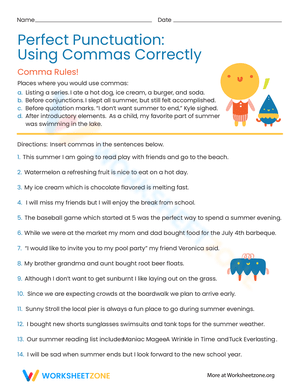
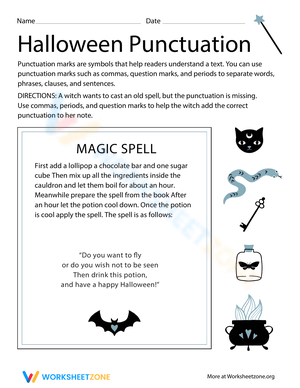
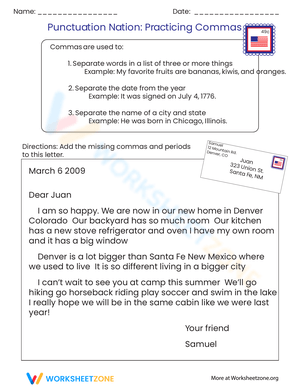
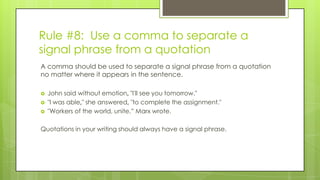
At Worksheetzone, we provide a comprehensive collection of resources designed to help teachers guide their students through this essential grammar rule. When students write, they often encounter situations where they need to list items, actions, or descriptors. Without proper punctuation, these lists can become confusing and difficult for a reader to interpret. Our commas in a series worksheets files offer structured practice that reinforces the rule of separating three or more items with a comma, ensuring that student work meets academic standards.
Understanding this rule is not just about memorizing a set of instructions; it is about learning how to organize thoughts on a page. When a student writes about their favorite fruits, such as apples, bananas, and cherries, the comma serves as a visual separator that tells the reader where one item ends and the next begins. This clarity is vital in both elementary and middle school writing. By using our printable materials, teachers can provide consistent reinforcement of these concepts across different writing genres, from narrative essays to technical reports.
The Mechanics of Punctuation in Lists
The primary rule for using commas in a series is straightforward: use a comma to separate three or more items in a list. These items can be nouns, verbs, adjectives, or even entire phrases. For example, in the sentence "The dog ran, jumped, and barked," the commas separate three distinct actions. Many students initially struggle with the difference between a list of two items and a list of three or more. It is a common error to place a comma between just two items, which is incorrect in standard American English. Our worksheets specifically target this area of confusion by providing contrasting examples for students to analyze.
In a series of adjectives, the punctuation can become slightly more complex. Students must determine if the adjectives are coordinate or non-coordinate. While our primary focus is on the standard series of three or more, introducing the concept of lists of descriptors early helps students develop a more sophisticated ear for sentence rhythm. Practice exercises often include identifying where a comma should be placed and where it should be omitted, forcing students to think critically about the structure of their sentences rather than just applying punctuation randomly.
The Debate Over the Oxford Comma
One of the most discussed topics in grammar instruction is the use of the serial comma, also known as the Oxford comma. This is the final comma placed before the conjunction in a list of three or more items. While some style guides, such as the AP Stylebook, often omit it unless necessary for clarity, most academic frameworks, including MLA and Chicago, require its use. At Worksheetzone, our worksheets typically emphasize the inclusion of the Oxford comma to help students maintain maximum clarity in their academic writing.
According to the Purdue University Online Writing Lab, commas are used to separate three or more items in a single series. Their research indicates that omitting the serial comma can lead to ambiguity in approximately 5% of complex sentences, making the Oxford comma a preferred tool for clarity in academic writing standards across most US schools.
By teaching students to always include the final comma, teachers provide them with a reliable rule that prevents potential misunderstanding. For instance, without an Oxford comma, a sentence like "I love my parents, Lady Gaga and Humpty Dumpty" could be misinterpreted in humorous ways. Including the comma ensures that the reader understands the parents and the famous figures are separate entities. Our commas in a series worksheets resources include specific sections dedicated to the Oxford comma to help students understand its function and importance.
Classroom Implementation: Scaffolding Punctuation
Implementing grammar lessons effectively requires a scaffolded approach that moves from simple identification to complex application. Teachers can start by using our basic identification worksheets, where students circle commas in correctly punctuated sentences. This builds visual familiarity with the mark. Next, students can move on to 'fix-it' exercises, where they must insert missing commas into sentences that lack them. This step requires a deeper understanding of where items start and end within a series.
Data from formative assessments suggests that students often struggle most with lists of adjectives rather than nouns, as they confuse coordinate adjectives with simple series, requiring targeted practice that separates these two distinct punctuation rules in grammar instruction. To address this, we recommend that teachers use color-coding during initial lessons. Asking students to highlight each item in a list with a different color before placing the comma can help them see the boundaries of each series component clearly.
For more advanced learners, teachers can introduce phrases in a series. Instead of just listing single words, students can practice punctuating longer elements, such as "The student worked on her project, studied for her exam, and practiced her presentation." This application shows students how punctuation scales with the complexity of their ideas. Our resources are designed to be flexible, allowing for small-group intervention or whole-class instruction depending on the needs of the classroom.
Common Pitfalls and How to Avoid Them
One of the most frequent mistakes students make is adding a comma after the final item in a series, before the rest of the sentence continues. For example, in the sentence "The red, white, and blue, flag waved," the comma after 'blue' is incorrect. Students often feel that since they are in a 'comma-placing' mindset, they should keep going until the end of the list's influence. Correcting this requires students to understand that the comma is a separator between items, not a decoration for the entire group.
Another pitfall is the confusion between a series and a compound predicate with only two items. Students might see two verbs and think they need a comma, resulting in "She sang, and danced." Teachers should emphasize that the rule specifically applies to three or more items. Our worksheets provide numerous 'non-examples' where students must identify why a comma is not needed, which is just as important as knowing where to put one. By focusing on these common errors, teachers can help students develop a more precise understanding of punctuation mechanics.
Teacher Tips for Engaging Grammar Lessons
Grammar does not have to be a dry subject. Teachers can make punctuation practice interactive by using 'living sentences.' Assign different students to be words in a sentence and have other students act as 'commas' who must stand in the correct positions within the human line. This kinesthetic activity helps students internalize the concept of the comma as a physical separator. Once the physical activity is complete, students can return to their desks and complete a commas in a series worksheets to reinforce what they learned.
Another effective strategy is to use mentor texts. Have students look through their favorite books to find examples of commas in a series. This shows them that the rules they are learning in class are the same ones used by professional authors. They can record these examples in their writing journals and explain why the author used the commas in that specific way. This connection between reading and writing is a powerful motivator for students to improve their own punctuation skills.
Frequently Asked Questions
1. When exactly do I need a comma in a series?
You need a comma whenever you have a list of three or more items. These items can be nouns, verbs, adjectives, or even long phrases. If you only have two items, you typically do not need a comma unless you are joining two independent clauses with a coordinating conjunction.
2. Is the Oxford comma mandatory?
While it is not mandatory in every style guide (like AP), it is strongly recommended in academic writing and required by most US school standards. Using it consistently helps prevent confusion and ensures that your lists are always clear to the reader, regardless of their complexity.
3. How can I tell if I have a series of three or more?
Look for the number of distinct elements being joined together. If you can count one, two, and then a third item connected by a word like 'and' or 'or,' you have a series. Each of the first two items should be followed by a comma to keep them distinct for the reader.
4. Can a series include more than words?
Yes, a series can include phrases and even dependent clauses. For example, "I like to walk in the park, to swim in the lake, and to hike in the mountains." The same rules for comma placement apply regardless of whether the items are single words or longer groups of words.
5. What is the most common mistake with series commas?
The most common mistake is forgetting the Oxford comma or adding an extra comma after the entire list is finished. Remind students that commas go between the items to separate them, but they should not separate the last item from the rest of the sentence that follows it.
Clear All