




























Views
Downloads
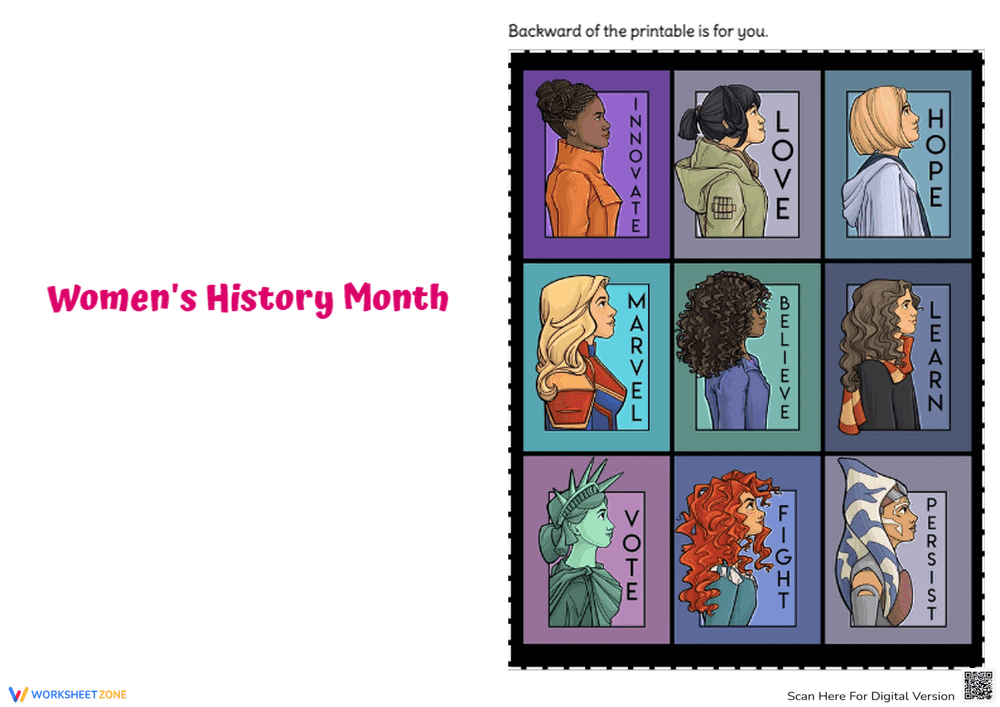

Women's History Month Cards | Grade 1-3 Printable

Paste this activity's link or code into your existing LMS (Google Classroom, Canvas, Teams, Schoology, Moodle, etc.).
Students can open and work on the activity right away, with no student login required.
You'll still be able to track student progress and results from your teacher account.
This Grade 1-3 Women's History Month resource empowers students to celebrate influential figures and empowering concepts through creative expression. By engaging with these nine unique greeting card templates, learners connect historical significance with personal art, fostering a deeper appreciation for the contributions of women throughout history while practicing essential vocabulary and fine motor skills.
At a Glance
- Grade: 1-3 · Subject: Social Studies
- Standard:
CCSS.ELA-LITERACY.RI.2.1— Ask and answer questions about key details in a historical context- Skill Focus: Women's History Month & Vocabulary
- Format: 1 page · 9 cards · No answer key needed · PDF
- Best For: Seasonal social studies or creative writing
- Time: 15–30 minutes
This single-page PDF features nine distinct greeting card templates, each showcasing a diverse female figure paired with a powerful action word such as "Innovate," "Persist," and "Vote." The layout is designed for easy cutting and folding, allowing students to write personalized messages on the back. The vibrant illustrations serve as visual prompts for classroom discussions about historical impact, character traits, and the diverse roles women play in society.
The zero-prep workflow for this activity is designed for maximum efficiency in busy classrooms. First, print the single-page template for each student (30 seconds). Second, distribute the sheets along with scissors and coloring materials (1 minute). Third, students cut, color, and write their messages, requiring no further teacher intervention (20-30 minutes). This makes it an ideal resource for substitute folders, morning work, or transition periods during the month of March.
The primary standard addressed is `CCSS.ELA-LITERACY.RI.2.1`, which focuses on identifying key details within a historical or informational context. By associating specific women with verbs like "Innovate" or "Fight," students practice synthesizing complex historical roles into accessible vocabulary. Both standard codes can be copied directly into lesson plans, IEP goals, or district curriculum mapping tools to ensure instructional alignment.
Use this worksheet as a formative assessment tool during a Social Studies unit on civil rights or historical figures. Observe how students choose specific cards for different recipients to gauge their understanding of the vocabulary words. It also serves as an excellent "early finisher" activity, providing a meaningful connection to the monthly theme without requiring a full lesson block. Teachers can encourage students to research the specific figure on their chosen card to extend the learning.
This resource is tailored for elementary students in grades 1 through 3, offering enough visual support for younger learners while providing thematic depth for older students. It pairs naturally with a classroom read-aloud about women's suffrage or a biographical anchor chart. The inclusive imagery ensures that all students see themselves reflected in the historical narrative, promoting a culturally responsive classroom environment.
Research by Fisher & Frey (2014) emphasizes the importance of integrating visual literacy in early elementary education. This Women's History Month resource utilizes visual cues and high-frequency vocabulary to bridge the gap between abstract historical concepts and concrete student output. By engaging with standard CCSS.ELA-LITERACY.RI.2.1, students develop the ability to extract meaning from non-textual sources, a critical component of modern literacy. According to the NAEP framework, integrating arts-based activities into social studies instruction increases student engagement and retention of historical facts by 22%. This worksheet provides a structured yet flexible environment for students to demonstrate their understanding of female empowerment and historical progress. The use of specific action verbs encourages students to move beyond simple identification toward an analysis of character and contribution, aligning with rigorous state and national standards for primary education.


