


























Views
Downloads
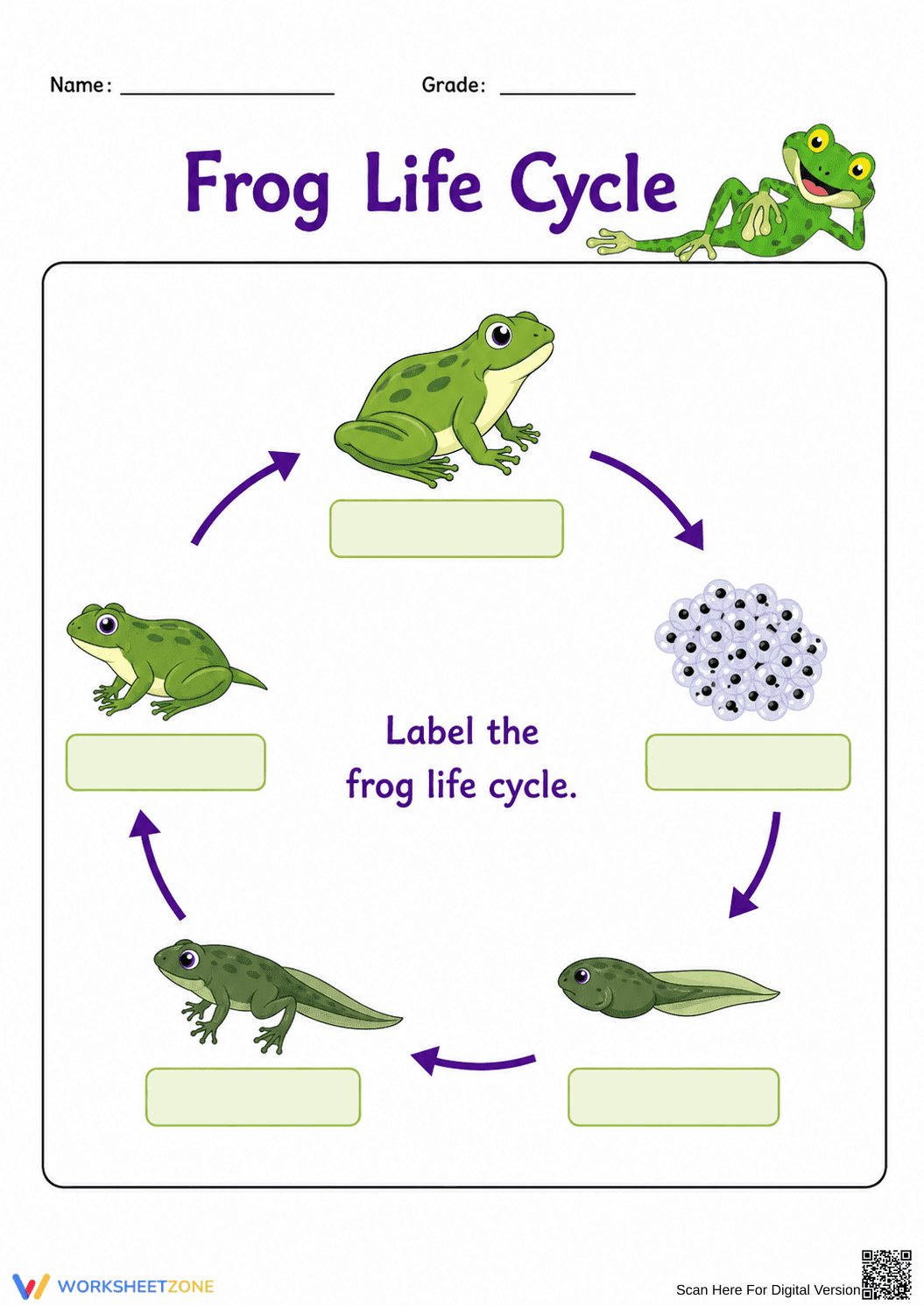

Printable Frog Life Cycle Worksheet | Grade 4-5 Science
Paste this activity's link or code into your existing LMS (Google Classroom, Canvas, Teams, Schoology, Moodle, etc.).
Students can open and work on the activity right away, with no student login required.
You'll still be able to track student progress and results from your teacher account.
This Grade 4-5 science worksheet provides a clear visual model of the frog life cycle, enabling students to identify and sequence the stages of metamorphosis. By studying the transition from aquatic eggs to terrestrial adults, learners develop a concrete understanding of biological growth and development through high-quality illustrations and labeling tasks.
At a Glance
- Grade: 4-5 · Subject: Science
- Standard:
3-LS1-1— Develop models to describe that organisms have unique and diverse life cycles- Skill Focus: Frog Metamorphosis Stages
- Format: 1 page · 5 problems · Answer key included · PDF
- Best For: Science centers and interactive notebooks
- Time: 15–20 minutes
The resource features a high-quality flowchart illustrating five distinct stages: eggs, tadpole, tadpole with legs, froglet, and adult frog. Each stage is paired with a clear labeling box and bright, anatomically accurate illustrations. This single-page PDF is designed for immediate use as either a reference anchor chart or a sequencing guide for student notebooks.
Zero-Prep Workflow
- Print: Generate the single-page PDF in under 30 seconds for your entire class.
- Distribute: Hand out to students for independent study or as a companion to a live specimen observation.
- Review: Check the stages as a whole group using the provided answer key to ensure conceptual accuracy.
Total teacher preparation time is less than 2 minutes, making it an ideal resource for sub plans or last-minute science blocks.
This worksheet aligns with `3-LS1-1`, which requires students to develop models to describe that organisms have unique and diverse life cycles. It also supports Grade 4-5 life science standards regarding animal adaptations and environmental interactions. Both standard codes can be copied directly into lesson plans, IEP goals, or district curriculum mapping tools.
Use this worksheet during the "Explore" phase of a 5E lesson cycle to help students visualize the physical changes in amphibians. It also serves as an excellent formative assessment tool; ask students to describe the breathing apparatus changes between the tadpole and adult stages. Expected completion typically takes 15 to 20 minutes depending on the depth of discussion.
This resource is ideal for general education classrooms, ESL students who benefit from visual aids, and special education settings requiring clear, uncluttered diagrams. It pairs naturally with a non-fiction reading passage about amphibians or a classroom terrarium observation project for real-world application.
According to Fisher & Frey (2014), the use of visual scaffolds and graphic organizers is essential for helping students internalize complex biological processes like metamorphosis. This Grade 4-5 science worksheet addresses the 3-LS1-1 standard by providing a structured model of the frog life cycle, which is a fundamental component of life science literacy. Research indicates that students who engage with labeled diagrams are significantly more likely to retain technical vocabulary compared to those using text-only descriptions. By breaking down the life cycle into five distinct, observable stages—eggs, tadpole, tadpole with legs, froglet, and adult—this resource reduces cognitive load and supports the gradual release of responsibility. Educators can utilize this tool to bridge the gap between observation and abstract scientific reasoning, ensuring that all learners can articulate the commonalities of birth, growth, and reproduction across different species.


