


























Views
Downloads
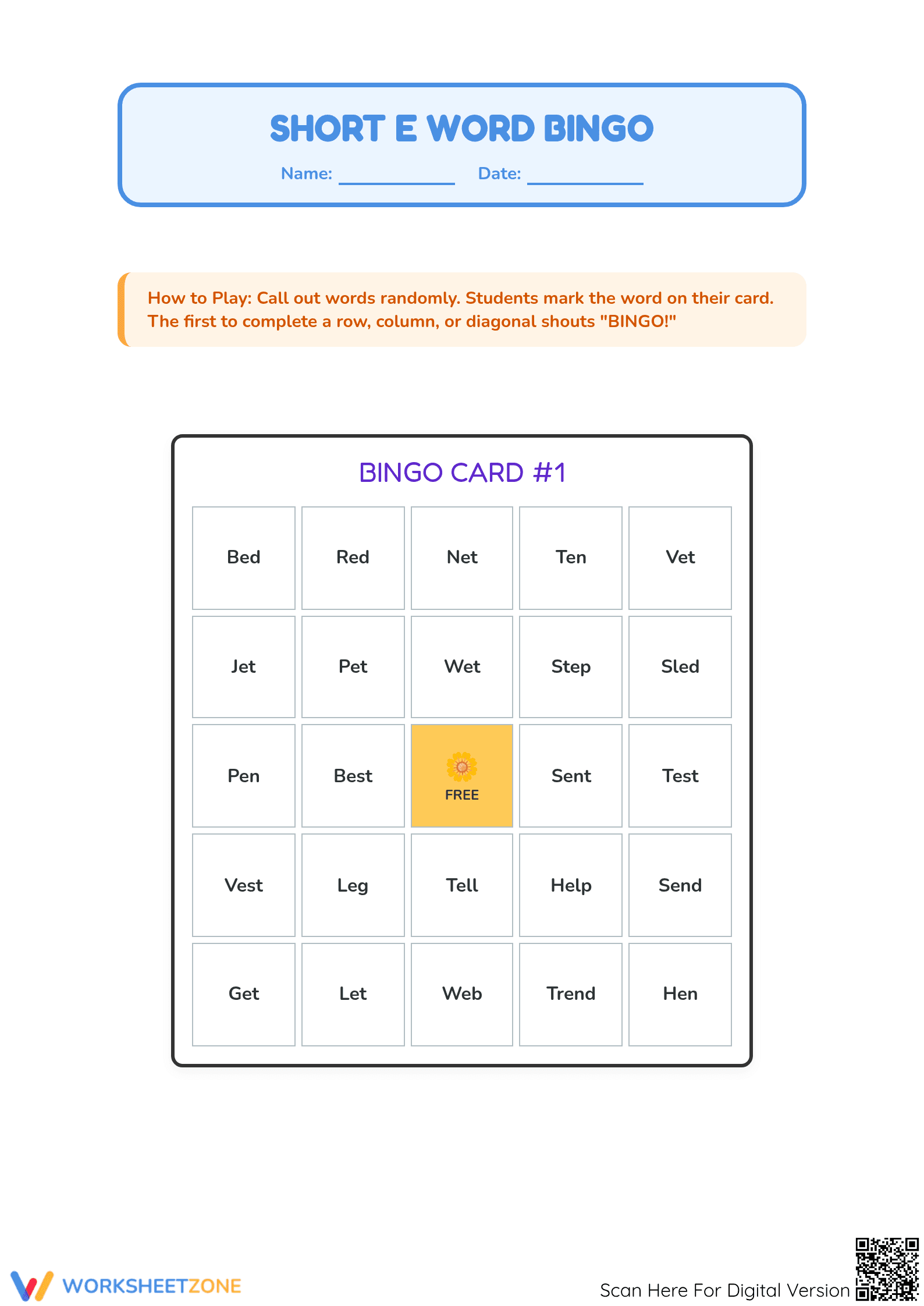


Printable Short E Bingo Game | Grade 1 Phonics Fun
Paste this activity's link or code into your existing LMS (Google Classroom, Canvas, Teams, Schoology, Moodle, etc.).
Students can open and work on the activity right away, with no student login required.
You'll still be able to track student progress and results from your teacher account.
This Grade 1 phonics worksheet transforms short e vowel practice into an engaging bingo game. Students build auditory discrimination and decoding skills by identifying 24 distinct short e words in a social, interactive format. It provides a high-interest alternative to traditional drills while ensuring students master essential CVC and CCVC patterns.
At a Glance
- Grade: 1 · Subject: ELA
- Standard:
CCSS.ELA-LITERACY.RF.1.3.B— Decode regularly spelled one-syllable words with common vowel patterns- Skill Focus: Short E vowel recognition
- Format: 2 pages · 24 words · Teacher call list included · PDF
- Best For: Whole-class phonics review or small groups
- Time: 15–20 minutes
This 2-page PDF includes two unique bingo cards and a comprehensive teacher's call list. Each card features a 5x5 grid with a central "Free" space and 24 words such as "bed," "net," "step," and "trend." The call list allows teachers to track which words have been announced, ensuring a smooth and organized gameplay experience.
Zero-Prep Workflow:
- Print (1 minute): Select the number of copies needed for your class or small group.
- Distribute (30 seconds): Hand out cards and markers such as counters, beans, or crayons.
- Review (15 minutes): Call words from the list while students identify and mark them on their grids.
Total teacher preparation time is under 2 minutes, making this an ideal resource for substitute folders or Friday phonics reviews.
The primary standard addressed is CCSS.ELA-LITERACY.RF.1.3.B, which requires students to decode regularly spelled one-syllable words. By focusing specifically on the short e sound, this activity supports foundational literacy development and phonological awareness. Both standard codes can be copied directly into lesson plans, IEP goals, or district curriculum mapping tools.
Use this as a formative assessment during a phonics unit to observe which students struggle to distinguish the short e sound from other vowels. It also works perfectly as a "brain break" that maintains instructional focus. Expected completion time ranges from 15 to 20 minutes depending on the speed of the caller and student familiarity with the vocabulary.
This resource is designed for first-grade students, but it is also highly effective for kindergarteners ready for CVC words or second graders needing remedial support. It pairs naturally with a short e anchor chart or a decodable reader focused on the "e" vowel sound to reinforce learning across different modalities.
Research from Fisher & Frey (2014) emphasizes that gamified learning environments increase student engagement and retention of foundational literacy skills. This worksheet aligns with the Science of Reading by providing targeted practice on the CCSS.ELA-LITERACY.RF.1.3.B standard, specifically focusing on the decoding of one-syllable words with the short e vowel pattern. By moving beyond isolated word lists into a social bingo format, students apply phonemic awareness in a low-stakes, high-reward setting. The inclusion of 24 distinct words allows for multiple rounds of play, reinforcing the sound-symbol relationship through repeated exposure. According to NAEP data, early mastery of vowel patterns is a critical predictor of later reading fluency. This resource provides the necessary repetition for students to move from slow decoding to automatic word recognition, which is essential for developing the cognitive capacity required for reading comprehension in later grades.


