


























Views
Downloads

Women's History Matching Worksheet | Grade 2 Essential
Paste this activity's link or code into your existing LMS (Google Classroom, Canvas, Teams, Schoology, Moodle, etc.).
Students can open and work on the activity right away, with no student login required.
You'll still be able to track student progress and results from your teacher account.
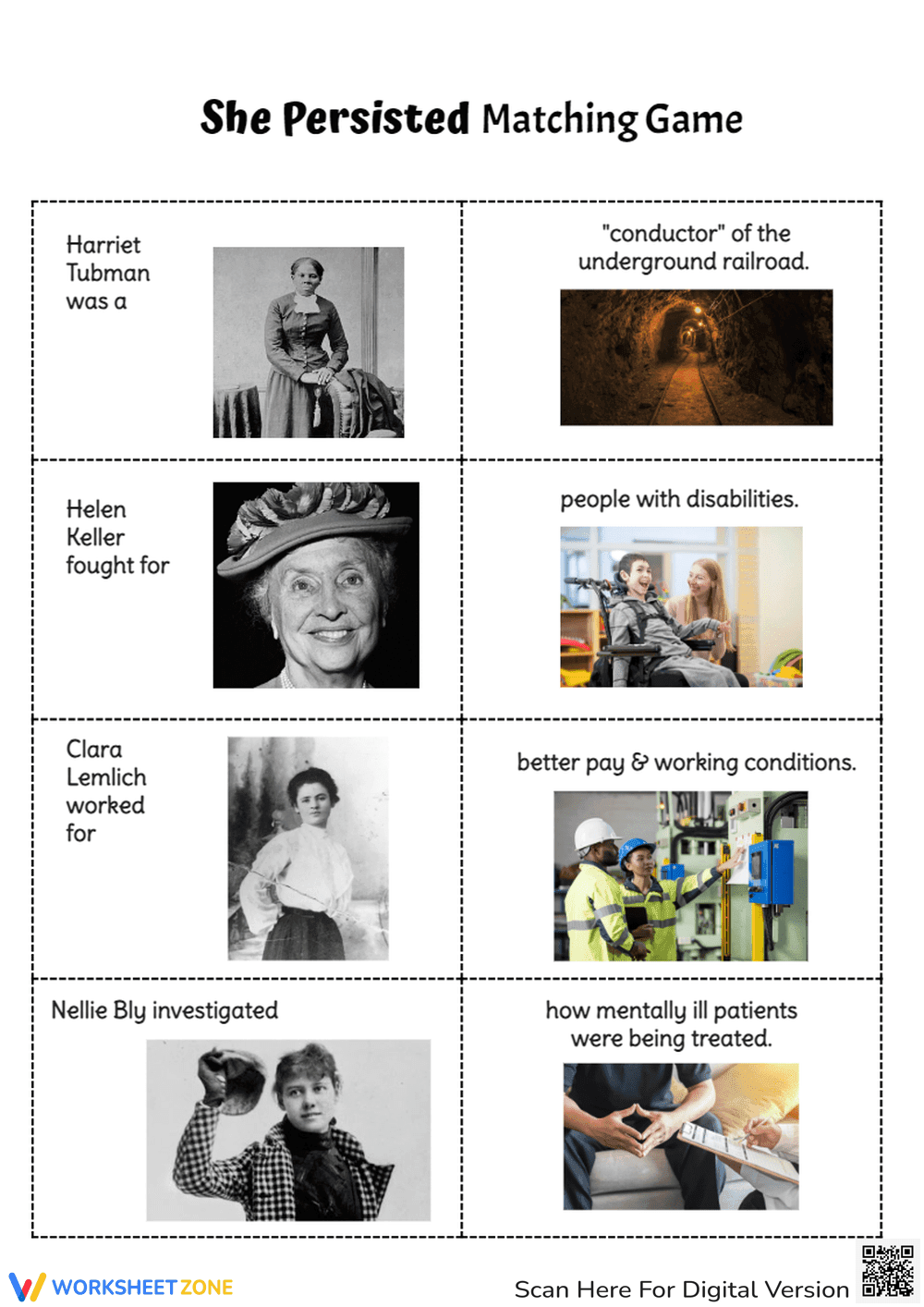
This Social Studies worksheet helps primary students identify influential women in history through an engaging matching game. By connecting portraits of figures like Harriet Tubman and Helen Keller to their specific historical contributions, learners build foundational knowledge of civil rights and social reform. It is an effective tool for developing informational text comprehension and historical empathy.
At a Glance
- Grade: 2 · Subject: Social Studies
- Standard:
CCSS.ELA-LITERACY.RI.2.3— Describe the connection between historical individuals and their significant contributions- Skill Focus: Historical Figure Recognition
- Format: 1 page · 4 problems · Answer key included · PDF
- Best For: Women's History Month introductory activity
- Time: 10–15 minutes
The resource features a single-page layout containing four distinct matching tasks. Each task pairs a high-quality historical photograph with a concise sentence fragment describing a major achievement. Figures included are Harriet Tubman, Helen Keller, Clara Lemlich, and Nellie Bly. The clear dashed lines make it ideal for either a draw-to-match activity or a cut-and-paste craft, providing flexibility for different fine-motor skill levels.
This worksheet is designed for a zero-prep classroom environment. Teachers can follow a simple three-step workflow: Print the required number of copies (30 seconds), Distribute to students as a warm-up or center activity (1 minute), and Review the answers as a whole group to reinforce the historical facts (5 minutes). Total teacher preparation time is under 2 minutes, making it an excellent choice for emergency sub plans or transition periods.
The primary alignment is `CCSS.ELA-LITERACY.RI.2.3`, which requires students to describe the connection between a series of historical events or individuals. By matching the person to their specific action—such as Harriet Tubman to the Underground Railroad—students demonstrate an understanding of how these individuals influenced history. Both standard codes can be copied directly into lesson plans, IEP goals, or district curriculum mapping tools.
Use this worksheet during the instructional phase of a Women's History unit. It works well as a formative assessment after a read-aloud of biographical texts. Teachers should observe if students can use visual cues from the photographs to assist their reading. Expected completion time is 10 to 15 minutes, depending on whether students are cutting and pasting or simply drawing lines.
This activity is tailored for Grade 1 through Grade 3 students, particularly those beginning to explore biography and non-fiction. It provides necessary scaffolding for English Language Learners through the use of visual aids. It pairs naturally with a classroom anchor chart featuring persistence as a character trait or a library of short biographical picture books.
Research from Fisher & Frey (2014) emphasizes the importance of visual literacy and scaffolded informational text in the primary grades to build background knowledge. This worksheet addresses that need by providing a concrete, visual-to-text connection for four pivotal figures in American history. By focusing on the standard CCSS.ELA-LITERACY.RI.2.3, the activity ensures that students are not just memorizing names but are understanding the specific reasons behind each woman's historical significance. According to the NAEP, students who engage with diverse historical narratives early in their education show higher levels of civic engagement and reading comprehension in later years. This resource provides a structured, 1-page entry point into complex topics like labor rights, disability advocacy, and abolition. It serves as a reliable, research-backed tool for meeting Social Studies requirements while simultaneously reinforcing ELA informational reading skills through 4 targeted matching tasks.


