What Frog Life Cycle Worksheets Actually Teach
Frog life cycle worksheets give your students a repeatable way to track one animal through complete metamorphosis, from a jelly-covered egg to a four-legged adult. For a K-3 science unit, that structure matters: instead of memorizing a vocabulary list, students sequence real stages, label the parts that change, and explain why a tadpole and an adult frog look nothing alike. A strong printable set moves from picture-based sorting for emergent readers to short written explanations for third graders who can describe how gills give way to lungs. That range is what lets one topic carry an entire week of small-group work.
These worksheets fit most spring life science units, pond and habitat studies, and end-of-unit review. Because the frog changes so visibly at each stage, the topic works well for labeling diagrams, cut-and-paste sequencing, and quick exit tickets that show you who still confuses the tadpole and froglet stages.
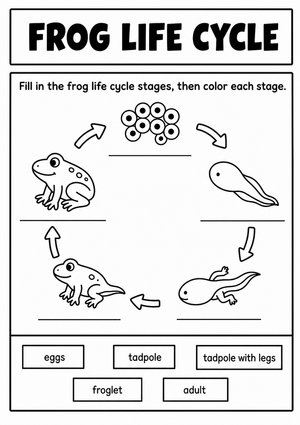
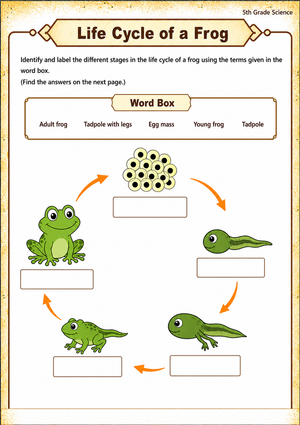
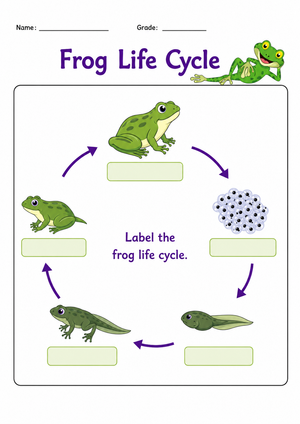
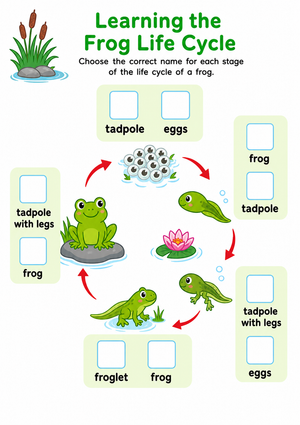
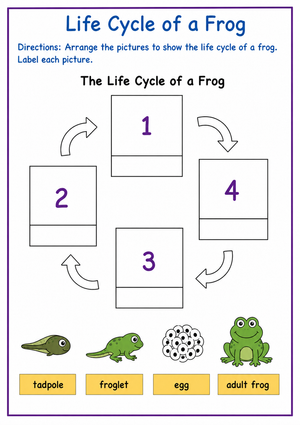
The Four Stages Students Sequence and Label
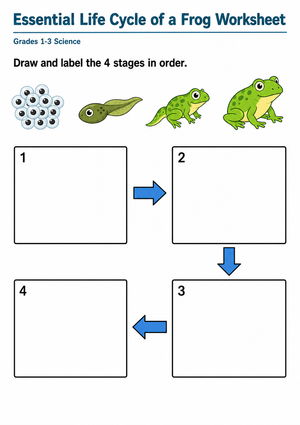
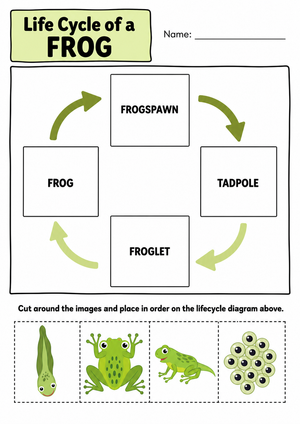
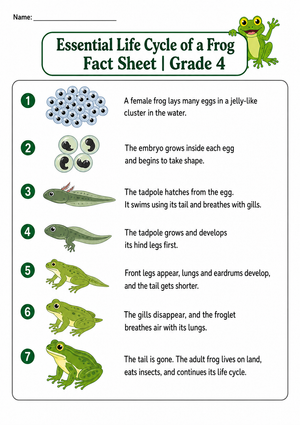
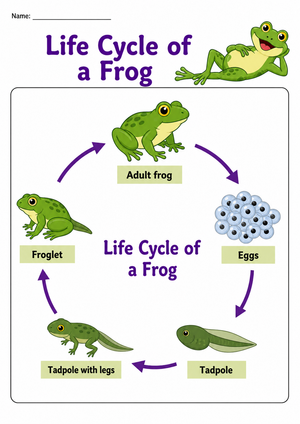
Most elementary units frame the frog life cycle as four main stages, and your worksheets should keep that sequence front and center:
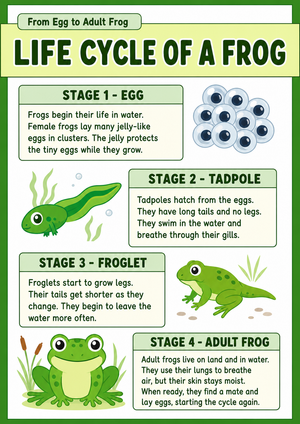
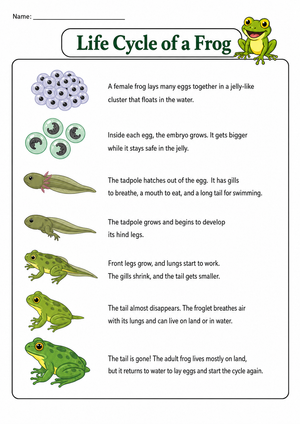
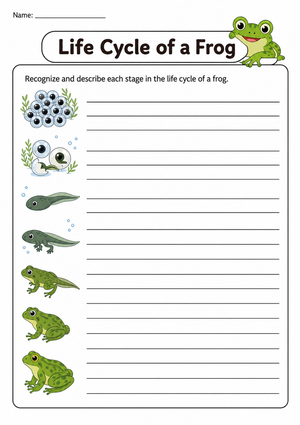
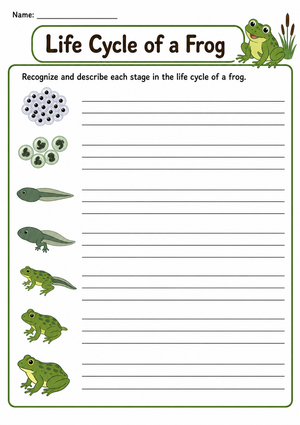
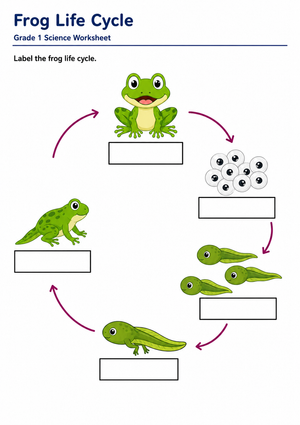
- Egg: Frogs lay eggs in water in a jelly-like cluster. These eggs usually hatch in about 1 to 3 weeks, so a labeling task can point to the protective jelly and the water habitat.
- Tadpole: A newly hatched tadpole has a tail, no legs, and breathes through gills. It feeds on algae and plant matter, which makes a sharp contrast with the adult diet.
- Froglet: Hind legs grow first, then front legs, the tail shortens, and lungs begin replacing gills. This is the stage students most often skip, so it deserves its own box on the diagram.
- Adult frog: The tail is gone, four legs support hopping, and lungs support life on land and in water.
Asking students to order these four stages and then label one structural change per stage turns a coloring page into an actual reasoning task.
Why Metamorphosis Is Worth the Class Time
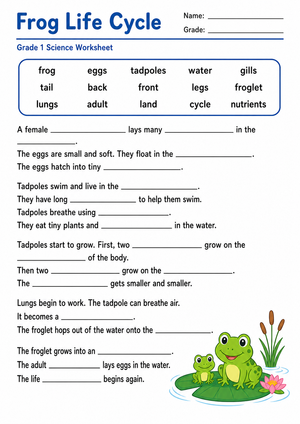
The frog is one of the clearest classroom examples of complete metamorphosis, because the body plan reorganizes rather than just growing larger. Hind legs appear before front legs, the tail is reabsorbed, and the animal shifts from a gill-breathing plant-eater to a lung-breathing predator. Pointing to those specific changes helps students connect structure and survival instead of treating the stages as random pictures. It also sets up the vocabulary you want on the labeled diagram.
Here is the detail that hooks students: the change is not automatic growth but a hormone-driven transformation. A thyroid hormone triggers metamorphosis, which is why hind legs, then front legs, then lung development happen in a fixed order. Framing the froglet stage as a scheduled sequence, not a random jump, gives third graders a cause-and-effect story they can actually explain on an assessment.
A Survival Data Point That Anchors Discussion
Survival is the part of the story that makes students lean in, and it pairs naturally with a discussion of adaptation.
According to the Life Cycle of a Frog overview from Home Science Tools, only about 5 of every 1,000 frog eggs survive to adulthood. That steep drop-off explains why a single female lays such a large egg cluster, and it gives students a concrete reason to discuss how each stage's structures support survival.
Classroom Implementation
Here's how to fit frog life cycle worksheets into a real week of instruction rather than a single throwaway lesson:
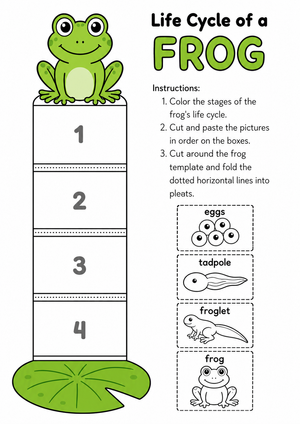
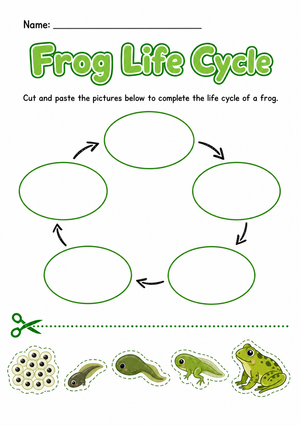
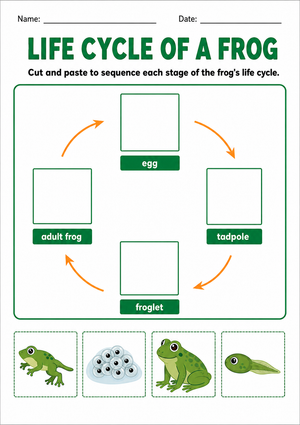
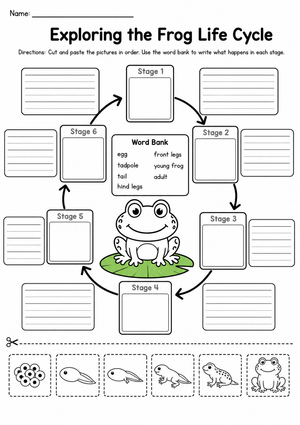
- Open with sorting: Hand out mixed-up stage cards and have partners sequence egg, tadpole, froglet, and adult before any labels go on paper. Misordered cards tell you exactly where the confusion sits.
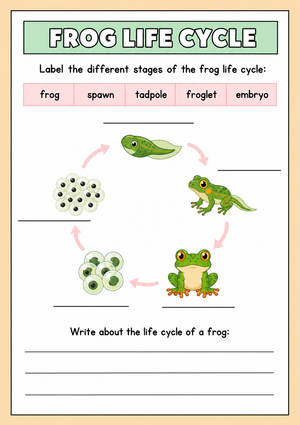
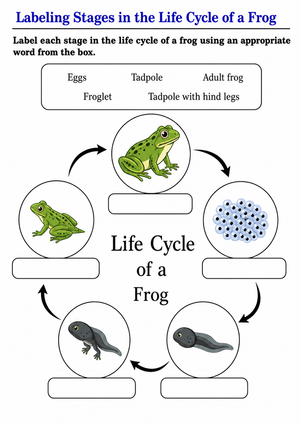
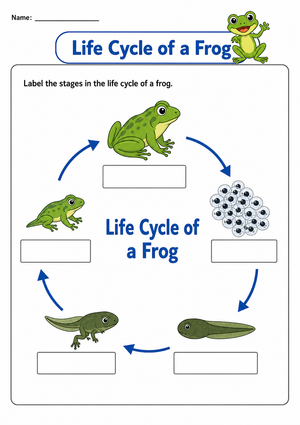
- Build the labeled diagram: Move to a full four-stage diagram where students add vocabulary like metamorphosis, gills, and lungs. Emergent readers can match word cards while stronger readers write the terms.
- Use a spring science center: Stock a center with a sequencing mat and a short explanation prompt so small groups rotate through independently during a pond or habitat unit.
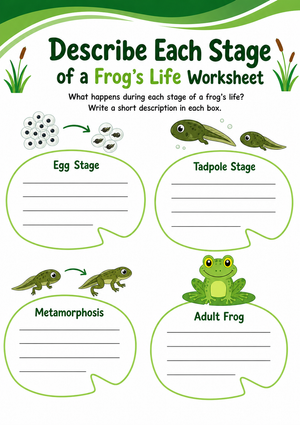
- Close with an exit ticket: A quick label-and-explain worksheet works as a formative check, showing who can still name each stage and one change that happens there.
Spacing the worksheets across sorting, labeling, center work, and assessment keeps students revisiting the same four stages until the sequence sticks.
Differentiating for K-2 and Grade 3
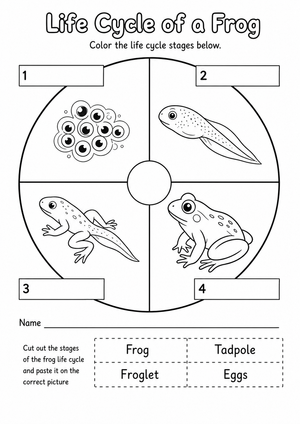
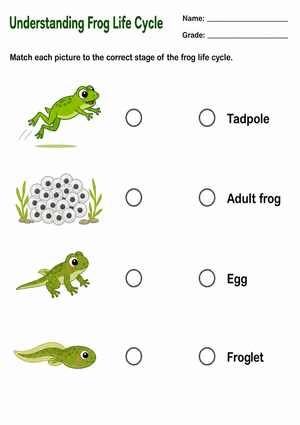
The same topic stretches across several grade levels if you adjust the worksheet, not the science. For kindergarten and first grade, lean on a simplified three-stage version that folds the froglet into the tadpole-to-adult transition, uses large picture boxes, and pairs each image with a single vocabulary word. Picture-based sequencing and color-and-label pages let emergent readers show understanding without heavy writing.
For second and third grade, use the detailed four-stage worksheet with a dedicated froglet box and short answer lines. Ask these students to explain one structural change per stage, such as how lungs replace gills, so the worksheet doubles as a writing task. Offering both a three-stage and a four-stage version of the same sheet is the simplest way to run one lesson across a mixed-ability small group.
Pairing Frogs With Other Life Cycles
Once students can sequence the frog, a compare-and-contrast worksheet deepens the concept of complete metamorphosis. Set the frog beside a butterfly or dragonfly and have students mark what is shared, such as distinct stages and a dramatic body change, and what differs, such as the frog's move between water and land. This pairing keeps metamorphosis from feeling like a single-animal fact and turns it into a pattern students can apply to new organisms. That transfer, spotting the same life-cycle structure in a new animal, is exactly the kind of thinking elementary life science standards ask for, and it gives your fast finishers a meaningful extension instead of busywork.
Frequently Asked Questions
1. What grade level are frog life cycle worksheets best suited for?
They fit K-3 science units best. Kindergarten and first grade work well with simplified picture sequencing, while second and third graders can handle the full four-stage diagram with written explanations of each structural change.
2. How many stages should students learn in the frog life cycle?
Most elementary units use four stages: egg, tadpole, froglet, and adult frog. Younger students can start with a simplified three-stage version and add the froglet stage once they are comfortable sequencing.
3. How can these worksheets support life science standards?
Frog metamorphosis is a clear model for how an organism's structures support survival across environments. Labeling how gills become lungs or how legs develop lets students connect body structures to function and life-cycle stages.
4. How long does it take a frog to go through its full life cycle?
Roughly 12 to 16 weeks, depending on species and conditions. Eggs hatch in about 1 to 3 weeks, and the tadpole and froglet stages fill out the rest of the timeline before the adult stage.
5. How can teachers differentiate these worksheets for younger and older students?
Swap the worksheet, not the topic. Use large picture boxes and word matching for K-1, and detailed four-stage diagrams with short-answer explanation lines for grades 2 and 3 during the same lesson.