


























Views
Downloads
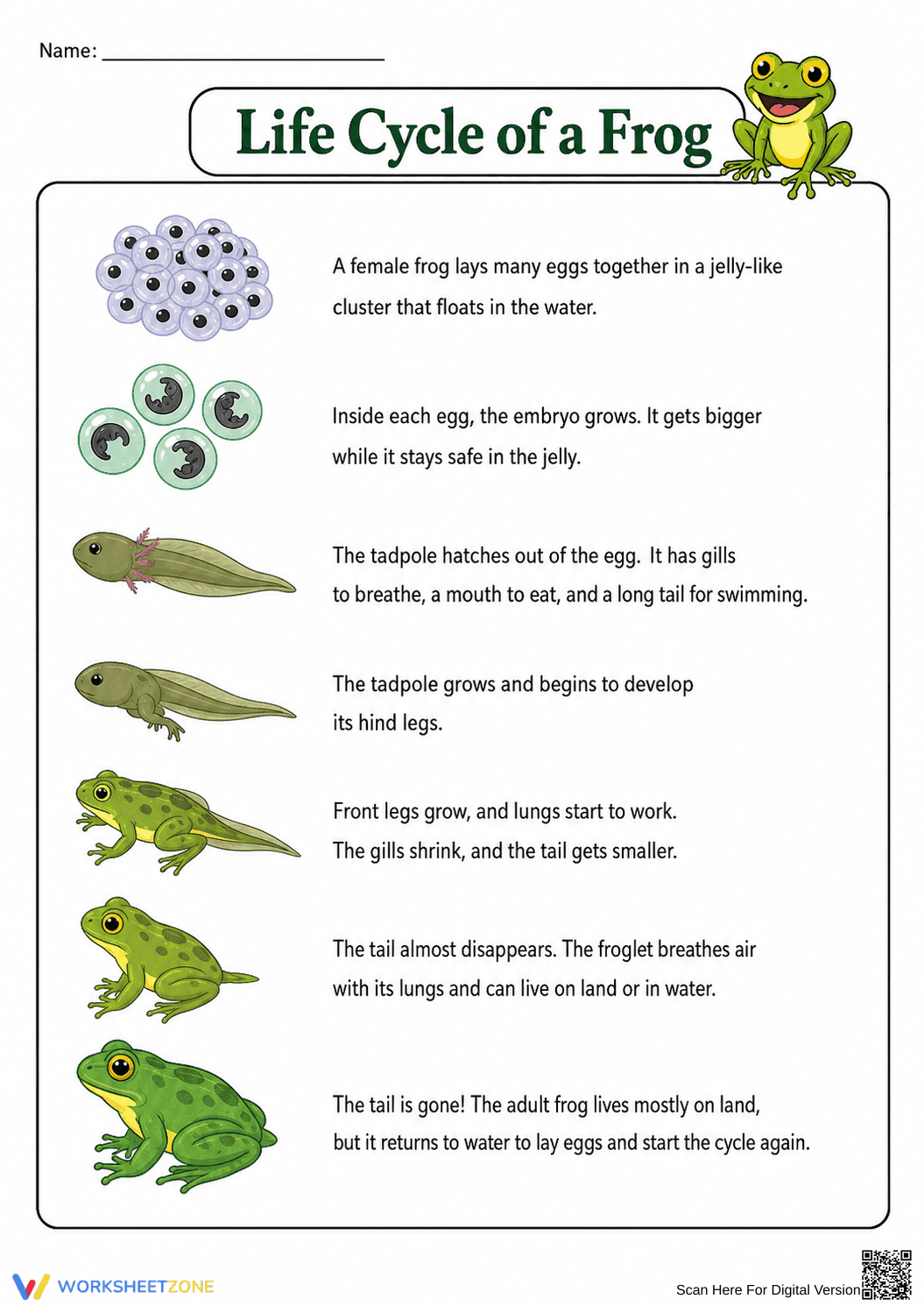

Printable Frog Life Cycle Chart | Grade 3 Science
Paste this activity's link or code into your existing LMS (Google Classroom, Canvas, Teams, Schoology, Moodle, etc.).
Students can open and work on the activity right away, with no student login required.
You'll still be able to track student progress and results from your teacher account.
This Grade 3 frog life cycle reference chart provides students with a clear, visual guide to the seven stages of amphibian development. By reading the detailed descriptions and observing the corresponding illustrations, learners identify how frogs grow from eggs to adults, mastering biological growth patterns and metamorphosis.
At a Glance
- Grade: 3 · Subject: Science
- Standard:
3-LS1-1— Describe unique and diverse animal life cycles- Skill Focus: Frog life cycle and metamorphosis
- Format: 1 page · 7 stages · No answer key needed · PDF
- Best For: Science reference and reading
- Time: 10–15 minutes
This single-page informational resource features seven distinct stages of a frog's life cycle, from the initial egg cluster to the fully developed adult. Each stage includes a high-quality color illustration paired with a concise paragraph explaining biological changes, such as the development of gills, lungs, and hind legs. The structured layout serves as an excellent anchor chart or individual reading guide.
Teachers can integrate this resource into their science block in under two minutes. Simply print the PDF (30 seconds), distribute it to students as a reading guide or reference sheet (30 seconds), and review the stages as a whole class or in small groups (1 minute). Its self-explanatory layout makes it an ideal choice for emergency sub plans or independent station work during a biology unit.
This worksheet is aligned with 3-LS1-1: "Develop models to describe that organisms have unique and diverse life cycles but all have in common birth, growth, reproduction, and death." It also supports ELA standards for reading informational text by requiring students to connect illustrations with technical descriptions. Both standard codes can be copied directly into lesson plans, IEP goals, or district curriculum mapping tools.
Use this chart during the "Explain" phase of a 5E science lesson to provide concrete vocabulary for metamorphosis. It serves as an excellent reference for students to keep in their science folders. For a quick formative assessment, ask students to cover the text and describe the biological changes occurring in each image to a partner. Completion typically takes 10 to 15 minutes depending on reading level.
This resource is designed for Grade 3 students but is highly appropriate for Grade 2 through Grade 5 learners studying biology. It is particularly helpful for visual learners and English Language Learners who benefit from the direct pairing of text and imagery. Pair this with a live classroom observation or a video of tadpoles for a comprehensive learning experience.
According to the RAND AIRS 2024 report on elementary science instruction, high-quality visual models are essential for helping young learners grasp abstract biological concepts like metamorphosis. This resource addresses the 3-LS1-1 standard by providing a structured sequence of the frog life cycle, allowing students to observe the transition from aquatic to terrestrial life. Combining technical text with visual representations significantly improves retention of scientific vocabulary in the primary grades. By identifying seven specific developmental milestones, students build a foundation for understanding more complex ecological systems. This printable PDF serves as a reliable tool for classroom teachers seeking to meet NGSS requirements while maintaining a low-prep environment. It provides the necessary scaffolding for students to master the plain-English skill of describing unique and diverse animal life cycles accurately and confidently.


