




























Views
Downloads
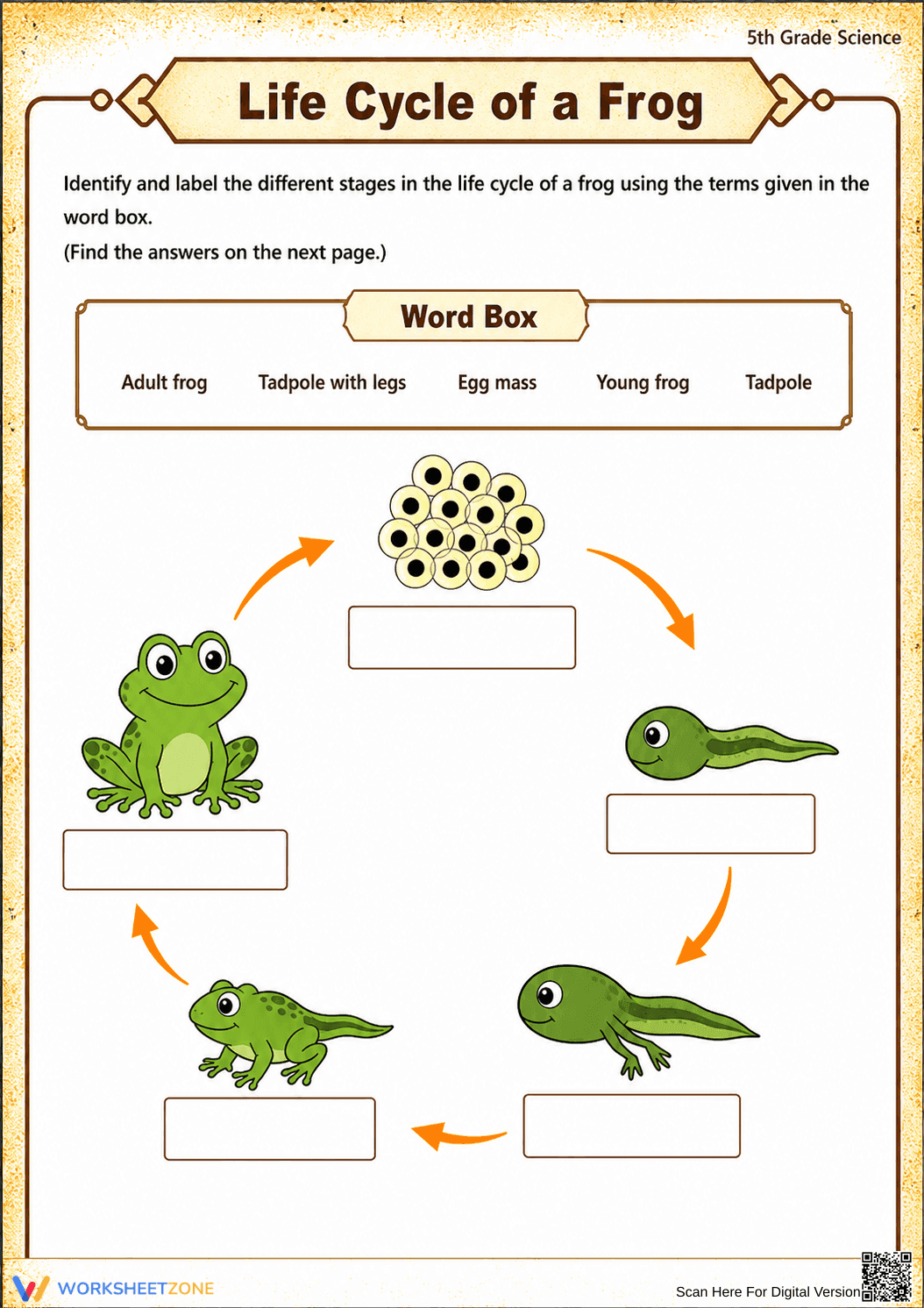
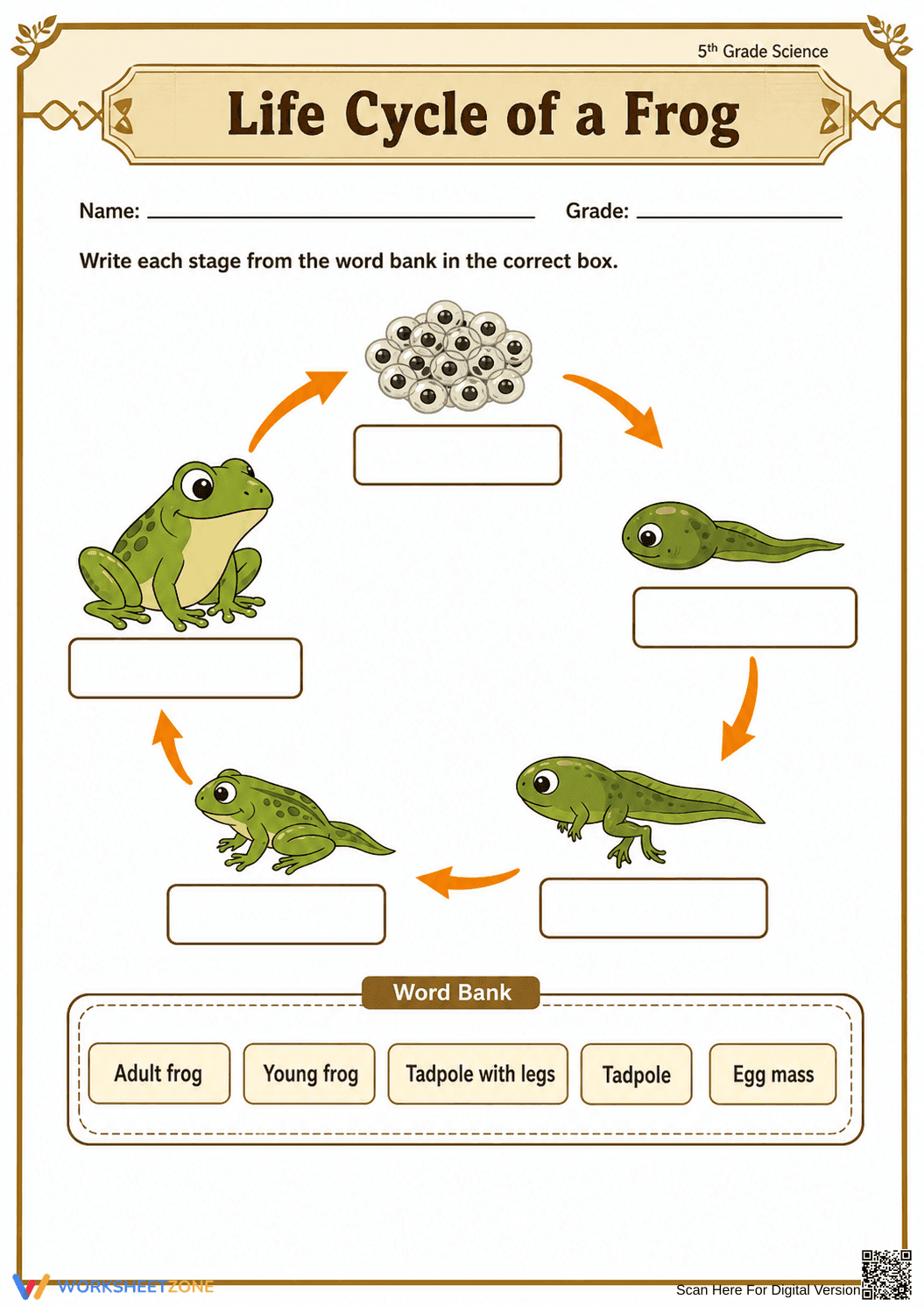

Printable Frog Life Cycle Worksheet | Grade 5 Science

Paste this activity's link or code into your existing LMS (Google Classroom, Canvas, Teams, Schoology, Moodle, etc.).
Students can open and work on the activity right away, with no student login required.
You'll still be able to track student progress and results from your teacher account.
This ready-to-use science worksheet helps students master the biological stages of amphibian development by labeling the life cycle of a frog. By completing this visual diagram, learners will accurately sequence the transformation from egg mass to adult frog, reinforcing essential life science vocabulary and concepts.
At a Glance
- Grade: 5 · Subject: Science
- Standard:
3-LS1-1— Develop models to describe organism life cycles- Skill Focus: Sequencing and labeling amphibian life stages
- Format: 2 pages · 5 problems · Answer key included · PDF
- Best For: Independent practice and review
- Time: 10–15 minutes
This resource includes a clear, circular diagram illustrating the five distinct stages of a frog's development. Students are provided with a helpful word bank containing key vocabulary terms such as tadpole, egg mass, and adult frog. The two-page PDF features the main student labeling activity and a built-in self-checking answer key to support independent learning.
Zero-Prep Workflow
This worksheet is designed for immediate classroom implementation.
- Print (1 minute): Simply print the two-page PDF. The layout is optimized for standard letter paper.
- Distribute (1 minute): Hand out the worksheets to students. The clear instructions and included word bank mean students can begin working immediately.
- Review (3 minutes): Use the included answer key for rapid whole-class review or allow students to self-check their work.
With a total teacher prep time of under two minutes, this activity is an excellent addition to any emergency sub plan or quick science center.
Standards Alignment
This worksheet aligns with 3-LS1-1, requiring students to develop models to describe that organisms have unique and diverse life cycles but all have in common birth, growth, reproduction, and death. The vocabulary and visual modeling are highly appropriate for fifth-grade review. Both standard codes can be copied directly into lesson plans, IEP goals, or district curriculum mapping tools.
How to Use It
Deploy this worksheet immediately after direct instruction on amphibian development to solidify new vocabulary. Alternatively, use it as a morning work activity to activate prior knowledge before a broader unit on ecosystems. As students work, observe whether they can correctly distinguish between the "tadpole" and "tadpole with legs" stages; confusion here offers a quick formative assessment opportunity to review metamorphosis. Expected completion time is 10 to 15 minutes.
Who It's For
This resource is primarily designed for fifth-grade science students, though it functions perfectly for upper elementary learners reviewing basic biology concepts. The visual nature of the diagram and the provided word bank offer built-in scaffolding, making it highly accessible for English Language Learners and students requiring vocabulary support. Pair this worksheet with a short nonfiction reading passage about wetland habitats to create a comprehensive cross-curricular lesson.
Understanding biological sequences is a fundamental component of elementary science education. Aligning with 3-LS1-1, this activity requires students to develop models to describe organism life cycles, specifically focusing on the metamorphosis of amphibians. According to a ScienceDirect TpT Analysis, visual diagramming and explicit vocabulary practice significantly improve student retention of complex biological processes. By actively labeling the stages from egg mass to adult frog, learners transition from passive observation to active conceptual modeling. This structured approach ensures that students not only memorize terms but also comprehend the sequential nature of growth and development in living organisms. Integrating targeted visual tasks into the science curriculum provides a reliable method for reinforcing essential life science frameworks.


