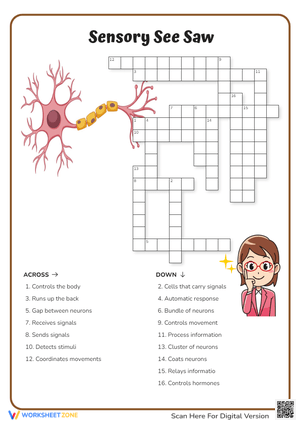
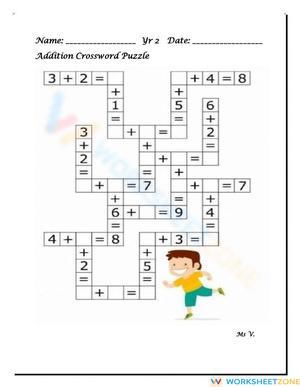
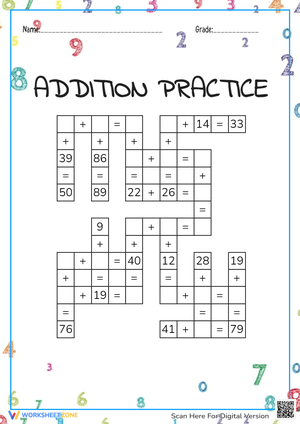
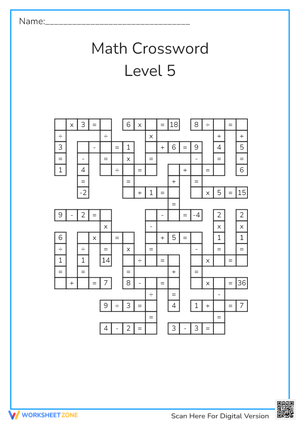
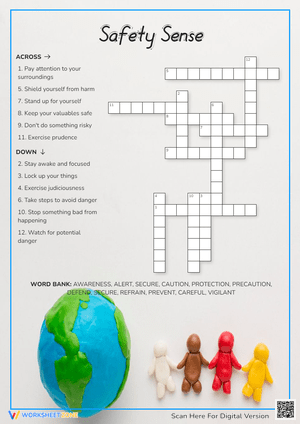
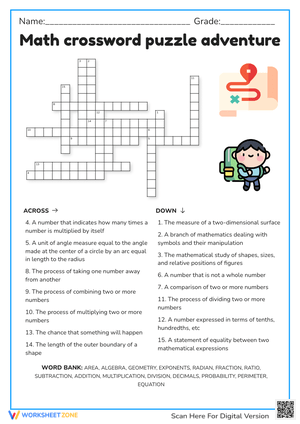
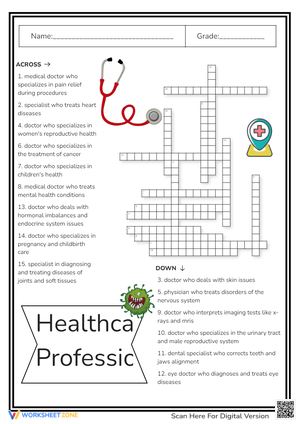
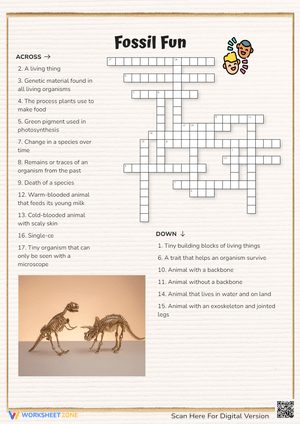
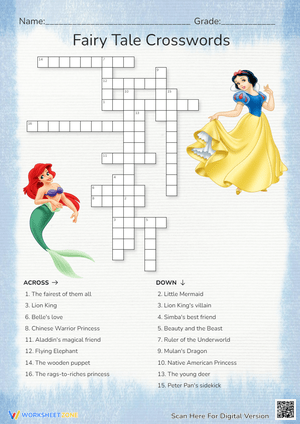
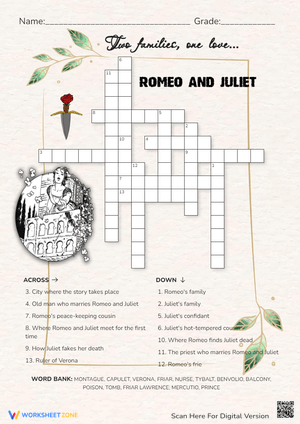
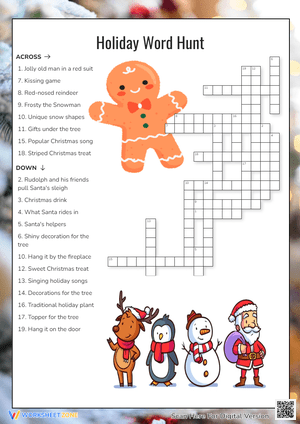
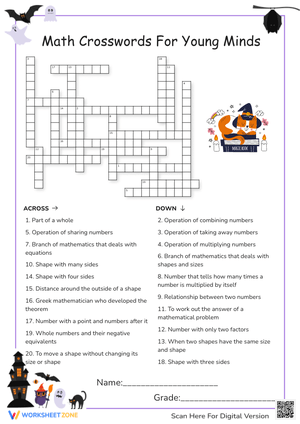
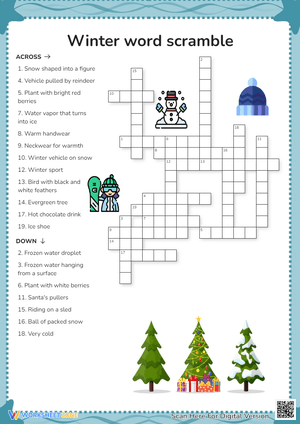
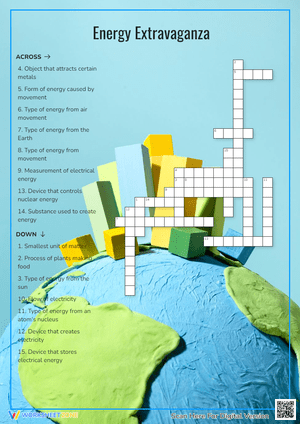
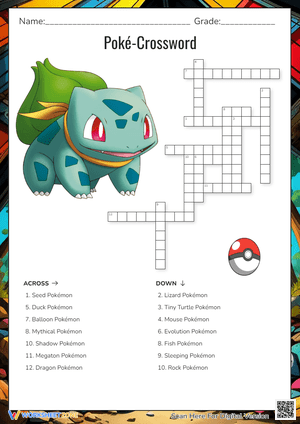
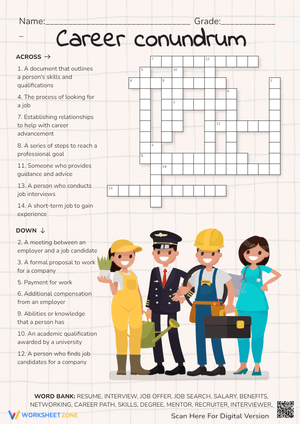
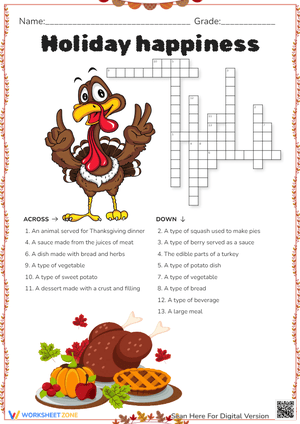
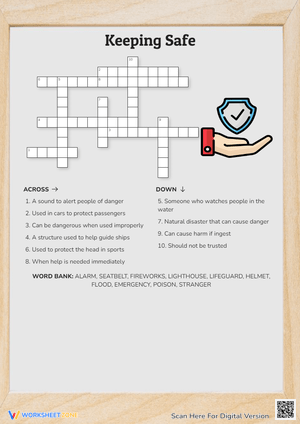
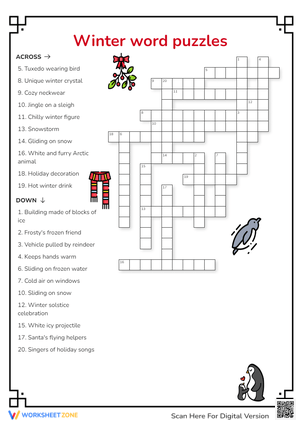
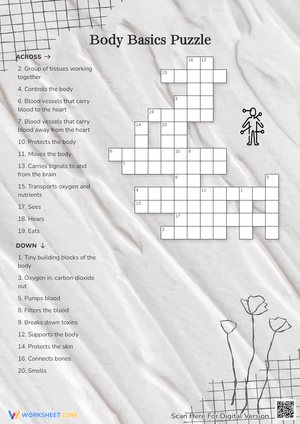
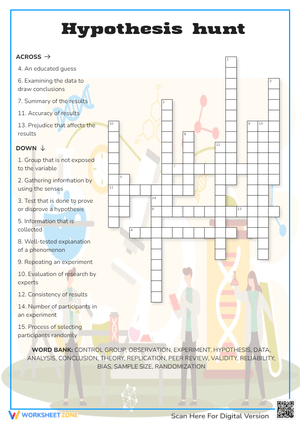
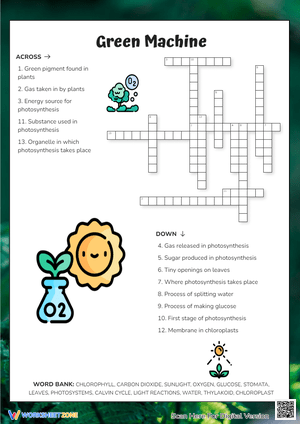
Crossword pdf worksheets give teachers a format where students are doing two things at once: retrieving content vocabulary from a clue and verifying the spelling of that answer letter by letter, with crossing squares acting as a built-in self-check that requires no teacher facilitation. The set here draws from ELA, science, social studies, and seasonal classroom content, sized to fit bell ringers, station rotations, review days, and sub plans. PDF formatting keeps grid layout and box sizing consistent whether printed on a school copier or shared digitally for homework.
What Each Worksheet Asks Students to Do
Each worksheet is built around a defined vocabulary set — terms pulled from a unit, a text, a content theme, or a grade-level topic — and students work through numbered clues to fill the corresponding squares in the grid. The mechanics of the puzzle enforce a level of precision that fill-in-the-blank and matching tasks don't: a correct meaning doesn't help if the spelling is off by a letter, and a plausible guess fails the moment it contradicts a crossing answer.
- Definition-to-term recall: students read a short, direct clue and retrieve the matching vocabulary word
- Accurate spelling: the grid confirms or contradicts each answer at the letter level
- Directional reading: students identify across vs. down clues and apply them correctly — a persistent point of confusion in grades 3 and 4
- Using partial information: letters already placed by crossing answers narrow down or confirm later responses
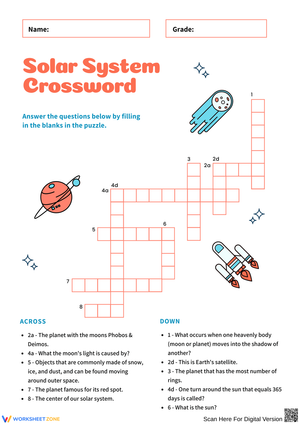
- Domain vocabulary in context: content-area puzzles connect terms to functions, relationships, or real-world applications rather than isolated definitions
Clue language across the set stays short and direct. That design keeps cognitive load on the content itself: students spend effort recalling the material, not decoding what the clue is asking.
Putting These Worksheets to Work Across the School Day
These worksheets produce the best results when assigned with a stated purpose — vocabulary review, pre-quiz consolidation, station independent work — rather than as general time-fill. For a morning entry routine, assign five to eight clues and review answers verbally as a class before the day's instruction begins. This reactivates prior-lesson vocabulary without requiring a separate review slide or additional prep. In a centers rotation, the crossword station gives students productive independent work while you run a guided reading or math group; pair the worksheet with a vocabulary reference card or open notebook so students can self-support without interrupting the small group.
Crossword pdf worksheets travel well as homework because the PDF holds its formatting across devices and printers, and the task directions are self-explanatory — families rarely need to interpret the instructions. For sub plans, include an answer key and a brief note indicating whether students may work with a partner; that one instruction removes the main source of sub-day friction with this format.
A follow-up move worth building into the printed directions: after students complete the puzzle, ask them to select three solved words and write one sentence for each that places the word in the content context, not just restates a definition. That five-minute extension shifts the work from recall to application and surfaces which terms students actually understand versus which they filled in correctly by letter-count alone.
Common Student Errors Worth Catching Before They Compound
The most consistent error pattern crosswords expose is over-commitment to a wrong first answer. A student fills in EVAPORATE for a nine-letter clue about the water cycle, then holds onto it even as crossing answers keep producing impossible letter combinations — because revising means conceding the first attempt was wrong. Crosswords surface this metacognitive resistance quickly. Watching where students lock in and refuse to change course tells you something about self-monitoring habits that a multiple-choice item cannot reveal.
Direction confusion is predictable in grades 3 and 4 and almost always fixable with three minutes of whole-class orientation at the start of the period. Students who haven't internalized the across/down convention fill in answers vertically when the clue label says "across," creating a cascade of wrong crossing letters that compounds through the grid. Walking through the first two clues together — pointing to the numbered square, tracing the direction, counting the boxes aloud — eliminates most of this confusion for the rest of the session.
A third pattern: students write a word that satisfies the box count without re-reading the clue to confirm the meaning actually fits. They see six boxes, they know a six-letter science word, and they move on. Training students to check the clue again after writing an answer, not just before, catches this before it cascades into the crossing entries.
Standard Alignment
The CCSS Language Standards L.3.6, L.4.6, and L.5.6 each require students to acquire and use grade-appropriate academic and domain-specific vocabulary with accuracy. Crossword tasks fit most naturally at the consolidation phase of a vocabulary sequence — after students have encountered terms through direct instruction and reading — because the format demands both retrieval and correct spelling, two indicators that understanding has moved past initial exposure. Content-area puzzles also address vocabulary expectations in NGSS and the C3 Framework for Social Studies, where precise use of field-specific terms is a content skill in its own right. The grid makes precision non-optional: if the spelling is wrong, the crossing answers don't work.
Adapting Each Worksheet for Different Levels of Learners
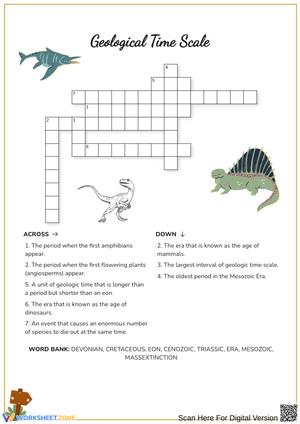
The fastest and most effective support adjustment is the word bank. Listing target vocabulary at the top of the page shifts the task from open recall to recognition-and-matching — still meaningful content practice, but with the retrieval demand reduced enough for students still building familiarity with the unit terms. Assigning only the across clues or only the down clues further shortens the task without creating a separate version of the worksheet. Enlarging the print before photocopying helps students in intervention groups who find the standard box size cramped and discouraging.
For students who need more challenge, remove the word bank entirely and replace straightforward definitional clues with application-based prompts ("the term for the process that moves water from leaf surfaces into the atmosphere"). A larger grid raises difficulty not because the vocabulary is harder but because students must hold more partial answers in working memory at once. Crossword pdf worksheets adapt to this range without requiring the teacher to build a new activity — the same content, the same grid, with the level of support adjusted based on what each group actually needs.
Frequently Asked Questions
When in a unit should these worksheets be assigned?
At or near the end, after students have met the vocabulary through instruction, reading, or discussion. Students encountering terms for the first time often freeze when they can't retrieve a word, and that frustration works against the purpose of the task. These worksheets function best as review — the day before a quiz, during a unit wrap-up, or in a weekly Friday vocabulary block — when students have enough prior exposure to work through clues with reasonable confidence.
Can completed crosswords serve as informal assessment data?
Yes, selectively. A finished worksheet shows which terms a student spelled correctly, which clues were skipped, and — when you circulate during work time — where students got stuck or had to guess. That information informs small-group planning and next-day review without requiring formal grading. A student who completes every vocabulary-definition clue but skips all the process-based clues in a science puzzle is showing you something specific about where the gap lives.
How do I handle the pace gap between fast finishers and students still working?
Build an extension directly into the printed directions: When you finish, circle the three words you were least confident about and write one sentence for each. Fast finishers stay in academic work without needing a separate activity, and the sentences give you something useful to glance at during collection. For students still working near the end of the period, reading two or three crossing answers aloud as a class hint typically breaks the logjam without giving everything away. These crossword pdf worksheets are also worth keeping in an early finisher bin — students who work through the same puzzle a second time weeks later are doing spaced retrieval practice, and that repetition builds retention more than a single exposure does.












 Interactive Worksheet Maker
 Quiz Maker
 Word Search Maker
 Crossword Puzzle Maker
 Word Scramble Generator
 Sentence Scramble Generator
 Handwriting Worksheet Generator
 Name Tracing Generator
 Fill In The Blank Generator