


























Views
Downloads
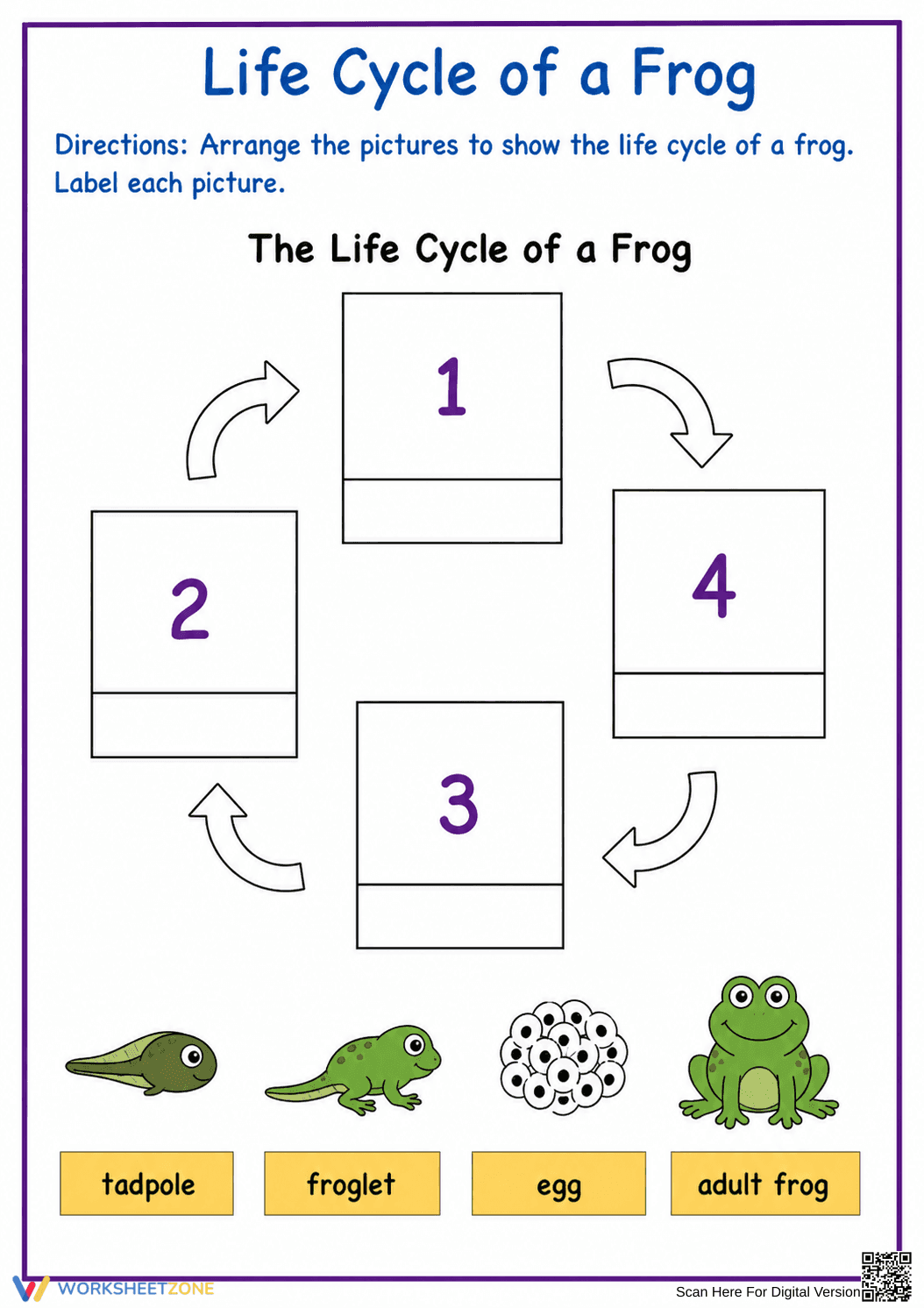

Frog Life Cycle Worksheet | Grade 3 Printable
Paste this activity's link or code into your existing LMS (Google Classroom, Canvas, Teams, Schoology, Moodle, etc.).
Students can open and work on the activity right away, with no student login required.
You'll still be able to track student progress and results from your teacher account.
This Grade 3 frog life cycle worksheet helps students visualize and sequence the biological stages of amphibians. By arranging images and labeling key terms, learners develop a concrete understanding of growth and development. This activity ensures students can identify the transition from egg to adult frog while building essential scientific vocabulary and observation skills.
At a Glance
- Grade: 3 · Subject: Science
- Standard:
3-LS1-1— Develop models to describe that organisms have unique and diverse life cycles- Skill Focus: Frog life cycle sequencing
- Format: 1 page · 4 problems · Answer key included · PDF
- Best For: Independent practice or science centers
- Time: 15–20 minutes
Inside this resource, you will find a single-page activity featuring a circular life cycle diagram with four numbered slots. The worksheet includes four distinct illustrations representing the egg, tadpole, froglet, and adult frog stages. A clear word bank is provided at the bottom to support students in labeling each phase accurately, alongside a comprehensive answer key for quick grading.
The zero-prep workflow for this resource is designed for maximum efficiency. First, print the single-page PDF (30 seconds). Second, distribute the sheets to your class or small group (1 minute). Third, review the completed diagrams using the provided answer key or as a whole-class discussion (5 minutes). This makes it an ideal choice for emergency sub plans or morning work.
This activity aligns with `3-LS1-1`, which requires students to develop models to describe that organisms have unique and diverse life cycles but all have in common birth, growth, reproduction, and death. It also supports ELA standards for following multi-step technical procedures. Both standard codes can be copied directly into lesson plans, IEP goals, or district curriculum mapping tools.
Use this worksheet as a formative assessment after a direct instruction lesson on amphibians. It works well as a "check for understanding" to see if students can differentiate between the tadpole and froglet stages. Expected completion time is 15 to 20 minutes. Observe whether students use the arrows to understand the cyclical nature of the process rather than just linear growth.
This resource is designed for Grade 3 students but is adaptable for Grade 2 or Grade 4 learners needing review. It is particularly effective for visual learners and English Language Learners (ELLs) due to the heavy reliance on pictorial cues. Pair this worksheet with a live classroom observation or a high-quality non-fiction text about pond life.
Research from Fisher & Frey (2014) emphasizes the importance of visual scaffolding and sequencing in developing scientific literacy among elementary students. This frog life cycle worksheet directly addresses the 3-LS1-1 standard by requiring students to construct a model of biological progression. By integrating image-to-text labeling, the activity reinforces the instructional framework, allowing for a gradual release of responsibility as students move from identifying pictures to correctly sequencing the 4 stages of amphibian development. Studies from the NAEP suggest that hands-on modeling of life cycles significantly improves long-term retention of biological concepts compared to passive reading alone. This 1-page PDF provides the structured practice necessary for students to master the vocabulary of egg, tadpole, froglet, and adult frog, ensuring they meet grade-level expectations for describing the diverse life cycles of organisms within their local ecosystems.


