


























Views
Downloads

Frog Life Cycle Labeling Worksheet | Grade 3 Essential
Paste this activity's link or code into your existing LMS (Google Classroom, Canvas, Teams, Schoology, Moodle, etc.).
Students can open and work on the activity right away, with no student login required.
You'll still be able to track student progress and results from your teacher account.
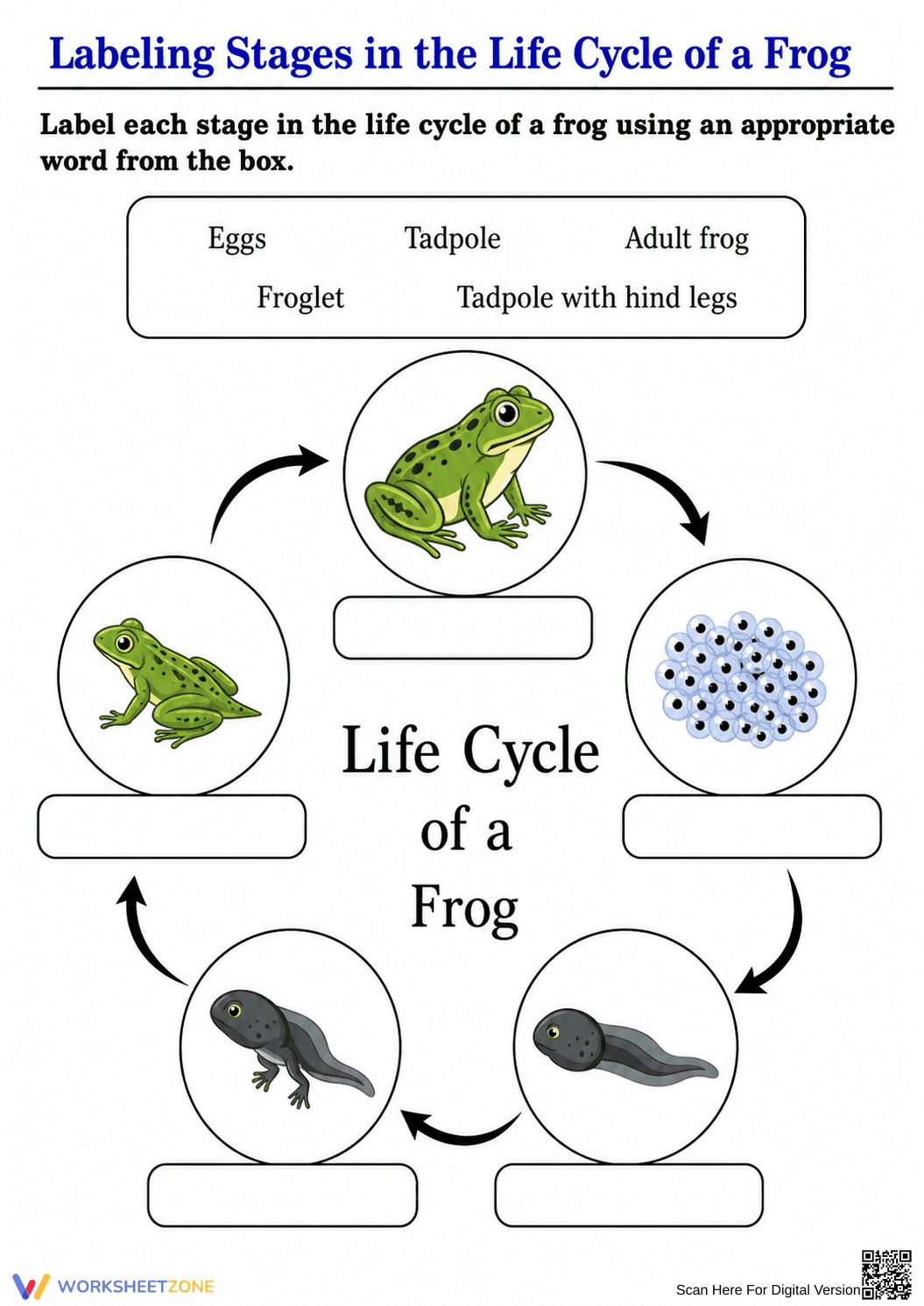
This Grade 3 frog life cycle worksheet helps students identify and sequence the biological stages of an amphibian. By matching vocabulary to visual diagrams, learners develop a concrete understanding of growth and development. It provides a clear, structured way to assess student comprehension of how organisms change over time.
At a Glance
- Grade: 3 · Subject: Science
- Standard:
3-LS1-1— Develop models to describe that organisms have unique and diverse life cycles- Skill Focus: Life cycle sequencing and vocabulary
- Format: 1 page · 5 problems · Answer key included · PDF
- Best For: Introduction to animal biology and metamorphosis
- Time: 10–15 minutes
This single-page PDF features a circular diagram representing the continuous nature of the frog life cycle. It includes five distinct illustrations—eggs, tadpole, tadpole with hind legs, froglet, and adult frog—paired with empty labeling boxes. A clear word bank at the top provides the necessary scientific terminology to support spelling and vocabulary acquisition.
The zero-prep design allows for immediate classroom implementation. Teachers can print the document in under 1 minute, distribute it to the class in 30 seconds, and review the completed diagrams together in 5 minutes. This streamlined workflow makes it an ideal choice for morning work, science centers, or emergency substitute plans.
This resource aligns with `3-LS1-1`: "Develop models to describe that organisms have unique and diverse life cycles but all have in common birth, growth, reproduction, and death." It specifically addresses the "growth" and "reproduction" components of the standard. Both standard codes can be copied directly into lesson plans, IEP goals, or district curriculum mapping tools.
Use this worksheet during the "Explain" phase of a 5E lesson model to solidify vocabulary after an initial observation of live specimens or videos. It also serves as an effective formative assessment tool; observe if students can correctly sequence the transition from tadpole to froglet. Expected completion time is 10 to 15 minutes.
This activity is designed for Grade 3 students but is adaptable for Grade 2 or Grade 4 learners requiring review. It is particularly beneficial for visual learners and English Language Learners (ELLs) who rely on the pictorial cues to connect scientific concepts with new English vocabulary. Pair this with a life cycle anchor chart.
According to the RAND AIRS 2024 report, high-quality visual models are critical for elementary students to internalize complex biological processes like metamorphosis. This worksheet utilizes a circular model to demonstrate the 3-LS1-1 standard, ensuring students recognize that life cycles are continuous rather than linear. By requiring students to label five specific stages—eggs, tadpole, tadpole with hind legs, froglet, and adult frog—the activity reinforces the plain-English skill of identifying how an organism changes throughout its life. Research from Fisher & Frey (2014) suggests that combining word banks with visual diagrams significantly lowers the cognitive load for developing readers, allowing them to focus on the scientific content. This resource provides a structured, evidence-based approach to early biology instruction that is easily integrated into any NGSS-aligned curriculum.


