


























Views
Downloads
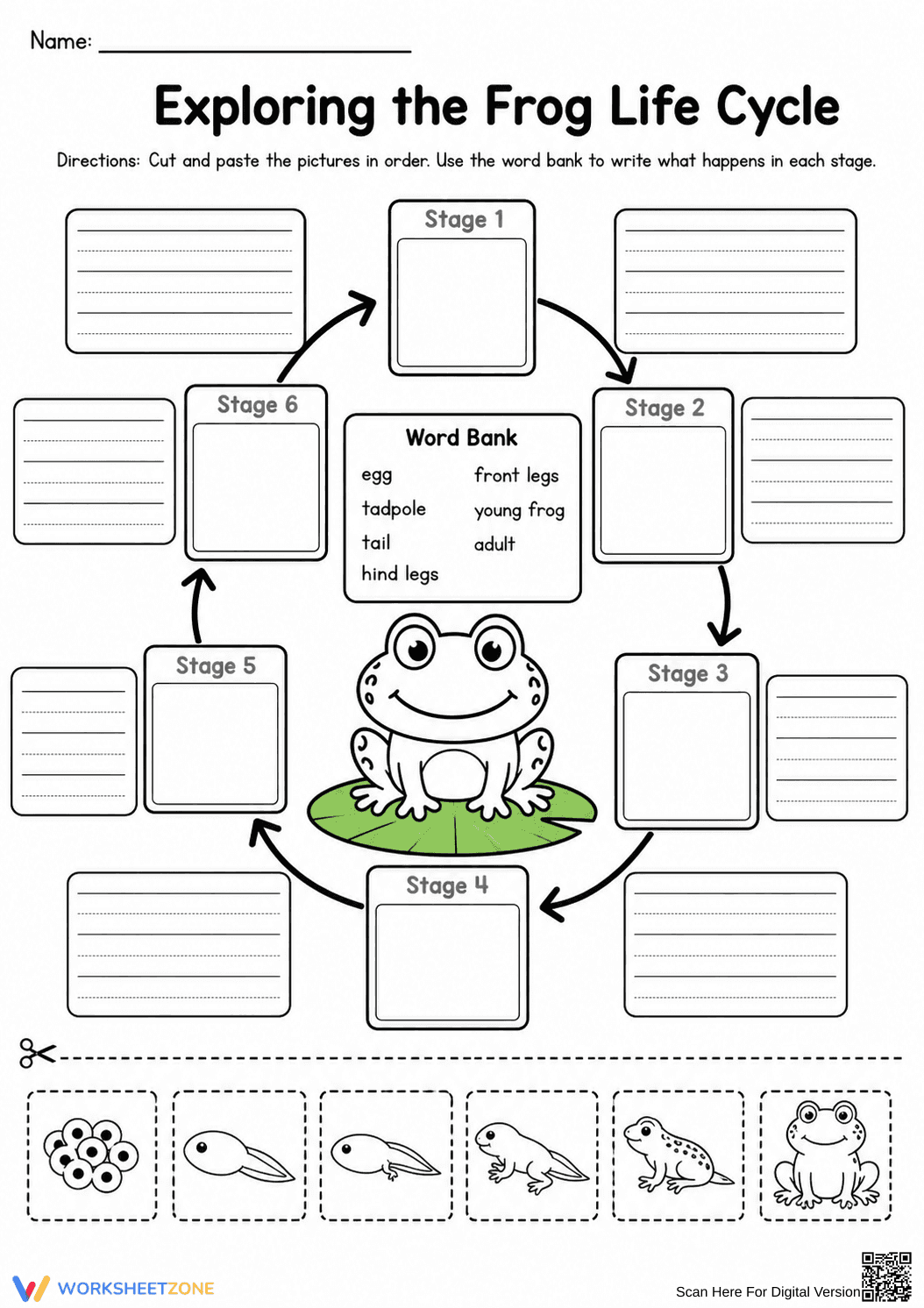

Grade 3 Frog Life Cycle — Printable No-Prep Worksheet
Paste this activity's link or code into your existing LMS (Google Classroom, Canvas, Teams, Schoology, Moodle, etc.).
Students can open and work on the activity right away, with no student login required.
You'll still be able to track student progress and results from your teacher account.
This Grade 3 science worksheet helps students sequence and describe the frog life cycle from egg to adult. By combining a cut-and-paste activity with guided writing prompts, learners actively construct their understanding of amphibian metamorphosis and reinforce essential biology vocabulary.
At a Glance
- Grade: 3 · Subject: Science
- Standard:
3-LS1-1— Develop models to describe organism life cycles- Skill Focus: Sequencing and describing life cycle stages
- Format: 1 page · 6 stages · Answer key included · PDF
- Best For: Independent practice and science centers
- Time: 15–20 minutes
This single-page resource features a circular diagram with six distinct stages of frog development. Students receive six cut-and-paste image tiles representing the egg, tadpole, tadpole with legs, young frog, and adult frog. A built-in word bank provides essential vocabulary, such as "hind legs" and "adult," to support students as they write a brief descriptive sentence for each sequenced stage. A complete answer key is provided for quick grading.
Zero-Prep Workflow
- Print (1 minute): Generate the PDF and print a class set. No special materials are required beyond standard scissors and glue.
- Distribute (1 minute): Hand out the worksheets and direct students to the word bank and cut-out section at the bottom of the page.
- Review (3 minutes): Quickly check the sequenced images before students begin writing their descriptions to ensure accuracy.
Total teacher prep time is under two minutes, making this an excellent, self-contained activity for emergency sub plans or busy science blocks.
This resource is directly aligned to 3-LS1-1: Develop models to describe that organisms have unique and diverse life cycles but all have in common birth, growth, reproduction, and death. By physically arranging the stages and describing the physical changes, students create a functional model of amphibian development. Both standard codes can be copied directly into lesson plans, IEP goals, or district curriculum mapping tools.
Deploy this worksheet during independent practice after a whole-class read-aloud about amphibians. It also functions perfectly as a science center station where students can collaborate to sequence the images before writing their individual descriptions. As a formative assessment tip, observe students while they place the "tadpole with hind legs" versus "front legs" to gauge their attention to developmental details. Expected completion time is 15 to 20 minutes.
This activity is designed for third-grade science students, though it adapts for second-grade learners needing visual supports or fourth-graders reviewing biology concepts. The integrated word bank provides excellent scaffolding for English Language Learners and students requiring vocabulary reinforcement. Pair this worksheet with a non-fiction text about pond habitats or a direct instruction lesson on metamorphosis.
Understanding biological sequencing through visual models is a foundational component of elementary science education. When students engage with standard 3-LS1-1 to develop models to describe organism life cycles, they build critical cognitive frameworks for later biological studies. According to a ScienceDirect TpT Analysis, integrating kinesthetic tasks like cutting and pasting with academic writing significantly improves vocabulary retention in early elementary science learners. By physically manipulating the stages of development before writing about them, students process the information through multiple modalities. This dual-coding approach ensures that complex concepts, such as metamorphosis, become concrete and accessible. The structured use of a word bank further reduces cognitive load, allowing learners to focus entirely on the scientific sequence rather than spelling mechanics. This method provides a reliable pathway to mastering life science standards while supporting diverse learning profiles in the classroom.


