


























Views
Downloads
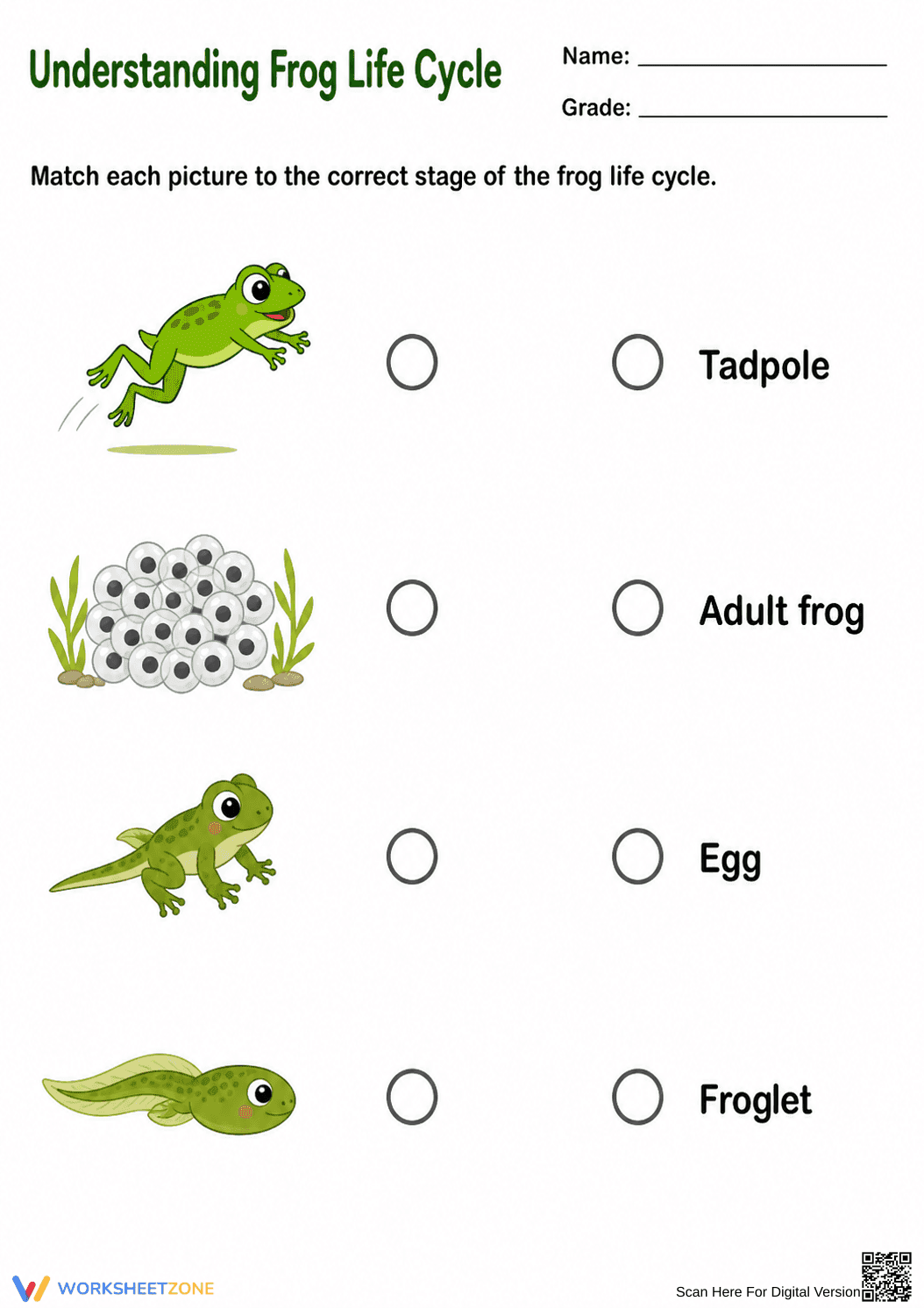

Frog Life Cycle Worksheet | Grade 2 Printable
Paste this activity's link or code into your existing LMS (Google Classroom, Canvas, Teams, Schoology, Moodle, etc.).
Students can open and work on the activity right away, with no student login required.
You'll still be able to track student progress and results from your teacher account.
Identify the stages of amphibian growth with this focused science activity. Students observe detailed illustrations of eggs, tadpoles, froglets, and adult frogs to build foundational biological knowledge. This resource ensures learners can sequence biological development accurately while improving visual discrimination skills through a simple matching interface.
At a Glance
- Grade: 2 · Subject: Science
- Standard:
3-LS1-1— Develop models to describe that organisms have unique and diverse life cycles- Skill Focus: Life cycle stage identification
- Format: 1 page · 4 problems · Answer key included · PDF
- Best For: Quick formative assessment or science centers
- Time: 5–10 minutes
This single-page PDF contains four high-quality illustrations representing the metamorphosis of a frog. Each image is paired with a selection area where students choose between labeled stages: Egg, Tadpole, Froglet, and Adult Frog. The layout includes dedicated fields for student name, date, and grade, making it easy to organize within a classroom portfolio or science journal.
The workflow for this resource is designed for maximum efficiency. First, print the single-page PDF (30 seconds). Next, distribute the sheets to students during your science block or as a morning warm-up (1 minute). Finally, review the answers using the included key or via a quick peer-check (1 minute). Total teacher preparation time is under 2 minutes, making it an ideal choice for substitute folders.
This worksheet aligns with `3-LS1-1`, which requires students to develop models to describe that organisms have unique and diverse life cycles but all have in common birth, growth, reproduction, and death. By identifying the specific physical changes in the frog's metamorphosis, students provide evidence for this biological progression. Both standard codes can be copied directly into lesson plans, IEP goals, or district curriculum mapping tools.
Use this worksheet as a "ticket out the door" after a lesson on amphibians to check for individual understanding. Alternatively, place it in a science center alongside a plastic frog life cycle model set for a tactile-to-visual reinforcement activity. Expected completion time ranges from 5 to 10 minutes depending on the student's reading level and familiarity with the vocabulary.
This resource is ideal for second-grade students beginning their study of animal biology. It provides necessary scaffolding for English Language Learners (ELLs) through clear visual cues and simplified text. It pairs naturally with a non-fiction text about pond habitats or an anchor chart detailing the transition from gills to lungs during the tadpole stage.
According to the RAND AIRS 2024 report on elementary science instruction, visual-to-text matching activities significantly improve the retention of specialized vocabulary in early learners. This worksheet targets the 3-LS1-1 standard by requiring students to differentiate between the four primary stages of amphibian metamorphosis: egg, tadpole, froglet, and adult. By isolating these stages, the resource helps students construct a mental model of biological growth and development. Research from Fisher & Frey (2014) suggests that such focused, single-page assessments are highly effective for formative data collection without overwhelming young students. The clear illustrations serve as non-linguistic representations that support diverse learners in mastering complex biological concepts. This printable PDF provides a reliable, evidence-based tool for teachers to verify student mastery of life cycle sequences in a time-efficient manner.


