


























Views
Downloads

Negative Adjectives Worksheet | Grade 6 Printable
Paste this activity's link or code into your existing LMS (Google Classroom, Canvas, Teams, Schoology, Moodle, etc.).
Students can open and work on the activity right away, with no student login required.
You'll still be able to track student progress and results from your teacher account.
This printable negative adjectives worksheet helps fifth and sixth-grade students expand their descriptive vocabulary and accurately express complex character traits. By moving from basic definitions to applied writing, learners develop the precise language needed to analyze literature and improve their own creative writing pieces.
At a Glance
- Grade: 6 · Subject: ELA
- Standard:
CCSS.ELA-LITERACY.L.6.6— Acquire and use accurately grade-appropriate vocabulary.- Skill Focus: Negative Adjectives & Character Traits
- Format: 3 pages · 15 problems · Answer key included · PDF
- Best For: Independent practice and vocabulary building
- Time: 25–35 minutes
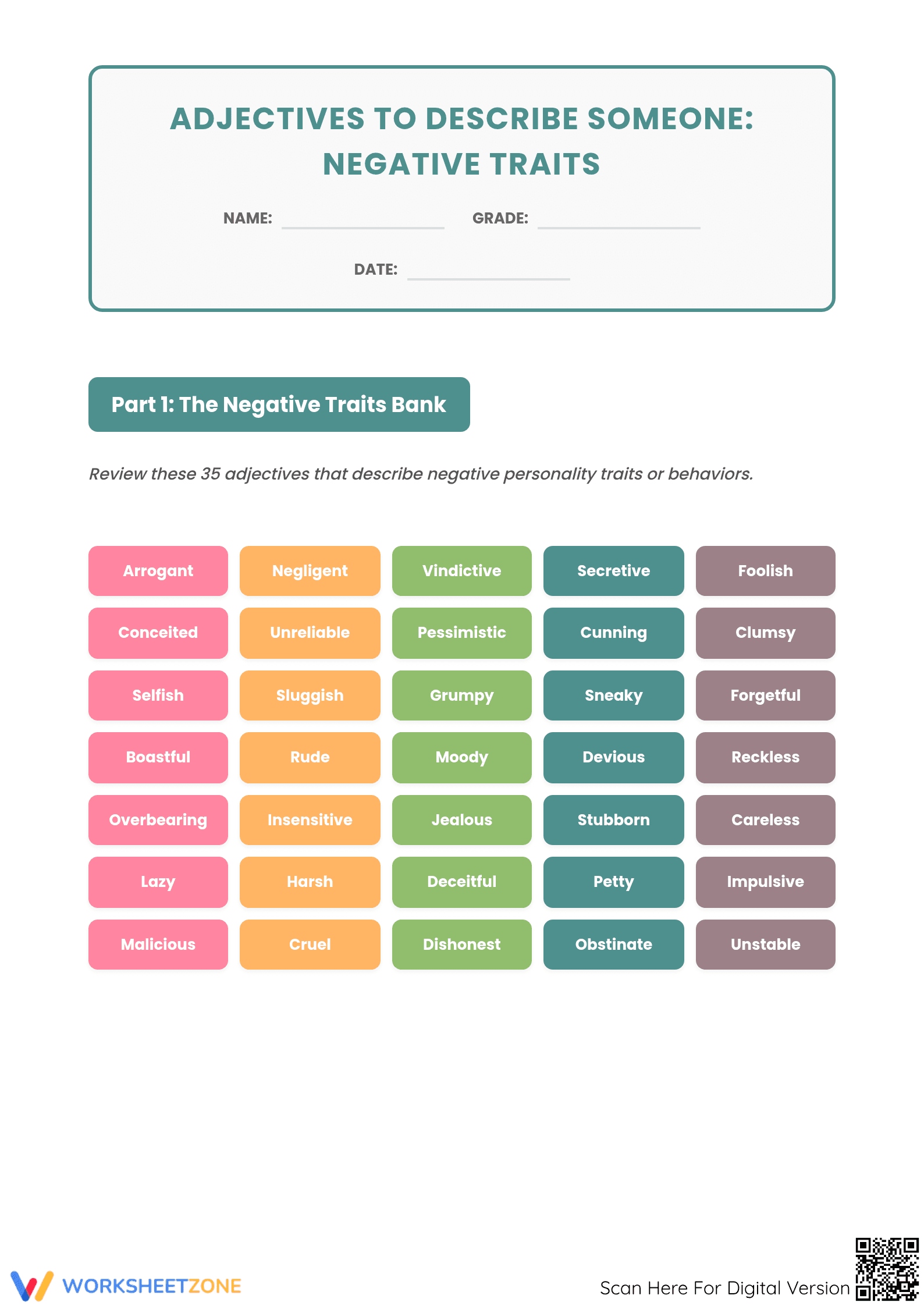
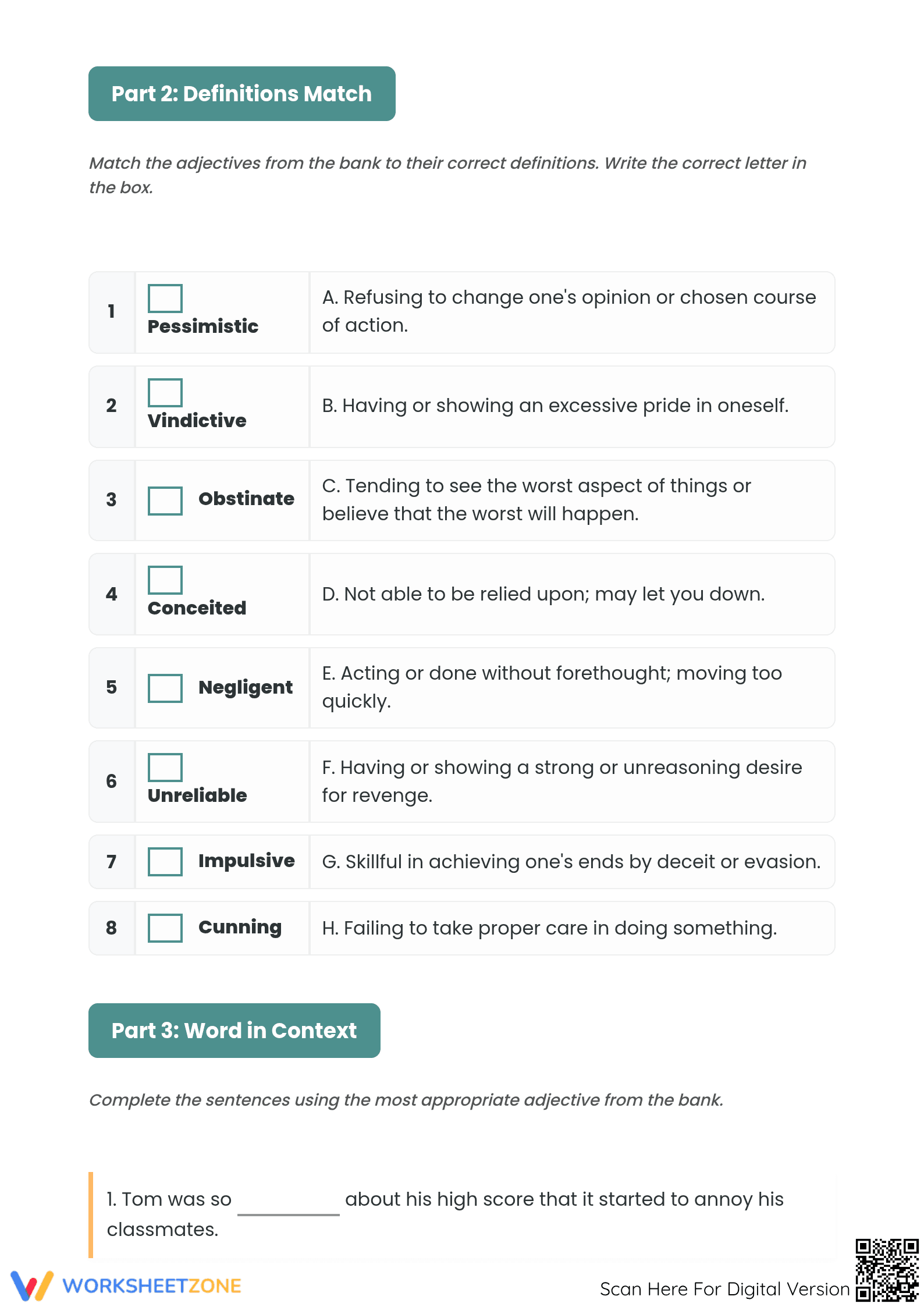
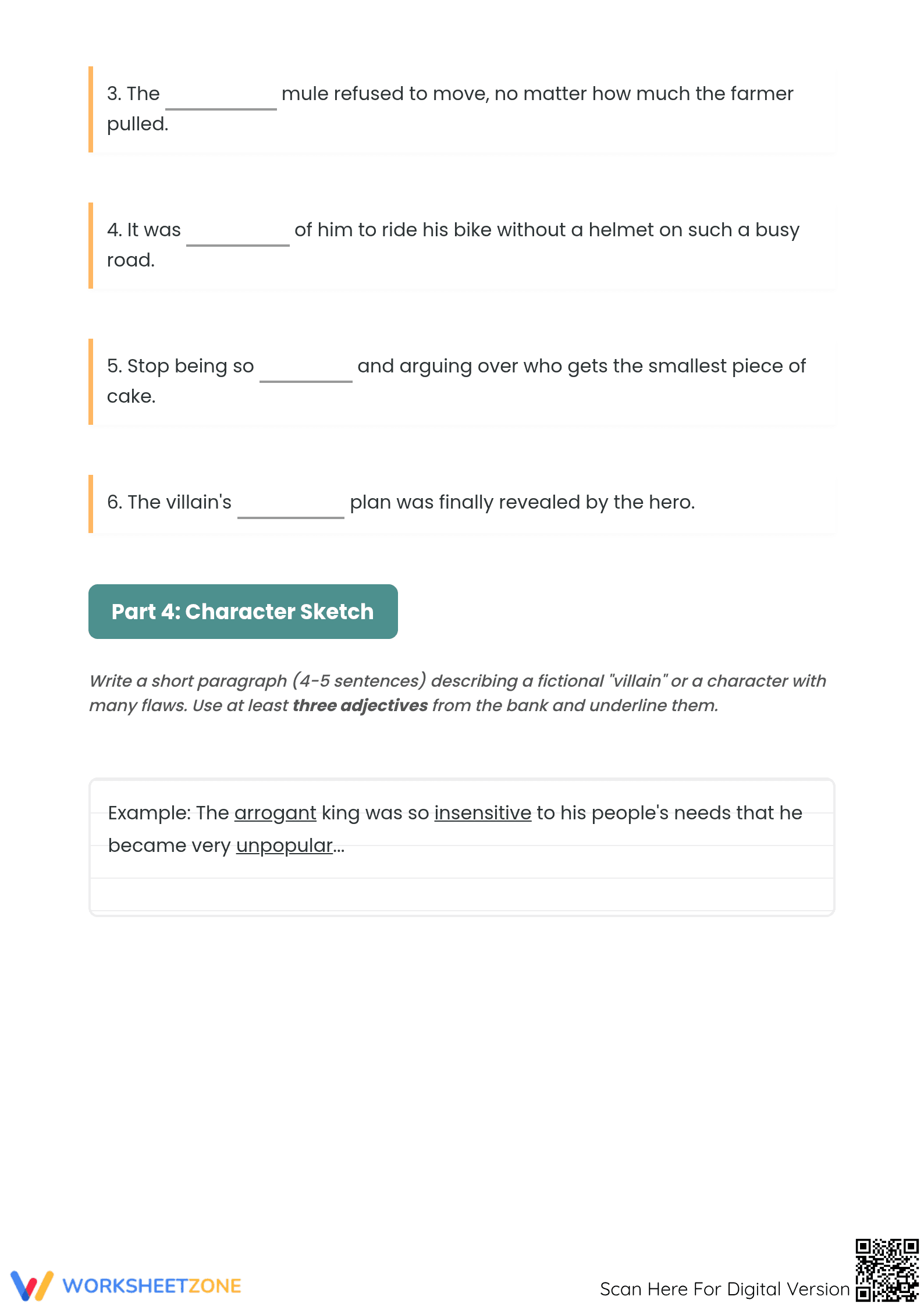
Inside this comprehensive resource, educators will find a structured three-page activity set designed to reinforce new vocabulary. The worksheet features a robust 35-word negative traits bank, an eight-question definition matching section, six fill-in-the-blank context sentences, and a short character sketch writing prompt. A complete answer key is provided to ensure quick and accurate grading.
- Guided practice: Students begin by reviewing the comprehensive word bank and matching eight specific adjectives, such as "vindictive" and "obstinate," to their exact definitions.
- Supported practice: Learners then apply their knowledge by selecting the correct adjective from the bank to complete six contextual sentences, relying on context clues for accuracy.
- Independent practice: Finally, students write a short, original paragraph describing a fictional villain, requiring them to use and underline at least three negative adjectives correctly.
This gradual-release approach ensures students build confidence before applying new vocabulary independently.
Aligned to CCSS.ELA-LITERACY.L.6.6, this resource requires students to acquire and use accurately grade-appropriate general academic and domain-specific words and phrases. It also supports reading comprehension by helping students gather vocabulary knowledge when considering a word or phrase important to expression. Both standard codes can be copied directly into lesson plans, IEP goals, or district curriculum mapping tools.
This worksheet is highly effective when used after direct instruction on characterization or during a creative writing unit. Teachers can assign the matching and context sections as independent classwork, reserving the character sketch for a homework assignment or peer-review activity. As a formative assessment tip, review the final writing prompt to ensure students are using the adjectives with the correct nuance and tone, rather than just inserting them randomly. Expected completion time is 25 to 35 minutes.
This resource is designed for fifth and sixth-grade general education students, but it also serves as an excellent tool for English Language Learners needing explicit vocabulary instruction. To differentiate for students needing extra support, teachers can pre-select a smaller group of words from the bank. It pairs perfectly with a character analysis anchor chart or a novel study focusing on complex antagonists.
Explicit vocabulary instruction is a critical component of reading comprehension and effective communication. By targeting specific descriptive words, this resource aligns with CCSS.ELA-LITERACY.L.6.6, which requires students to acquire and use accurately grade-appropriate vocabulary. According to Fisher & Frey (2014), providing students with multiple exposures to new words across different contexts—such as matching definitions, completing sentences, and generating original text—significantly increases long-term retention and expressive language capabilities. This worksheet's structured progression from recognition to application ensures that learners do not merely memorize definitions but actually integrate these negative adjectives into their active working vocabulary. By analyzing and describing character flaws, students develop a deeper understanding of human behavior and literary elements, ultimately strengthening both their analytical reading and creative writing skills.


