


























Views
Downloads

Letter Q Writing Practice | Grade K-1 Printable Worksheet
Paste this activity's link or code into your existing LMS (Google Classroom, Canvas, Teams, Schoology, Moodle, etc.).
Students can open and work on the activity right away, with no student login required.
You'll still be able to track student progress and results from your teacher account.
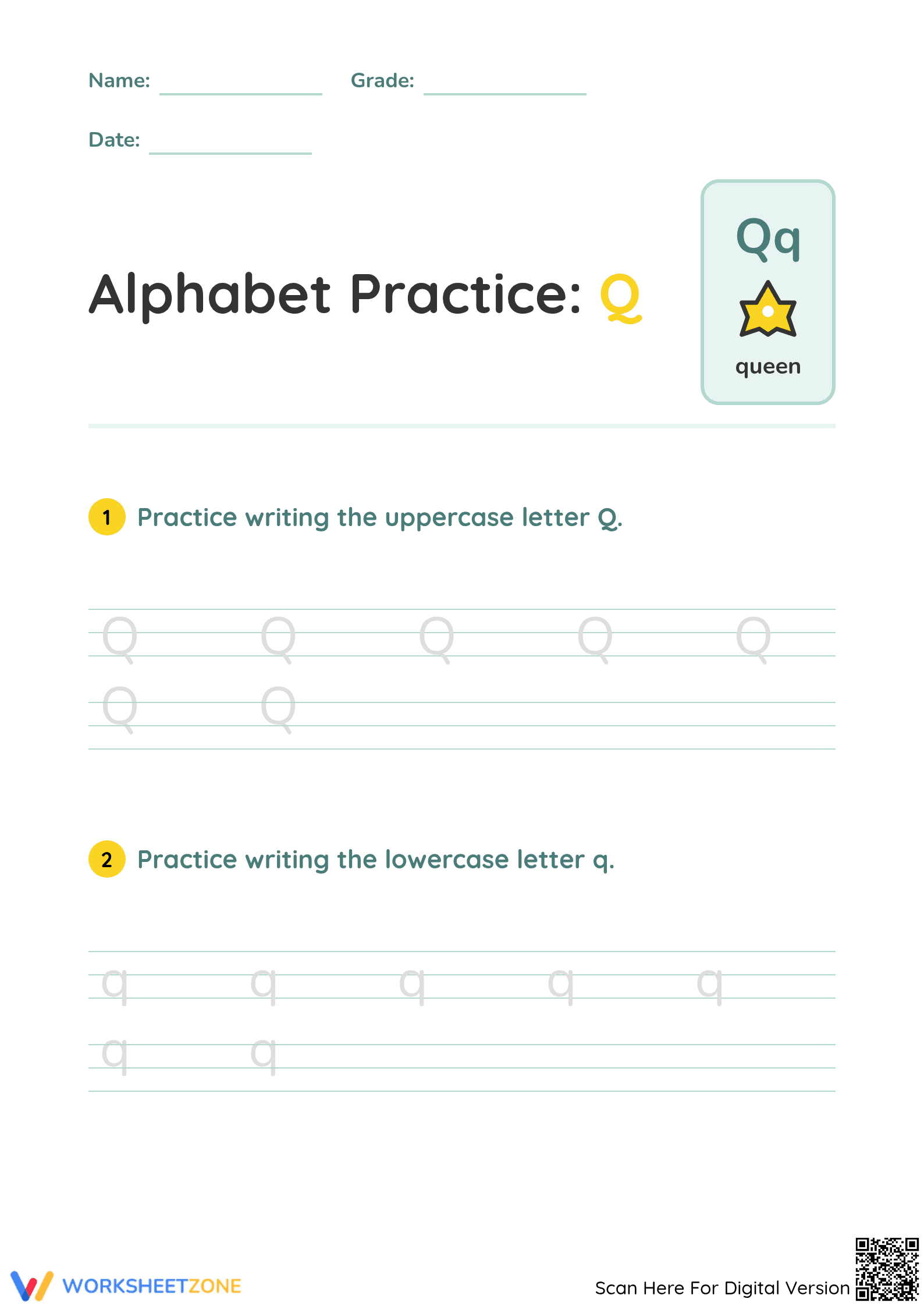
This Grade K-1 letter Q worksheet provides students with comprehensive practice in letter formation, phonics, and visual discrimination. Students master the uppercase and lowercase Q through guided tracing and creative application. By connecting the letter shape to beginning sounds, learners build the foundational literacy skills necessary for early reading and writing success.
At a Glance
- Grade: K-1 · Subject: English
- Standard:
L.K.1.A— Print many upper- and lowercase letters accurately and legibly- Skill Focus: Letter Q formation and identification
- Format: 2 pages · 4 problems · Answer key included · PDF
- Best For: Daily morning work or phonics centers
- Time: 15–20 minutes
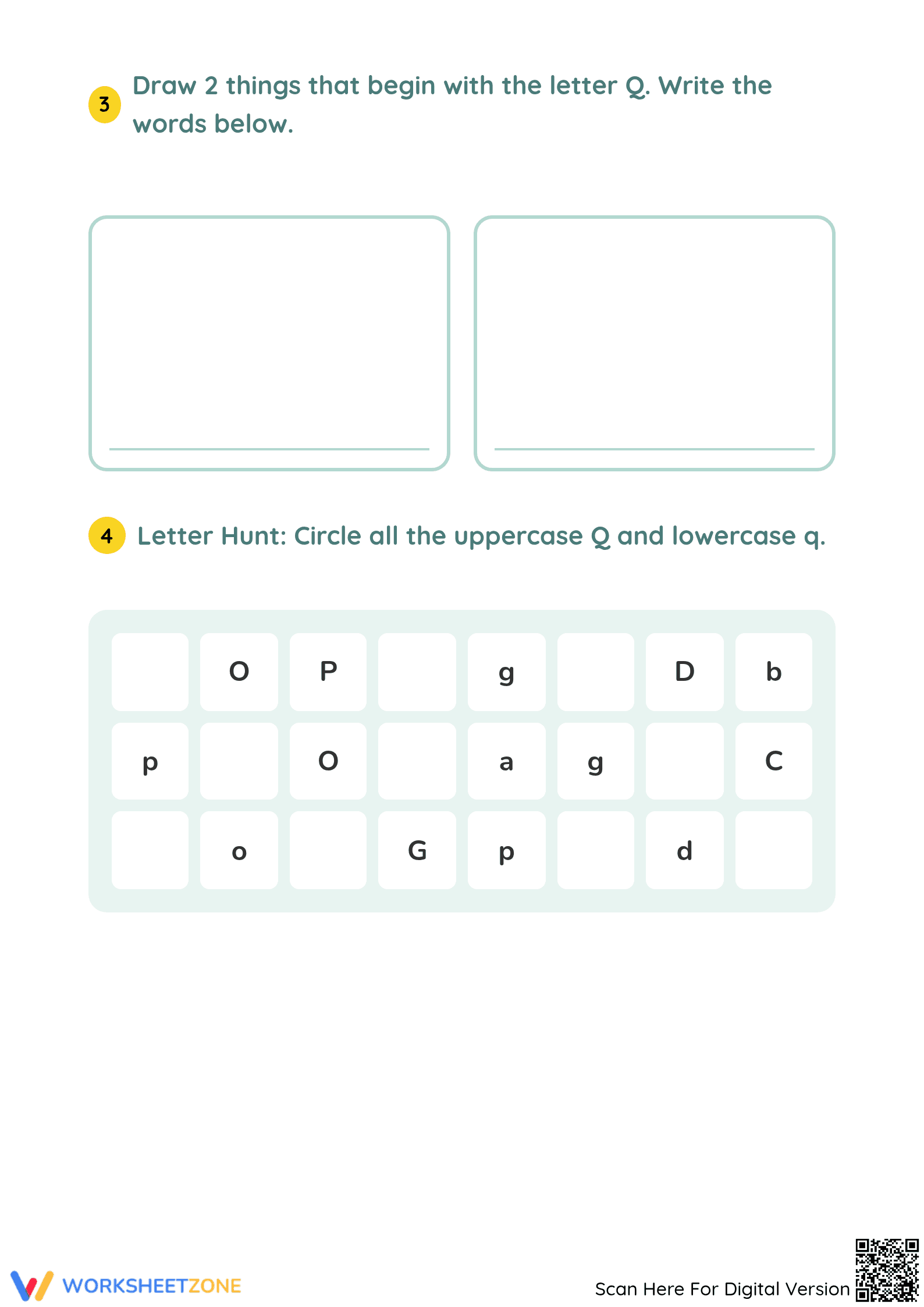
This two-page resource features four distinct activities designed for early learners. The first page focuses on fine motor development with dedicated tracing lines for both uppercase Q and lowercase q. The second page expands into phonics and visual scanning, including a creative drawing space for vocabulary and a Letter Hunt grid to reinforce letter recognition among distractors.
The workflow for this resource is designed for maximum efficiency. First, print the two-page PDF (30 seconds). Next, distribute the sheets to students during your phonics block or as a quiet morning activity (1 minute). Finally, use the included answer key to review the Letter Hunt and vocabulary drawing during a quick whole-class check (1 minute). Total teacher preparation time is under 2 minutes.
Standards Alignment
This worksheet is primarily aligned with `L.K.1.A`, which requires students to print many upper- and lowercase letters. It also supports `RF.K.1.D` by helping students recognize and name all upper- and lowercase letters of the alphabet. Both standard codes can be copied directly into lesson plans, IEP goals, or district curriculum mapping tools.
How to Use It
Use this worksheet during the independent practice phase of a direct instruction lesson on the alphabet. It serves as an excellent formative assessment tool; observe students as they trace to ensure they are following the correct stroke order for the letter Q. The expected completion time ranges from 15 to 20 minutes depending on the student's fine motor speed.
Who It's For
This resource is ideal for Kindergarten students first learning the alphabet and Grade 1 students requiring handwriting intervention. It pairs naturally with an alphabet anchor chart or a beginning sounds picture book. For students needing more support, provide a highlighter for them to trace over before using a pencil to complete the tasks.
According to the NAEP framework for early literacy, the ability to fluently produce letter forms is a significant predictor of later writing quality and reading fluency. This worksheet targets L.K.1.A by providing structured tracing and identification tasks for the letter Q, a less frequent but essential character in English orthography. Research from Fisher & Frey (2014) emphasizes that gradual release through guided tracing helps solidify muscle memory in emergent writers. By combining tactile tracing with visual discrimination in the Letter Hunt section, this resource addresses multiple learning modalities. The inclusion of a drawing task further bridges the gap between phonemic awareness and grapheme representation. Educators can utilize this 2-page set to provide the 15-20 minutes of daily handwriting practice recommended for primary grades to ensure students meet foundational CCSS benchmarks.


