


























Views
Plays



Essential Grade 3 Spanish Grammar: Hiatos & Infinitivos
Paste this activity's link or code into your existing LMS (Google Classroom, Canvas, Teams, Schoology, Moodle, etc.).
Students can open and work on the activity right away, with no student login required.
You'll still be able to track student progress and results from your teacher account.
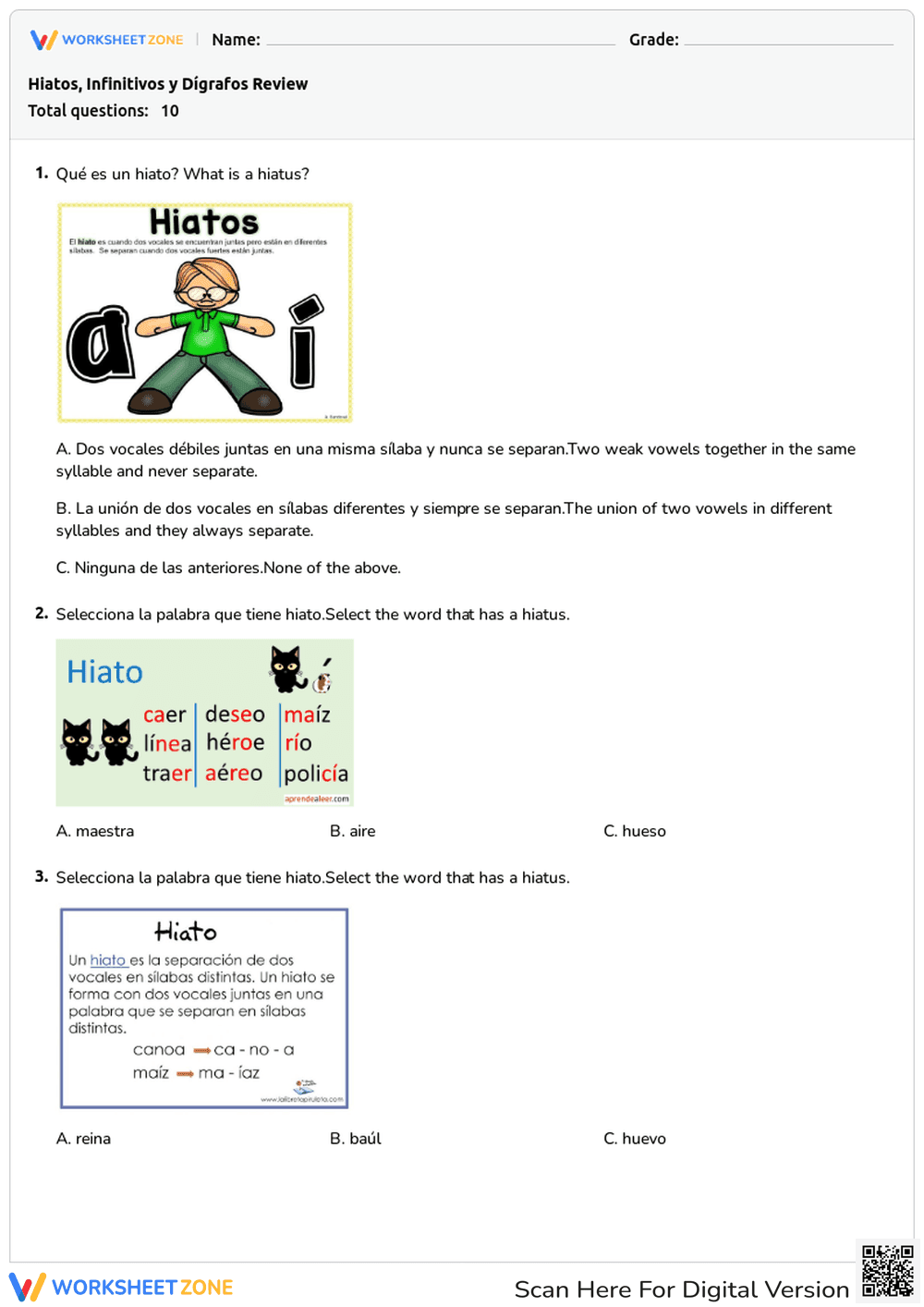
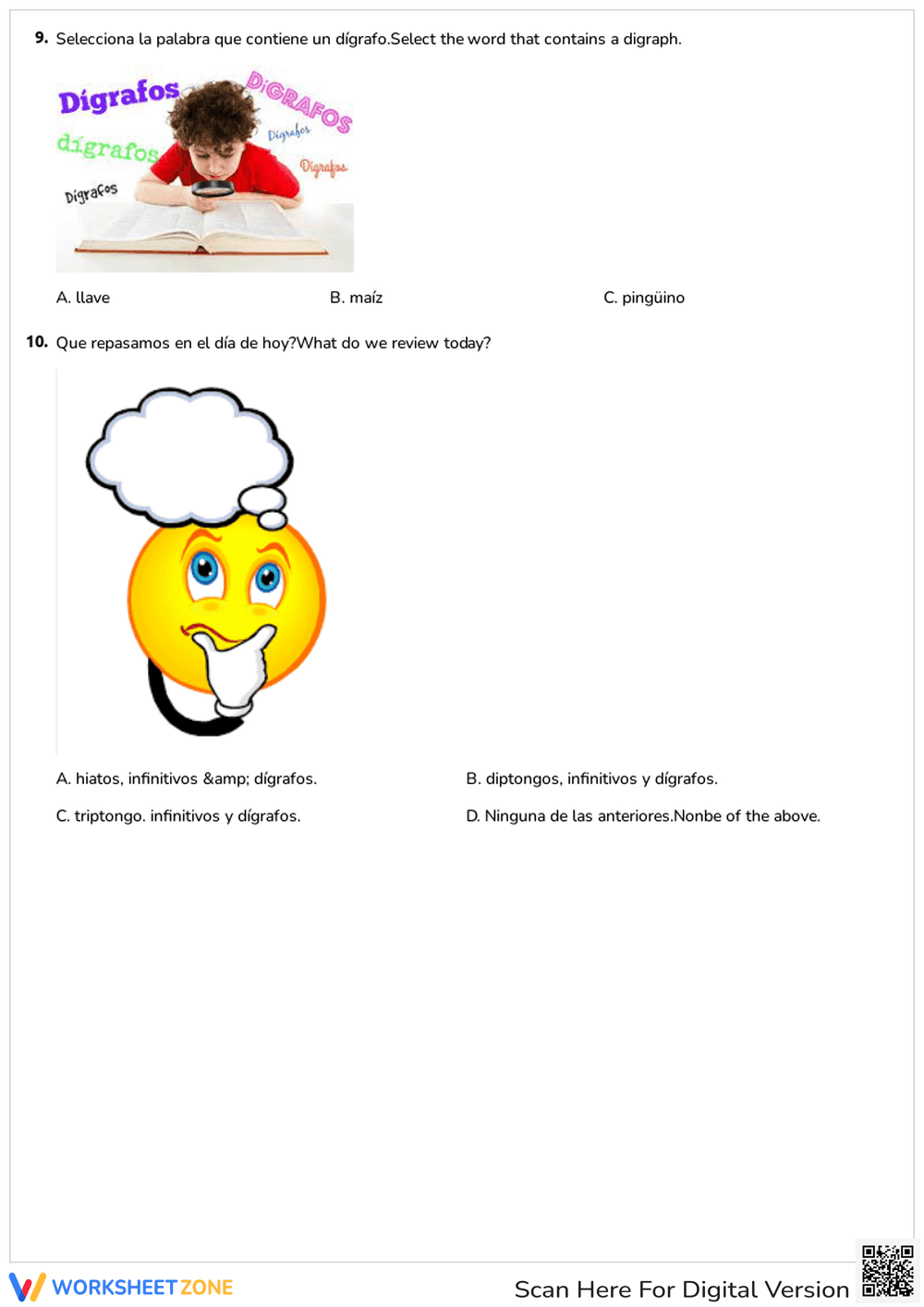
This Grade 3 Spanish grammar worksheet provides a comprehensive review of hiatos, infinitivos, and dígrafos through 10 targeted multiple-choice questions. Students demonstrate their ability to identify vowel separations, recognize base verb forms, and distinguish specific letter combinations that produce single sounds. It is an effective tool for reinforcing foundational literacy skills in bilingual or dual-language settings.
At a Glance
- Grade: 3 · Subject: ELA & Spanish Grammar
- Standard:
CCSS.ELA-LITERACY.L.3.2— Use conventional spelling patterns and generalizations in writing words- Skill Focus: Hiatus, Infinitives, and Digraphs
- Format: 4 pages · 10 problems · Answer key included · PDF
- Best For: Quick formative assessment or sub plans
- Time: 15–20 minutes
The resource consists of a 4-page PDF featuring 10 structured questions. Each section includes visual aids and bilingual instructions to support student comprehension. The worksheet covers the definition of a hiatus, identification of infinitive endings (-ar, -er, -ir), and the recognition of Spanish digraphs like "ch," "ll," and "rr." A full answer key is provided for rapid grading and immediate feedback.
The zero-prep design allows for immediate classroom implementation. First, print the 4-page document (30 seconds). Second, distribute the worksheets to students for independent or guided practice (1 minute). Finally, use the included answer key to review responses as a whole group or for individual grading (5 minutes). This streamlined workflow makes it an ideal choice for emergency sub plans or end-of-unit reviews where teacher time is limited.
This worksheet is primarily aligned with `CCSS.ELA-LITERACY.L.3.2`, which requires students to demonstrate command of the conventions of standard grammar, capitalization, punctuation, and spelling. It specifically targets the understanding of word patterns and phonics generalizations within the Spanish language. Both standard codes can be copied directly into lesson plans, IEP goals, or district curriculum mapping tools to ensure instructional compliance.
Use this worksheet as a formative assessment after a direct instruction lesson on Spanish phonics. It serves as an excellent exit ticket to gauge student mastery of vowel sounds and verb structures. Alternatively, assign it as a center activity where students work in pairs to justify their multiple-choice selections. Expected completion time is approximately 15 to 20 minutes depending on student proficiency and prior exposure to the concepts.
This resource is designed for Grade 3 and Grade 4 students in bilingual, ESL, or Spanish immersion programs. It provides necessary scaffolding for English Language Learners (ELLs) through bilingual prompts and clear visual examples. It pairs naturally with Spanish anchor charts or interactive notebooks focusing on "Las Vocales" and "Los Verbos" to provide a cohesive learning experience.
Research from the RAND AIRS 2024 report emphasizes that structured phonics review is critical for developing decoding automaticity in multi-language learners. By isolating specific linguistic features such as hiatos and dígrafos, this worksheet aligns with evidence-based practices for orthographic development. The inclusion of infinitives further bridges the gap between phonics and functional grammar, a key component of the CCSS.ELA-LITERACY.L.3.2 standard. According to Fisher & Frey (2014), the use of clear, visual-supported assessments allows teachers to identify specific misconceptions in word patterns before they become ingrained. This 10-question review provides the necessary data points for educators to adjust instruction in real-time. The bilingual format ensures that students can access complex grammatical concepts in their primary language while building academic vocabulary. This resource serves as a reliable tool for achieving mastery in foundational Spanish literacy skills.


