


























Views
Plays
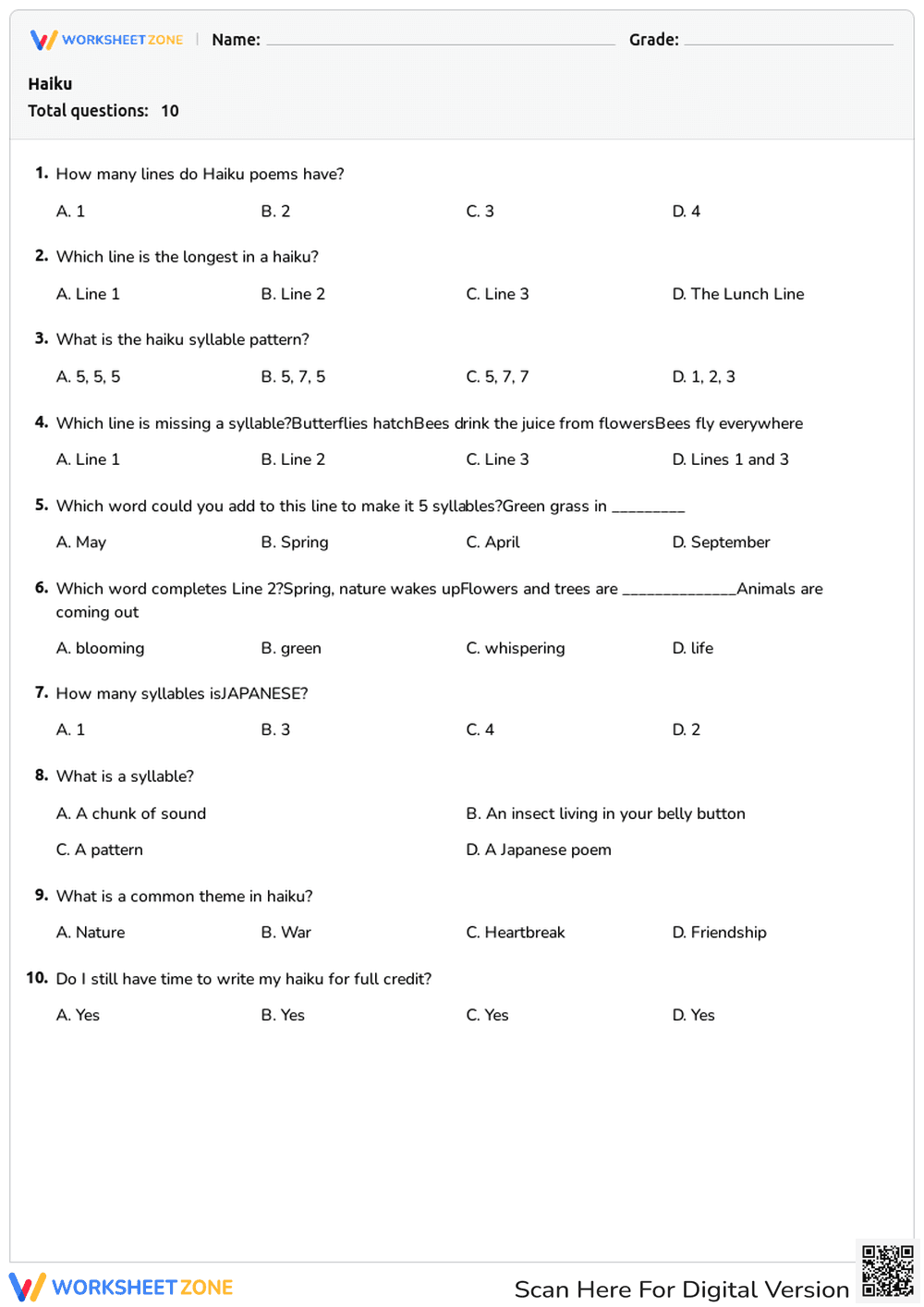

Haiku Poetry Structure Worksheet | Grade 2 Essential
Paste this activity's link or code into your existing LMS (Google Classroom, Canvas, Teams, Schoology, Moodle, etc.).
Students can open and work on the activity right away, with no student login required.
You'll still be able to track student progress and results from your teacher account.
This Grade 2 haiku worksheet provides a structured approach to understanding Japanese poetic forms. Students identify the specific syllable counts and line structures required to compose traditional haiku. By completing these 10 targeted questions, learners demonstrate mastery over the 5-7-5 rhythmic pattern and common nature-based themes essential for early poetry units.
At a Glance
- Grade: 2 · Subject: ELA Poetry
- Standard:
CCSS.ELA-LITERACY.RL.2.4— Describe how words and phrases supply rhythm and meaning in a poem- Skill Focus: Haiku structure and syllable counting
- Format: 1 page · 10 problems · Answer key included · PDF
- Best For: Quick formative assessment or poetry introduction
- Time: 10–15 minutes
The worksheet features 10 multiple-choice questions designed to evaluate a student's grasp of poetic mechanics. It includes specific tasks where students must count syllables in words like "Japanese" and identify missing words to complete a 5-syllable line. The layout is clean and distraction-free, ensuring that young writers can focus on the linguistic patterns without visual overwhelm.
This resource is designed for a zero-prep classroom workflow. Teachers can print the single-page PDF in less than 30 seconds. Distribution takes approximately 1 minute, and because the questions are multiple-choice, the review process can be completed as a whole-class activity in under 5 minutes. It serves as an ideal sub plan or a transition activity between reading and creative writing blocks.
This resource aligns with CCSS.ELA-LITERACY.RL.2.4, which requires students to describe how words and phrases supply rhythm and meaning in a poem. By focusing on the 5-7-5 syllable constraint, students learn how structural limitations create the unique rhythm of the haiku genre. Both standard codes can be copied directly into lesson plans, IEP goals, or district curriculum mapping tools.
Use this worksheet as a formative assessment after a direct instruction lesson on syllables and poetry. It works best during the guided practice phase of a writing workshop. Teachers should observe students as they tap out syllables for question 7; if students struggle to identify "Japanese" as three syllables, it indicates a need for further phonics intervention before they begin writing their own poems.
This worksheet is intended for Grade 2 and Grade 3 students, though it provides excellent scaffolding for English Language Learners (ELL) who are practicing phonological awareness. It pairs naturally with a nature-themed mentor text or a syllable anchor chart. The inclusion of a theme question helps students connect structural rules to the broader purpose of the poetic genre.
Understanding the structural constraints of poetry, such as the 5-7-5 syllable pattern in haiku, is a foundational step in developing phonological awareness and rhythmic literacy. This worksheet utilizes the CCSS.ELA-LITERACY.RL.2.4 standard to bridge the gap between simple word recognition and the appreciation of poetic form. By requiring students to identify missing syllables and determine line lengths, the resource reinforces the chunking of sounds, a critical skill in early ELA development. According to Fisher & Frey (2014), scaffolded practice with structural elements allows students to internalize complex linguistic patterns before moving toward independent creative production. This 10-question assessment provides the necessary data for teachers to gauge student readiness for original composition. The focus on nature themes further aligns with traditional haiku conventions, ensuring that students learn both the technical and thematic requirements of the genre in a single, efficient session.


