


























Views
Plays



Narrative Essay Structure Quiz | Grade 3 Essential
Paste this activity's link or code into your existing LMS (Google Classroom, Canvas, Teams, Schoology, Moodle, etc.).
Students can open and work on the activity right away, with no student login required.
You'll still be able to track student progress and results from your teacher account.
This Grade 3 narrative essay worksheet provides students with 10 targeted multiple-choice questions to master the fundamental components of storytelling and essay organization. By identifying key structural elements like introductions and conclusions, learners build the foundational knowledge necessary for coherent nonfiction and creative writing. This resource simplifies complex writing concepts into manageable, assessable tasks.
At a Glance
- Grade: 3 · Subject: ELA Writing
- Standard:
CCSS.ELA-LITERACY.W.3.3— Organize narrative sequences that unfold naturally using temporal words and phrases- Skill Focus: Essay Structure & Grammar
- Format: 4 pages · 10 problems · Answer key included · PDF
- Best For: Formative assessment or quick review
- Time: 15–20 minutes
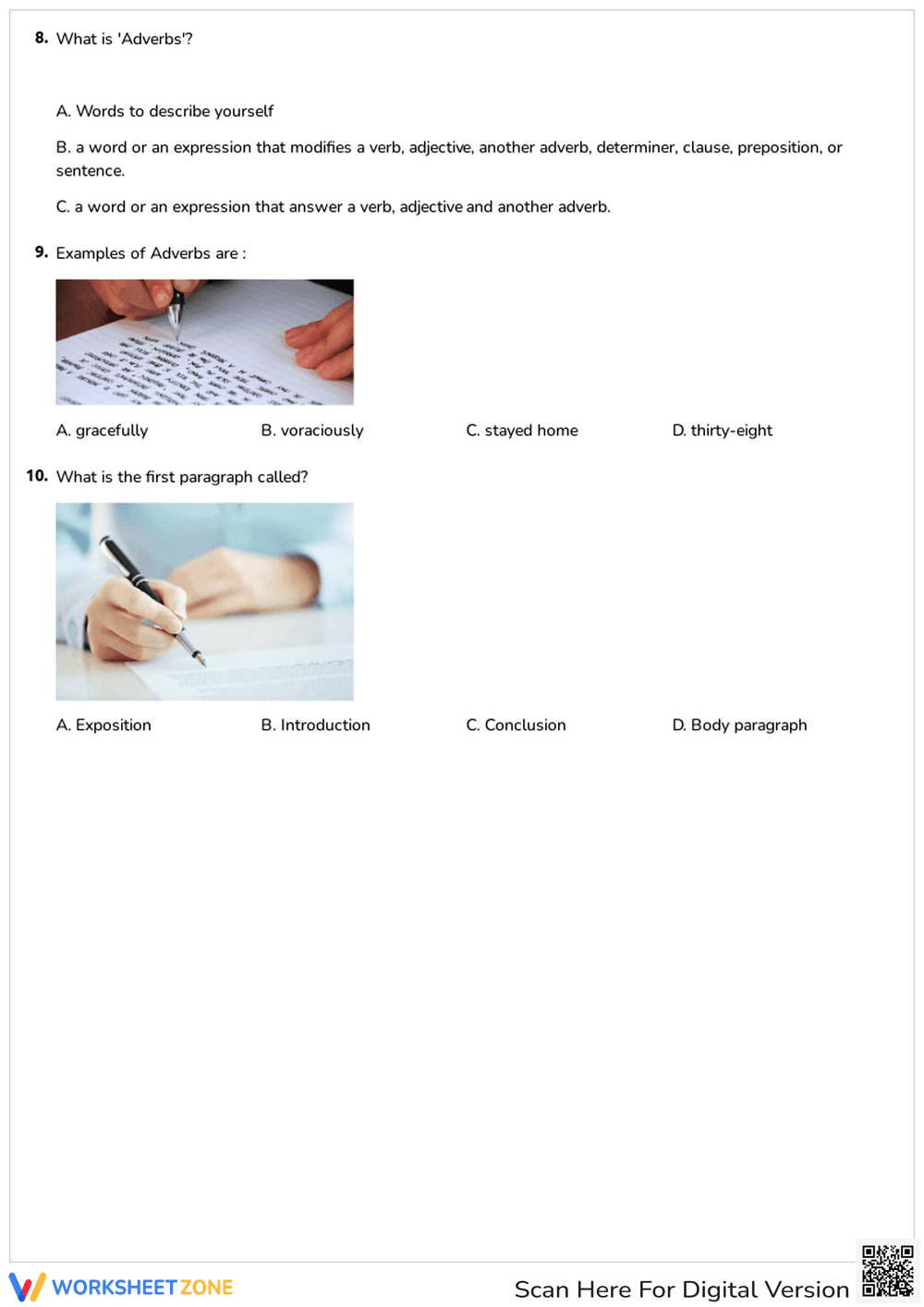
The resource contains a comprehensive 4-page quiz featuring 10 multiple-choice questions. Each question is paired with visual cues or instructional graphics to support student comprehension. The content covers paragraph naming conventions, the purpose of restating claims in a conclusion, the use of sentence connectors for coherence, and the identification of adverbs. A full answer key is provided for rapid grading and immediate student feedback.
This worksheet is designed for immediate classroom implementation with a total teacher prep time of under 2 minutes. Simply print the 4-page PDF (1 minute), distribute it to your students for independent work (30 seconds), and use the included answer key for a lightning-fast review or peer-grading session (30 seconds). It serves as an ideal sub plan or "bell-ringer" activity for busy ELA blocks.
This resource is primary aligned to `CCSS.ELA-LITERACY.W.3.3`, which requires students to write narratives to develop real or imagined experiences or events using effective technique, descriptive details, and clear event sequences. It also supports `CCSS.ELA-LITERACY.L.3.1` through its focus on adverbs and sentence connectors. Both standard codes can be copied directly into lesson plans, IEP goals, or district curriculum mapping tools.
Use this worksheet as a formative assessment after a direct instruction lesson on the "hamburger" essay model or narrative arcs. It is particularly effective during the "You Do" phase of a gradual release model. Teachers should observe if students can correctly identify the "Conclusion" as the final paragraph, as this indicates readiness for independent drafting. Expected completion time is 15 to 20 minutes for most third-grade learners.
This quiz is tailored for Grade 3 students but is highly effective for Grade 4 or 5 learners requiring a refresher on organizational terminology. It provides excellent support for English Language Learners (ELLs) through its use of visual aids and clear definitions of grammar terms like "Sentence Connectors." Pair this with a narrative graphic organizer or a mentor text analysis to reinforce the concepts of coherence and structure.
Research by Fisher & Frey (2014) emphasizes that student mastery of writing organization is significantly improved when structural terminology is explicitly taught and assessed through retrieval practice. This worksheet leverages that principle by requiring students to recall the specific functions of introductions and conclusions within a narrative framework. By aligning with CCSS.ELA-LITERACY.W.3.3, the 10-question format ensures that learners can distinguish between different paragraph roles and the grammatical tools, such as adverbs and connectors, that create coherence. According to the NAEP writing framework, early exposure to these organizational concepts is a strong predictor of later proficiency in complex essay composition. This resource provides the necessary scaffolding to move students from basic sentence construction to structured, multi-paragraph writing, ensuring they are prepared for the rigorous demands of upper-elementary ELA standards and standardized testing environments.


