




























Views
Downloads

English-Speaking Countries: Printable Grade 7 Worksheet

Paste this activity's link or code into your existing LMS (Google Classroom, Canvas, Teams, Schoology, Moodle, etc.).
Students can open and work on the activity right away, with no student login required.
You'll still be able to track student progress and results from your teacher account.
This Grade 7 research worksheet helps students investigate global English-speaking countries through structured inquiry. Students gather key facts about national flags, locations, languages, citizens, and unique cultural details. This template guides learners to synthesize information from multiple sources, building essential informational writing and vocabulary skills.
At a Glance
- Grade: Grade 7 · Subject: ELA & Vocabulary
- Standard:
CCSS.ELA-LITERACY.W.7.7— Conduct short research projects using multiple sources- Skill Focus: Country research and vocabulary
- Format: 1 page · 5 research prompts · No answer key · PDF
- Best For: Independent research and social studies
- Time: 30–45 minutes
What's Inside
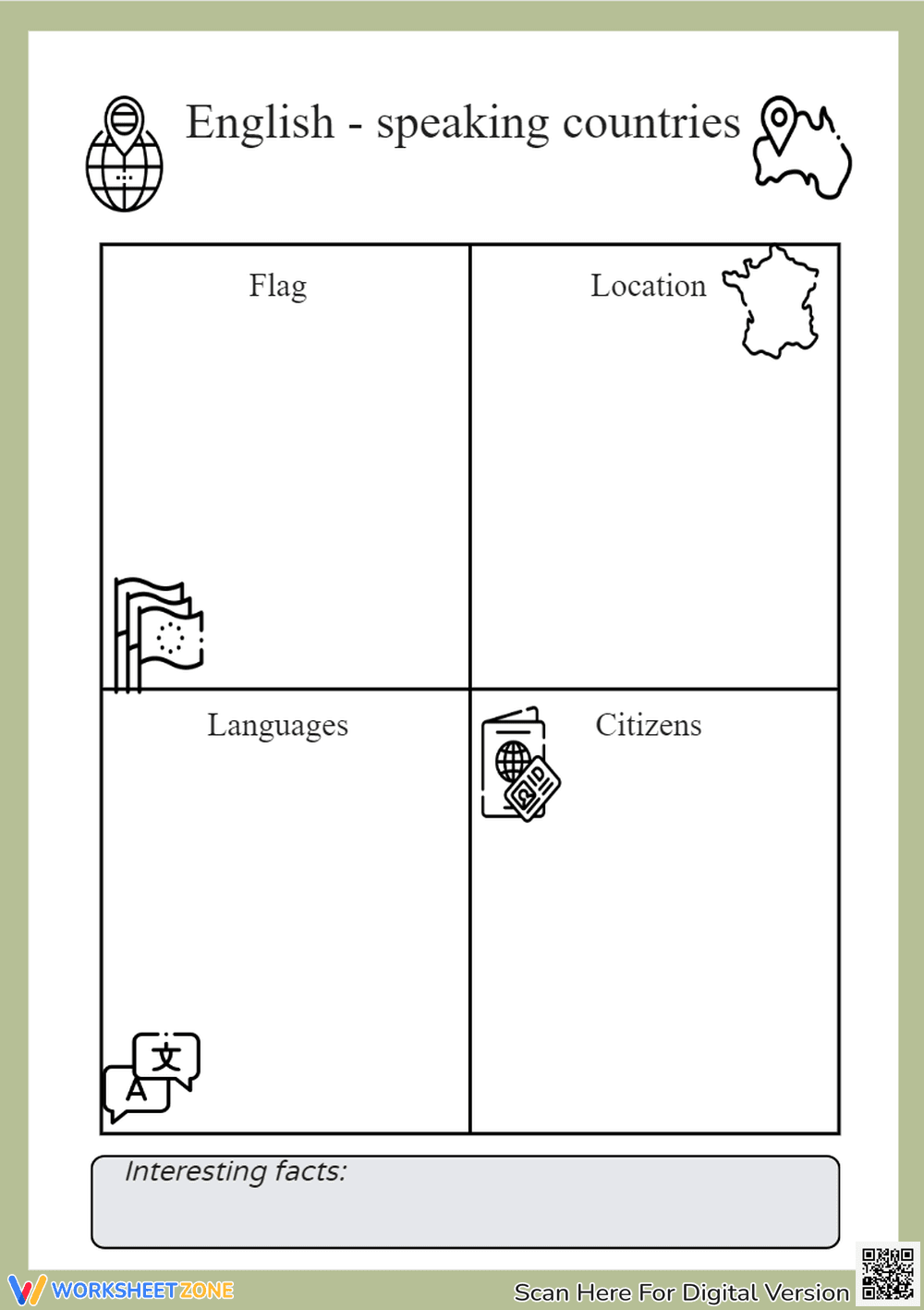
This single-page graphic organizer features a clean, four-quadrant layout to structure student research. The template prompts learners to identify the national flag, map the location, list official languages, and define the demonym for citizens. A dedicated bottom section provides space for students to write interesting facts, encouraging deeper exploration of their findings.
Zero-Prep Workflow
This resource offers a streamlined, three-step workflow requiring minimal teacher preparation. First, print the single-page PDF template in under 1 minute. Second, distribute the worksheet and allow 5 minutes to explain the prompts and direct students to approved databases. Third, review the completed organizers during a 10-minute peer-sharing session. The entire setup takes under 2 minutes, making it an ideal sub plan.
Standards Alignment
This worksheet aligns directly with Common Core Standard CCSS.ELA-LITERACY.W.7.7, which requires students to conduct short research projects to answer a question, drawing on several sources. By researching specific countries, students also practice domain-specific vocabulary acquisition aligned with supporting standard CCSS.ELA-LITERACY.L.7.6. Both standard codes can be copied directly into lesson plans, IEP goals, or district curriculum mapping tools.
How to Use It
Use this worksheet during the independent practice phase of a unit on global cultures. Introduce the activity by modeling how to research one country as a class, demonstrating how to find reliable demographic data. Alternatively, use the organizer as a formative assessment tool to evaluate how well students locate and summarize key facts. Students typically complete the research within 30 to 45 minutes.
Who It's For
This resource is designed for seventh-grade students developing independent research skills. It is highly adaptable for English language learners who benefit from visual organizers, as well as advanced students researching less common nations. Pair this worksheet with an introductory lesson on search engine queries or a shared classroom atlas to maximize student engagement.
This research organizer supports the development of inquiry skills aligned with CCSS.ELA-LITERACY.W.7.7 by guiding seventh-grade students through structured, multi-source investigations of English-speaking countries. According to the Fisher & Frey (2014) framework for gradual release of responsibility, structured graphic organizers scaffold the transition from guided instruction to independent research. By breaking down complex country profiles into manageable categories—such as flags, locations, languages, and citizen demographics—the worksheet reduces cognitive load and helps students organize information systematically. This targeted approach ensures that learners focus on extracting relevant data and applying domain-specific vocabulary rather than becoming overwhelmed by unstructured text. Educators can confidently integrate this tool to build foundational research habits, promote cultural literacy, and assess informational writing readiness in diverse classroom settings.


