Most conflict-resolution handouts ask students to be calm without ever showing them what calm, assertive language actually sounds like. A DEAR MAN worksheet closes that gap. Instead of a vague reminder to use your words, it walks a student through a specific sequence of steps for asking for something, setting a boundary, or resolving a disagreement while keeping the relationship intact. For school counselors, behavior specialists, and homeroom teachers running SEL blocks, that structure turns an abstract skill into something students can rehearse and apply the same day.
Breaking Down the DEAR MAN Acronym
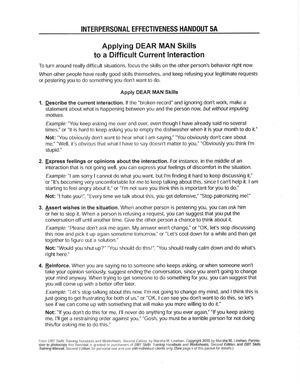
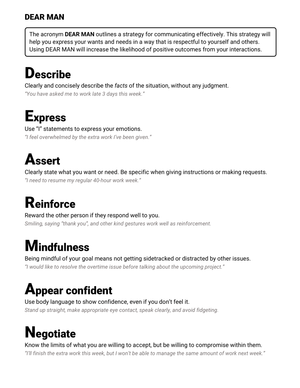
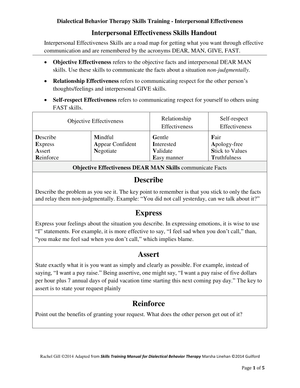
DEAR MAN is an interpersonal effectiveness skill from Dialectical Behavior Therapy, built around seven letters that each represent one step in an assertive request or boundary-setting conversation.
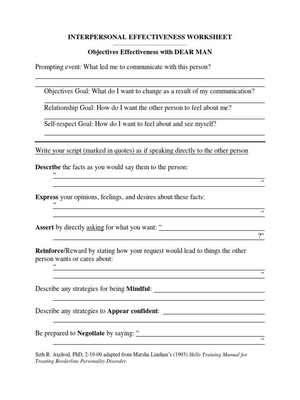
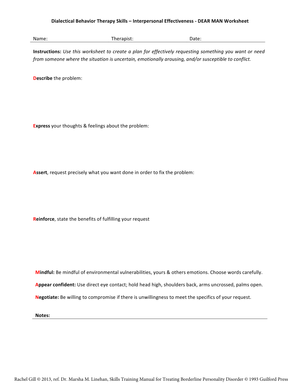
- Describe: State the facts of the situation without judgment.
- Express: Share feelings using I statements.
- Assert: Ask directly for what is needed.
- Reinforce: Explain the benefit of getting a yes.
- Mindful: Stay focused on the goal instead of getting pulled into a side argument.
- Appear confident: Use steady posture, tone, and eye contact.
- Negotiate: Be willing to problem-solve toward a workable outcome.
A worksheet typically presents a worked example first, such as asking a group partner to redo a shared assignment, then a blank template where the student fills in each letter for a conflict from their own school day.
Where DEAR MAN Fits in MTSS and Tier 2 Support
DEAR MAN worksheets are most often used as a Tier 2 or Tier 3 tool inside a Multi-Tiered System of Supports framework, delivered in small-group counseling sessions rather than whole-class instruction. A behavior specialist might introduce the skill to a group of four or five students who have repeated referrals tied to peer conflict, then track how often each student uses the steps during a check-in period.
In practice, students under stress reliably skip the Mindful step first, drifting into old arguments about who started it, so counselors who explicitly rehearse that single letter in isolation before combining the full sequence tend to see faster carryover into real hallway and classroom conflicts.
According to a DBT interpersonal effectiveness worksheet published by Therapist Aid, the DEAR MAN skill was designed to help a person state a request or refusal clearly while preserving self-respect and the relationship, a balance that maps directly onto the goals of a school behavior intervention plan.
Adapting the Language for Elementary and Secondary Students
The original DEAR MAN wording was written for adult clients, so classroom versions need translation. For elementary students, Describe can become tell what happened, like a movie camera would see it, and Assert can become say what you need in one sentence. Secondary students can generally handle the original acronym language directly, though it still helps to anchor each letter to a real example from that grade band, such as asking a teacher for an extension or asking a teammate to stop interrupting during group work.
Role-Play Scripts and Sentence Starters
Worksheets work best when paired with a short rehearsal, not just silent writing. Useful sentence starters include I noticed that, I feel, I am asking you to, and it would help both of us because. Pairing students to read their filled-in worksheet aloud to a partner, then swap roles, gives a low-stakes rehearsal before the student uses the script in an actual conversation with a peer, sibling, or teacher.
Classroom Implementation
To introduce a DEAR MAN worksheet without it feeling like a therapy exercise dropped into a school day, try this sequence.
- Open with a low-stakes example unrelated to any current student conflict, such as asking a friend to return a borrowed pencil.
- Model filling out each letter aloud before handing out blank worksheets.
- Have students draft their own DEAR MAN script for a real but low-intensity situation first, saving higher-conflict scenarios for later sessions.
- Use partner role-play so students hear their script spoken, not just written.
- Revisit the same worksheet format weekly in a small group so the sequence becomes familiar rather than a one-time handout.
Keeping a laminated copy of the acronym visible during group sessions also gives students a quick reference when they freeze mid-conversation.
Frequently Asked Questions
1. What does each letter in DEAR MAN stand for?
Describe, Express, Assert, Reinforce, stay Mindful, Appear confident, and Negotiate. Each letter represents one step in making a clear, respectful request or setting a boundary during a disagreement.
2. What grade levels or ages is DEAR MAN appropriate for?
DEAR MAN is commonly adapted for both elementary and secondary students in school counseling and SEL programs. Younger students typically need simplified wording for each letter, while older students can often use the original terms directly.
3. How is DEAR MAN different from GIVE or FAST?
DEAR MAN focuses on making a request or asking for something specific. GIVE centers on protecting the relationship through validation and warmth, while FAST centers on maintaining self-respect and personal values during the same conversation.
4. How can a teacher introduce DEAR MAN during an SEL lesson or counseling group?
Start with a low-stakes example, model filling out the worksheet aloud, then have students draft and role-play their own script before applying it to a real classroom or peer situation.
5. When should a teacher use a DEAR MAN worksheet instead of a general conflict-resolution worksheet?
A DEAR MAN worksheet is most useful when a student needs to make a specific request or set a clear boundary, rather than simply reflect on a conflict that already happened. It gives a repeatable script for the conversation itself, not just a debrief afterward.












 Interactive Worksheet Maker
 Quiz Maker
 Word Search Maker
 Crossword Puzzle Maker
 Word Scramble Generator
 Sentence Scramble Generator
 Handwriting Worksheet Generator
 Name Tracing Generator
 Fill In The Blank Generator