


























Views
Downloads

Darwin's Natural Selection Worksheet | Essential Biology
Paste this activity's link or code into your existing LMS (Google Classroom, Canvas, Teams, Schoology, Moodle, etc.).
Students can open and work on the activity right away, with no student login required.
You'll still be able to track student progress and results from your teacher account.
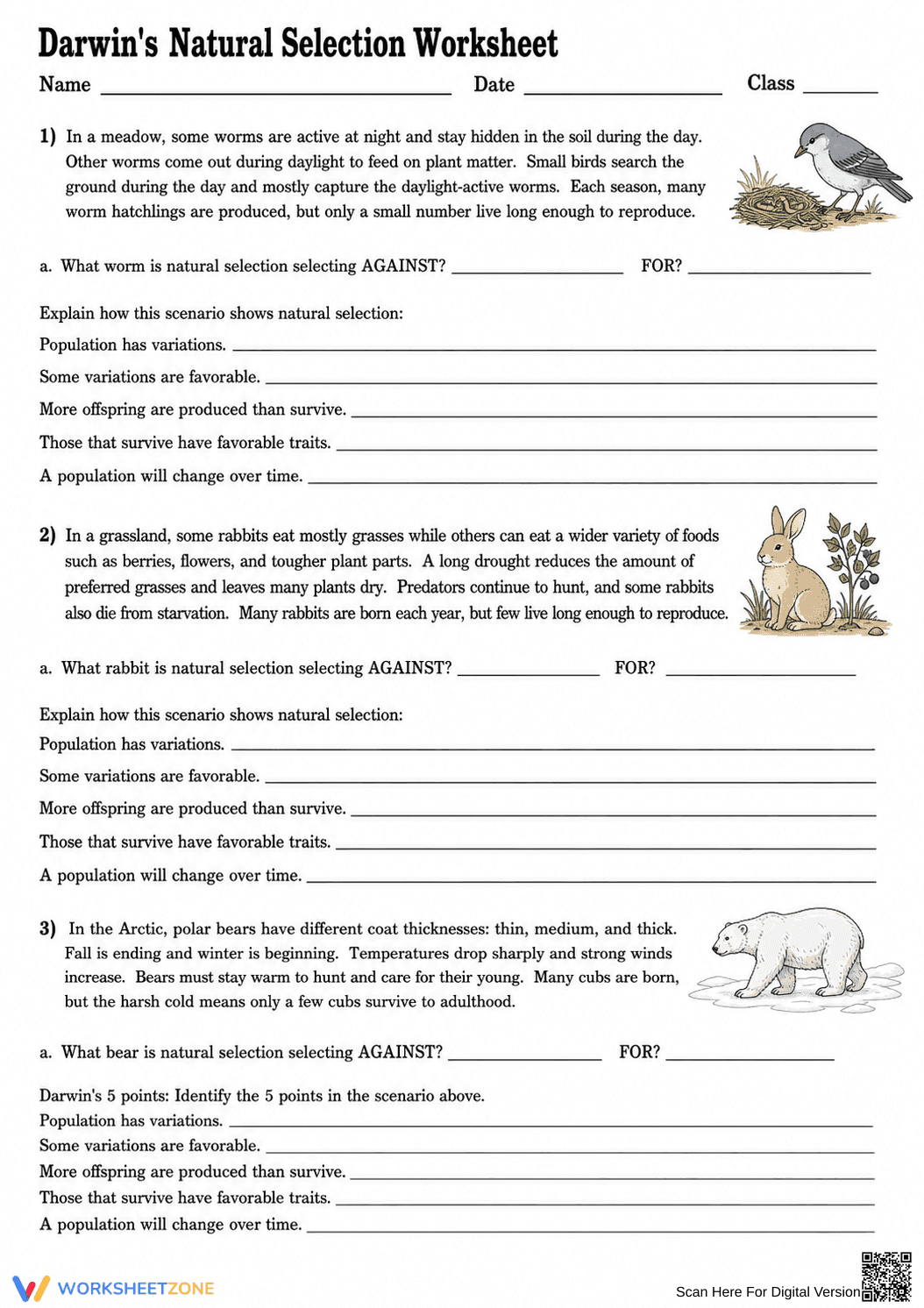
This Darwin's Natural Selection worksheet provides high school biology students with a structured framework to analyze how environmental pressures drive evolutionary change. By examining specific case studies, learners identify selective pressures and apply the five tenets of Darwinian theory to predict population shifts. It transforms abstract concepts into concrete biological evidence through rigorous scenario analysis.
At a Glance
- Grade: 9–12 · Subject: Biology
- Standard:
HS-LS4-4— Construct an explanation based on evidence for how natural selection leads to adaptation- Skill Focus: Evolutionary Mechanisms
- Format: 2 pages · 13 problems · Answer key included · PDF
- Best For: Reinforcing Darwinian principles after direct instruction
- Time: 30–45 minutes
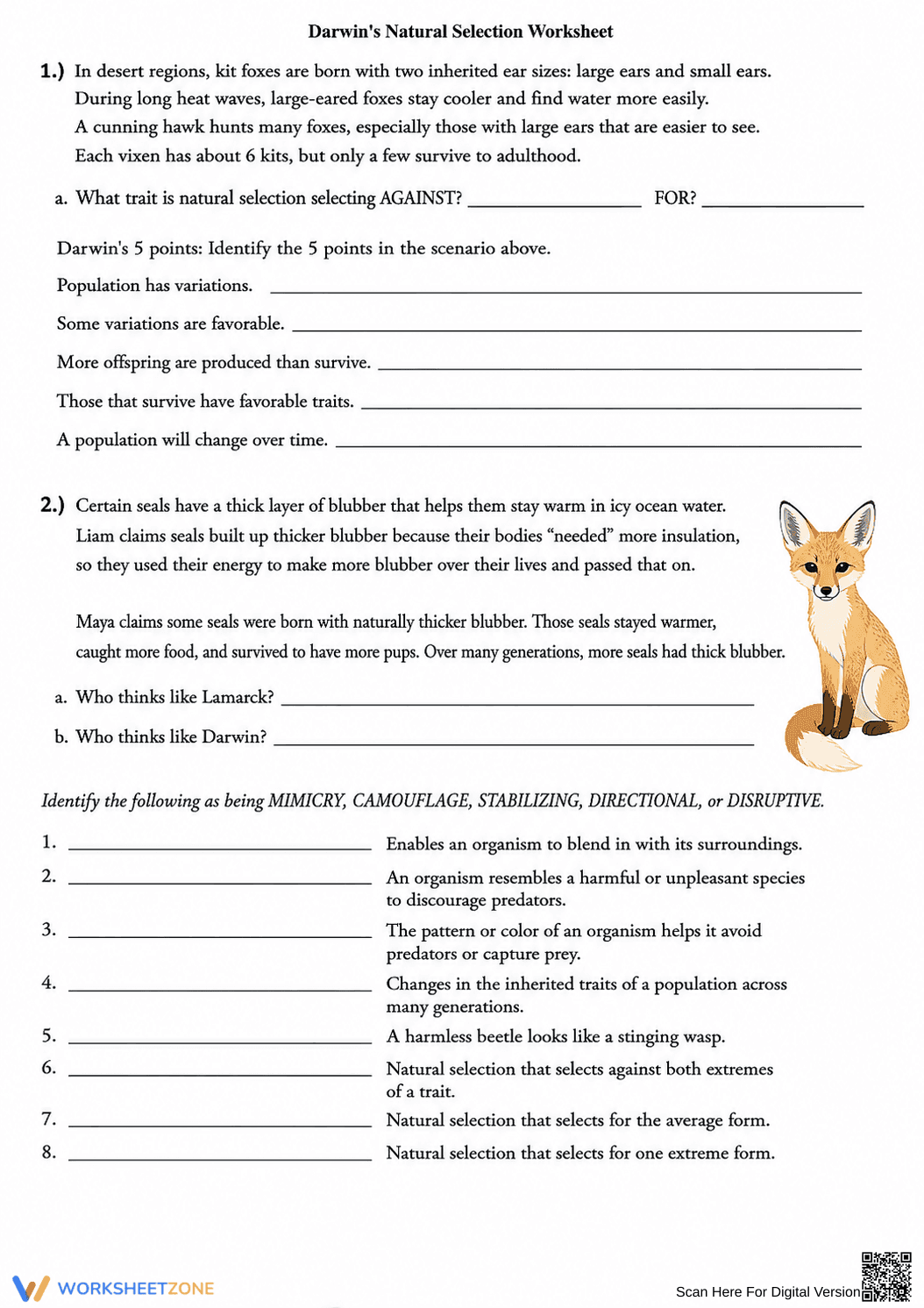
What's Inside: This 2-page PDF features five distinct biological scenarios, including nocturnal worms, drought-resistant rabbits, and Arctic polar bears. The resource includes a dedicated section for comparing Lamarckian and Darwinian perspectives, alongside an 8-item vocabulary matching task covering mimicry, camouflage, and selection types. A full answer key is provided to facilitate quick grading or student self-correction.
Skill Progression:
- Guided Practice: The first scenario provides explicit prompts to help students identify what is being selected against, establishing a baseline for the five points of natural selection.
- Supported Practice: Subsequent scenarios involving rabbits and polar bears require students to independently map observations to specific evolutionary steps with decreasing scaffolding.
- Independent Practice: The final page challenges students to differentiate between acquired characteristics and inherited traits while categorizing selection types like directional or disruptive selection.
This gradual-release approach ensures students move from simple identification to complex application of evolutionary theory.
Standards Alignment: This resource is primarily aligned to `HS-LS4-4`, which requires students to explain how natural selection leads to the adaptation of populations. It also supports `MS-LS4-4` for advanced middle school learners. Both standard codes can be copied directly into lesson plans, IEP goals, or district curriculum mapping tools.
How to Use It: Assign this worksheet during the "elaborate" phase of a 5E lesson cycle to deepen understanding of selective pressures. For a formative assessment, observe student responses to the Lamarck vs. Darwin seal scenario to identify misconceptions regarding the inheritance of acquired traits. Most students complete the 13 tasks within 40 minutes.
Who It's For: This worksheet is designed for high school biology students, including those in Honors or AP tracks requiring a review of fundamental mechanisms. It pairs effectively with a classroom anchor chart on Darwin's 5 points or a direct instruction slide deck on speciation.
The efficacy of scenario-based learning in biology is well-documented in Fisher & Frey (2014), which emphasizes that students must apply theoretical frameworks to varied contexts to achieve true mastery. This worksheet addresses the common struggle students face when moving from the definition of natural selection to the application of `HS-LS4-4` in real-world ecological shifts. By requiring students to identify specific traits selected for or against in 5 distinct environments, the resource builds the cognitive stamina necessary for high-stakes science assessments. Research from the RAND AIRS 2024 report suggests that structured practice with evolutionary scenarios significantly improves retention of the distinction between individual survival and population-level change. This resource provides the 13 critical tasks needed to bridge that conceptual gap, ensuring students can articulate how favorable variations lead to increased reproductive success over time.


