


























Views
Downloads
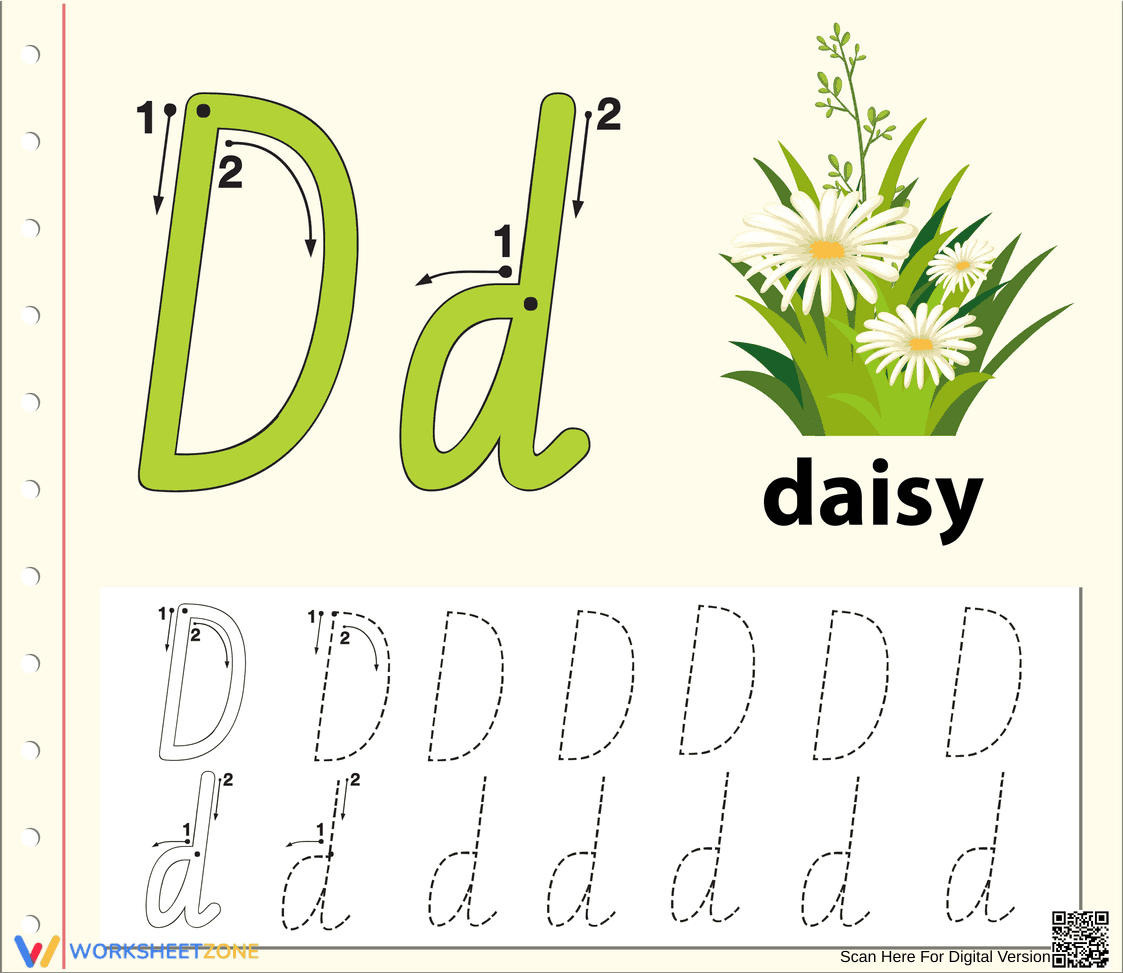

Letter D Tracing Worksheet | Printable Kindergarten ELA
Paste this activity's link or code into your existing LMS (Google Classroom, Canvas, Teams, Schoology, Moodle, etc.).
Students can open and work on the activity right away, with no student login required.
You'll still be able to track student progress and results from your teacher account.
This printable Kindergarten handwriting worksheet helps early learners master the letter D through guided tracing. By practicing uppercase and lowercase D'Nealian letterforms, students develop essential fine motor skills for fluent writing. The visual daisy cue reinforces letter-sound correspondence.
At a Glance
- Grade: Kindergarten · Subject: English Language Arts
- Standard:
CCSS.ELA-LITERACY.L.K.1.A— Print many upper- and lowercase letters- Skill Focus: Letter D Tracing
- Format: 1 page · 14 problems · No answer key needed · PDF
- Best For: Independent practice
- Time: 10–15 minutes
This single-page resource features a clear layout for early childhood education. Large instructional models of uppercase and lowercase D display numbered directional arrows to guide proper stroke sequence. A cheerful daisy illustration provides a phonetic anchor. Below, students will find two practice rows containing 14 dotted letters ready for tracing.
Zero-Prep Workflow
This resource is designed for immediate classroom implementation.
- Print (1 min): Download the PDF and print. The high-contrast design ensures crisp reproduction.
- Distribute (1 min): Hand out sheets with pencils. Visual stroke guides make the task immediately understandable.
- Review (1 min): Scan student work to ensure they follow directional arrows.
With under two minutes of prep time, this worksheet is excellent for emergency sub plans.
Standards Alignment
This practice sheet aligns directly with CCSS.ELA-LITERACY.L.K.1.A, requiring students to print many upper- and lowercase letters. By providing explicit stroke order cues, the worksheet ensures students build foundational mechanics. Both standard codes can be copied directly into lesson plans, IEP goals, or district curriculum mapping tools.
How to Use It
This tracing activity fits perfectly into morning work routines, allowing teachers time to manage morning transitions. Alternatively, use it during small group literacy centers for independent practice. Observation Tip: Watch closely as students trace the large model letters. Ensure they start at the correct numbered point and follow the arrows, correcting bottom-to-top stroke habits early. Expected completion time is 10 to 15 minutes.
Who It's For
This worksheet is designed for Kindergarten students developing foundational handwriting skills, or first-graders needing targeted intervention. For students requiring fine motor support, have them trace with a highlighter first. Pair this resource with a classroom alphabet anchor chart to reinforce the letter-sound connection.
Effective handwriting instruction requires explicit modeling and structured practice to build automaticity. According to Fisher & Frey (2014), providing clear visual cues and guided repetition is essential for early learners to develop the muscle memory needed for fluent writing. This resource supports that pedagogical approach by integrating numbered stroke arrows directly into the practice model. By targeting CCSS.ELA-LITERACY.L.K.1.A, which asks students to print many upper- and lowercase letters, this worksheet ensures foundational literacy skills are established early. The inclusion of the D'Nealian font style further supports cognitive development by bridging the gap between manuscript and cursive writing. Consistent, targeted practice with resources like this letter D tracing sheet reduces the cognitive load required for letter formation, allowing young students to eventually focus their mental energy on composition and spelling rather than the physical act of writing.


