


























Views
Downloads
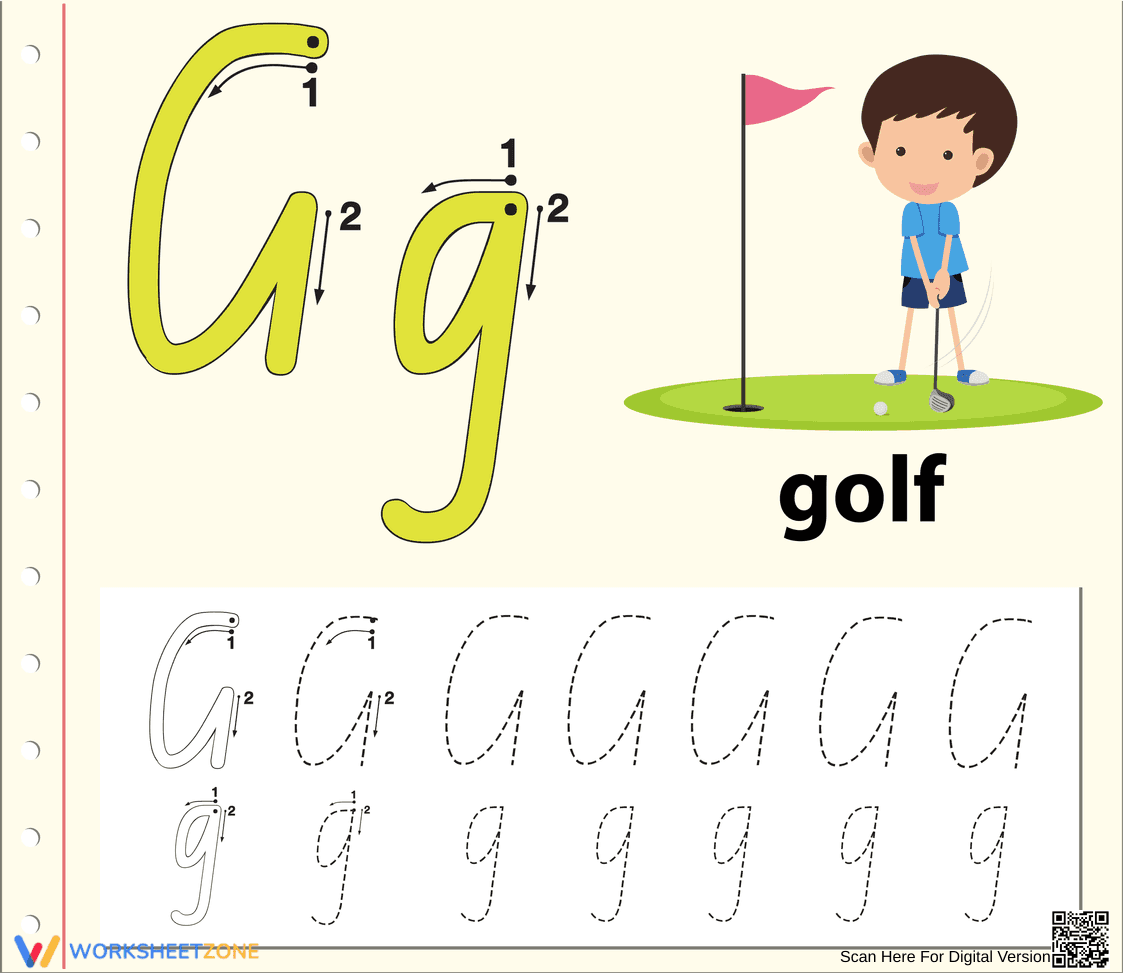

Printable Cursive G Tracing Worksheet | Grade 1
Paste this activity's link or code into your existing LMS (Google Classroom, Canvas, Teams, Schoology, Moodle, etc.).
Students can open and work on the activity right away, with no student login required.
You'll still be able to track student progress and results from your teacher account.
This printable Grade 1 handwriting worksheet provides focused practice for forming the cursive letter G. Students develop fine motor control and muscle memory by tracing both uppercase and lowercase letters. Featuring a fun golf theme, this resource keeps early learners engaged while they build essential penmanship skills.
At a Glance
- Grade: 1 · Subject: Handwriting
- Standard:
CCSS.ELA-LITERACY.L.1.1.A— Print all upper- and lowercase letters- Skill Focus: Letter G Tracing
- Format: 1 page · 14 problems · No answer key · PDF
- Best For: Morning work or centers
- Time: 5–10 minutes
This single-page resource features a large, clear model of the uppercase and lowercase letter G, complete with numbered directional arrows to guide proper stroke order. Below the instructional model, students will find 14 dotted tracing tasks—seven uppercase and seven lowercase letters. A colorful illustration of a golfer reinforces the phonetic connection, providing a visual anchor for early readers.
Zero-Prep Workflow
This worksheet requires zero teacher preparation.
- Print (1 minute): Simply download the PDF and print the desired number of copies. The high-contrast dotted lines ensure clean photocopies.
- Distribute (1 minute): Hand out the worksheets along with pencils or fine-tipped markers. The visual stroke guides make the task self-explanatory.
- Review (1 minute): Quickly scan student work to ensure they are following the directional arrows rather than drawing the letters backward.
With a total prep time of under two minutes, this activity is an excellent addition to any emergency sub plan or morning routine.
Standards Alignment
This handwriting activity aligns with CCSS.ELA-LITERACY.L.1.1.A, requiring students to print all upper- and lowercase letters. By providing structured tracing paths, the worksheet supports the foundational motor skills necessary for fluent writing. Both standard codes can be copied directly into lesson plans, IEP goals, or district curriculum mapping tools.
How to Use It
Deploy this worksheet during morning work to help students transition smoothly into the academic day. It also functions perfectly as an independent literacy center activity while the teacher conducts small group reading instruction. As a formative assessment tip, observe students while they trace the first few letters to ensure they start at the correct point and follow the numbered arrows, correcting any improper grip or stroke order immediately. Expected completion time is between 5 and 10 minutes.
Who It's For
This resource is designed for Grade 1 students mastering alphabet formation, but also supports Kindergarteners or older students needing occupational therapy for fine motor delays. For differentiation, provide pencil grips or thicker markers for students struggling with standard pencils. Pair this worksheet with a phonics anchor chart focusing on the hard and soft sounds of the letter G to reinforce both writing and reading skills simultaneously.
Mastering letter formation through guided tracing is a critical step in early literacy development. This worksheet targets CCSS.ELA-LITERACY.L.1.1.A, helping students print all upper- and lowercase letters with accuracy and confidence. According to Fisher & Frey (2014), explicit handwriting instruction significantly reduces the cognitive load required for transcription, allowing young writers to focus their mental energy on idea generation and complex composition. By utilizing numbered directional arrows and structured repetition, this resource builds the automaticity necessary for fluent writing. The integration of a phonetic visual cue further supports dual-coding, linking the physical act of writing the letter G with its corresponding sound. Consistent practice with targeted tracing materials ensures that foundational motor skills are firmly established before students transition to independent, unlined writing tasks.


