


























Views
Downloads
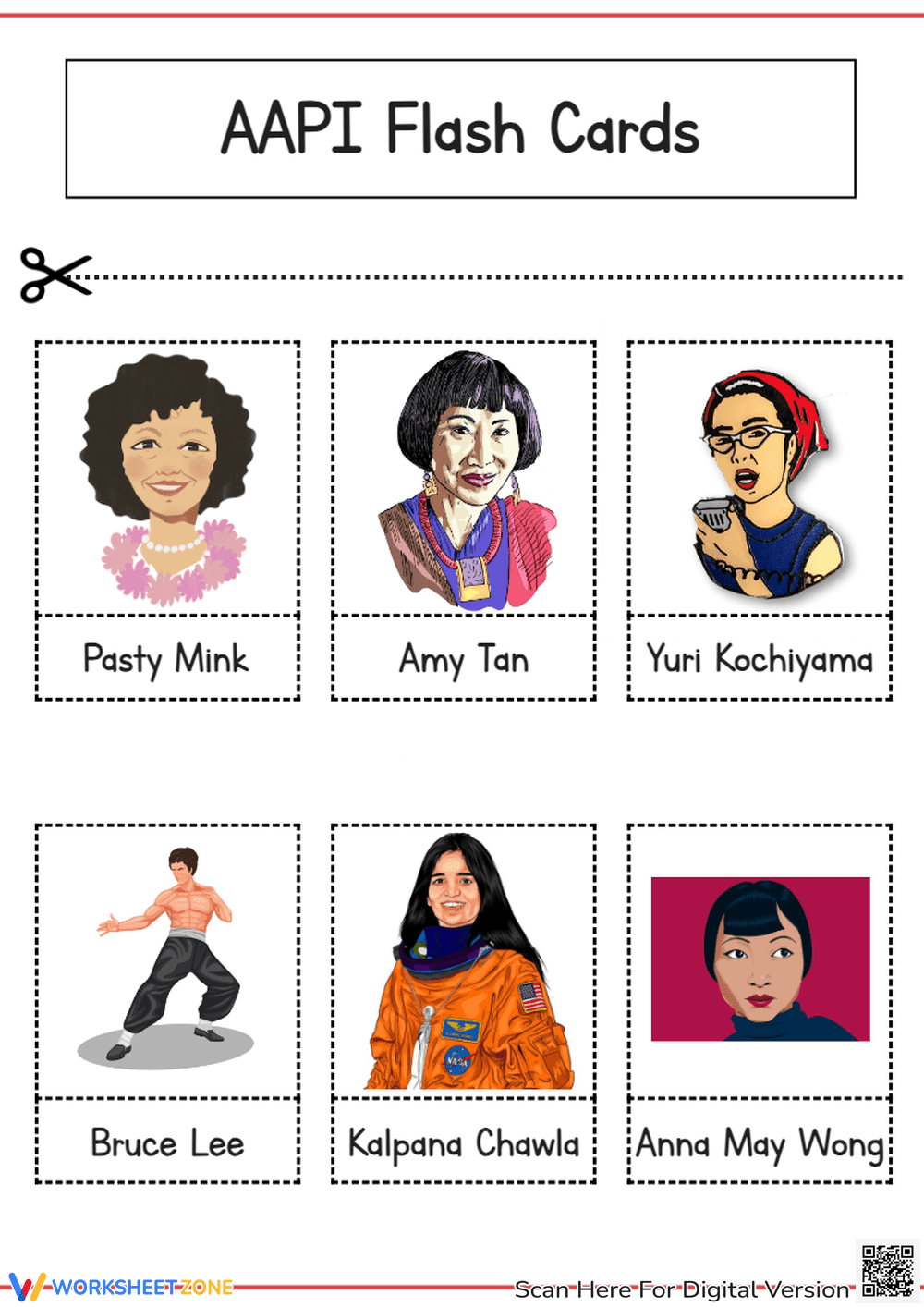

AAPI Flash Cards | Grade 1-3 Essential Printable
Paste this activity's link or code into your existing LMS (Google Classroom, Canvas, Teams, Schoology, Moodle, etc.).
Students can open and work on the activity right away, with no student login required.
You'll still be able to track student progress and results from your teacher account.
These AAPI Flash Cards provide a hands-on way for students in Grades 1-3 to identify and learn about influential Asian American and Pacific Islander figures. By engaging with visual and text-based cards, learners build historical knowledge and cultural appreciation. This resource helps students recognize the diverse contributions of leaders in science, arts, and civil rights.
At a Glance
- Grade: 1-3 · Subject: Social Studies
- Standard:
CCSS.ELA-LITERACY.RI.2.3— Describe connections between historical figures and their contributions to society- Skill Focus: Historical Figure Recognition
- Format: 1 page · 6 flashcards · No-prep · PDF
- Best For: Heritage Month activities and centers
- Time: 10–15 minutes
This single-page PDF features six high-quality flashcards, each showcasing a prominent AAPI individual such as Kalpana Chawla and Bruce Lee. The cards are designed with clear dashed lines for easy cutting, making them ideal for student-led assembly. Each card includes a vibrant illustration and the figure's name to support visual literacy and name recognition.
Zero-Prep Workflow
This resource is designed for immediate classroom implementation with three simple steps:
- Print (1 min): Output the single-page PDF in color or grayscale for your entire class or small groups.
- Distribute (1 min): Provide students with safety scissors to cut along the guided dashed lines.
- Review (5-10 mins): Use the cards for a matching game, a gallery walk, or as prompts for a quick research journal entry.
Total teacher preparation time is under two minutes, making this an excellent choice for morning work or emergency sub plans.
This resource aligns with `CCSS.ELA-LITERACY.RI.2.3`, which requires students to describe the connection between a series of historical events or individuals. By identifying these figures, students lay the groundwork for understanding broader historical narratives and cultural movements. Both standard codes can be copied directly into lesson plans, IEP goals, or district curriculum mapping tools.
Use these cards during Asian Pacific American Heritage Month as a "Person of the Day" warm-up activity. Display one card and have students predict the person's contribution before revealing facts. Alternatively, use them as a formative assessment tool; ask students to group the cards by profession (e.g., science, arts, activism) to observe their ability to categorize historical information. Completion takes approximately 15 minutes.
This resource is tailored for elementary students in Grades 1, 2, and 3, including English Language Learners who benefit from visual aids. It serves as a perfect companion to a read-aloud biography or an introductory anchor chart about AAPI history. Teachers can easily differentiate by asking older students to write one fact on the back of each card.
The AAPI Flash Cards resource supports the development of cultural competency and historical literacy through the lens of CCSS.ELA-LITERACY.RI.2.3. By focusing on specific individuals like Patsy Mink and Amy Tan, the worksheet facilitates the plain-English skill of describing connections between historical figures and their societal impact. Research from Fisher & Frey (2014) emphasizes that visual scaffolds and flashcards are essential for building the background knowledge necessary for complex text comprehension in early elementary grades. This resource provides a structured entry point for students to engage with diverse narratives, ensuring that representation is integrated into daily social studies instruction. With 6 distinct figures included, the cards offer a manageable yet diverse sample of AAPI excellence. Educators can utilize these cards to meet state-mandated heritage month requirements while simultaneously reinforcing foundational literacy and categorization skills.


