




























Views
Downloads
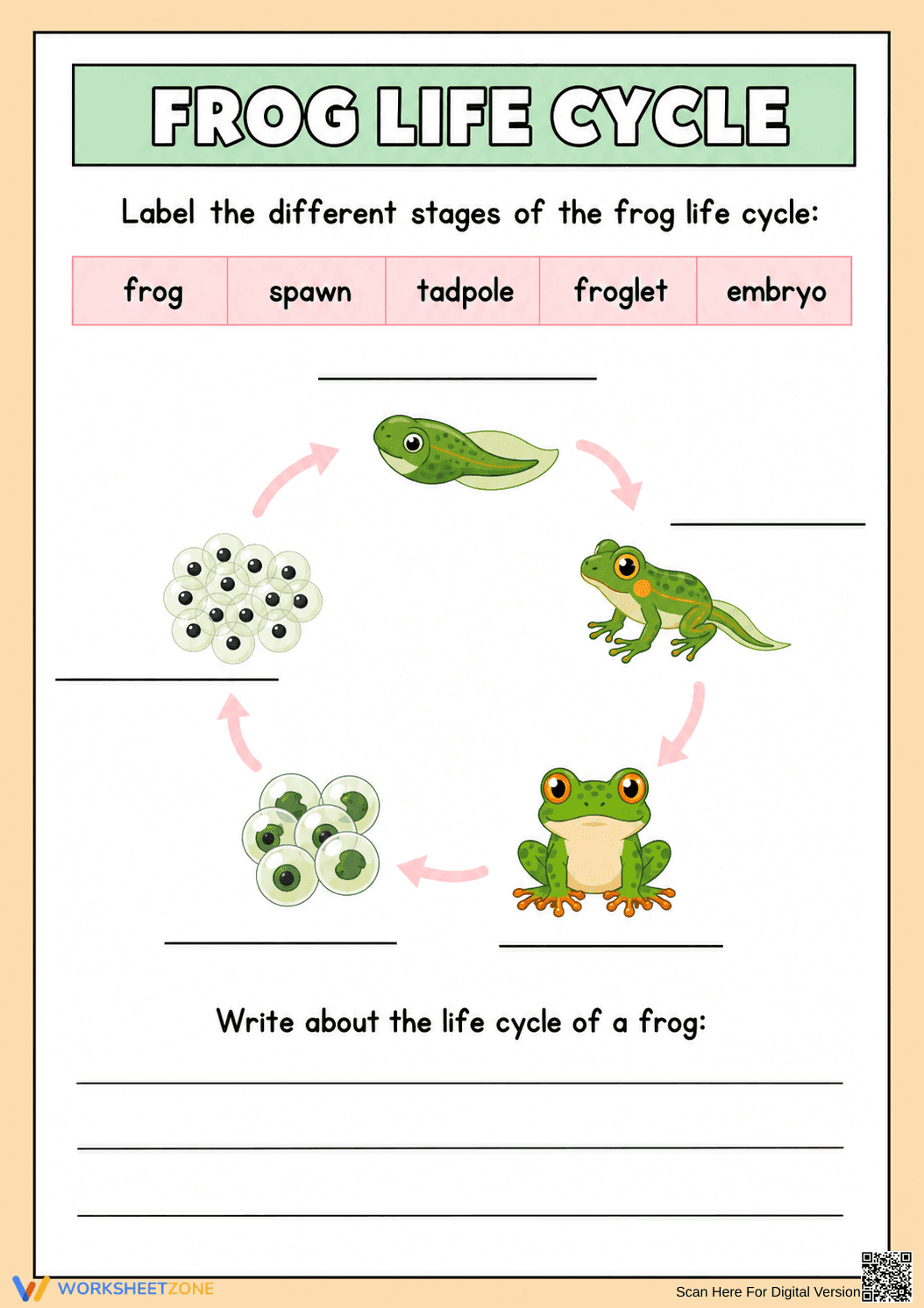

Grade 3 Frog Life Cycle — Printable No-Prep Worksheet

Paste this activity's link or code into your existing LMS (Google Classroom, Canvas, Teams, Schoology, Moodle, etc.).
Students can open and work on the activity right away, with no student login required.
You'll still be able to track student progress and results from your teacher account.
This Grade 3 science worksheet helps students master the stages of a frog's development by labeling a visual model and writing a descriptive summary. By connecting visual sequencing with academic writing, learners solidify their understanding of amphibian metamorphosis and build essential scientific communication skills.
At a Glance
- Grade: 3 · Subject: Science
- Standard:
3-LS1-1— Develop models to describe organism life cycles- Skill Focus: Frog life cycle stages and sequencing
- Format: 1 page · 6 problems · Answer key included · PDF
- Best For: Independent practice
- Time: 15–20 minutes
This single-page resource features a clear, circular diagram of a frog's life cycle with five fill-in-the-blank labels. A convenient word bank (frog, spawn, tadpole, froglet, embryo) is provided at the top to support spelling and vocabulary recall. Below the diagram, three writing lines prompt students to synthesize their knowledge by describing the entire life cycle process in complete sentences. A complete answer key is included for quick grading.
- Print (1 minute): Simply download the PDF and print a class set. The black-and-white friendly design ensures clear copies every time.
- Distribute (1 minute): Hand out the worksheet after a brief introductory lesson on amphibians. The included word bank means students can begin immediately.
- Review (3 minutes): Use the provided answer key to quickly check the labeling section, then review the short-answer writing prompt as a whole class.
With under two minutes of total teacher prep time, this resource is an excellent addition to any emergency sub plan or busy afternoon science block.
Aligned to primary standard 3-LS1-1: Develop models to describe that organisms have unique and diverse life cycles but all have in common birth, growth, reproduction, and death. The combination of visual modeling and written explanation ensures students meet the rigor of the standard. Both standard codes can be copied directly into lesson plans, IEP goals, or district curriculum mapping tools.
Use this worksheet as an independent practice activity immediately following direct instruction on amphibian life cycles. It also serves as an effective formative assessment; observe how well students transition from simply labeling the diagram to articulating the sequence of changes in the writing section. Expected completion time is 15 to 20 minutes, depending on the student's writing fluency.
This resource is designed for third-grade science students learning about organism traits and life cycles. The built-in word bank provides natural differentiation for emerging readers and English Language Learners, while the open-ended writing prompt challenges advanced students to use descriptive scientific vocabulary. It pairs perfectly with an introductory informational text or video about pond life.
Aligning instruction to 3-LS1-1 requires students to develop models to describe organism life cycles, moving beyond rote memorization to conceptual understanding. According to the RAND AIRS 2024 report, integrating visual models with structured writing tasks significantly improves students' retention of complex scientific processes. When young learners engage with multimodal formats—such as combining a visual diagram with a descriptive writing prompt—they are better able to internalize the sequence of biological events. By requiring learners to first label a diagram using a targeted word bank and then synthesize that information into a cohesive written summary, this worksheet actively reinforces dual-coding pathways in the brain. This evidence-based approach ensures that foundational science concepts regarding amphibian metamorphosis are firmly established. Ultimately, providing these structured opportunities for scientific communication prepares students for more advanced biological studies and complex informational writing tasks in later elementary grades.


