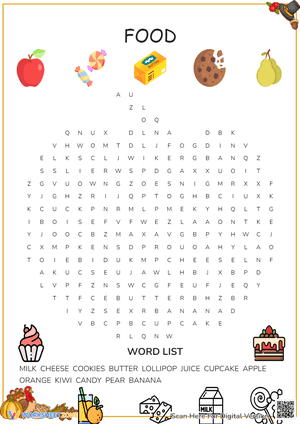
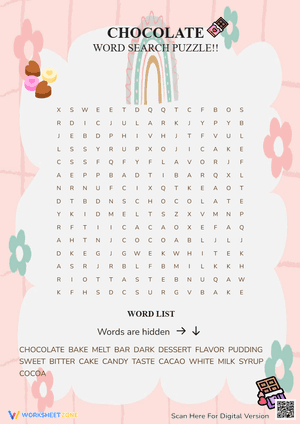
Food vocabulary maps almost perfectly onto common elementary health and nutrition units. Fruits, vegetables, proteins, and grains show up across science, health, and even social studies units on farming or community helpers. A food word search lets you introduce or reinforce that vocabulary set without needing new materials beyond the printed sheet, which makes it a low-lift addition to a lesson plan that is already packed with hands-on activities.
Supplementing a new unit launch with a themed word search has been linked to increased retention of that unit's vocabulary, since students encounter and physically trace each term multiple times while scanning the grid. That repeated visual exposure functions as a light form of retrieval practice, even though the activity feels more like a game than a quiz.
Supporting ESL and ELL Vocabulary Building
Food vocabulary is a natural entry point for English language learners because the words are concrete, visual, and often familiar from daily life. A food word search gives ELL students a low-pressure way to practice spelling and word recognition without the added demand of composing full sentences. Since the words are grouped by category (fruits, vegetables, proteins, grains), students start to build category-based vocabulary maps rather than memorizing isolated terms.
To strengthen the ESL value of the activity, have students sort the words they find into categories after finishing the puzzle. This shifts the task from simple visual scanning into a light classification exercise, which reinforces both vocabulary and conceptual grouping.
Classroom Implementation
To get the most out of a food word search, treat it as a short, purposeful block rather than an open-ended filler task. A simple implementation plan:
- Introduce the puzzle at the start of a nutrition or food-vocabulary lesson so students preview key terms before direct instruction
- Set a clear time limit, five to ten minutes for younger grades and up to fifteen for upper elementary
- Require a follow-up task, such as sorting words by category or writing a sentence, so the activity has an accountability piece
- Keep a stack on hand for early finishers so it doubles as a review tool throughout the unit, not just on day one
This structure keeps the activity tied to instructional goals instead of functioning purely as busy work, while still giving you the low-prep benefit that makes word searches so useful on a packed teaching day.
Frequently Asked Questions
1. What grade levels are food word searches most appropriate for?
Food word searches work well from kindergarten through fifth grade. Adjust the word count, placement (horizontal only versus diagonal and backward), and vocabulary complexity to match the grade level and current unit.
2. How can teachers use a food word search to support an ESL or vocabulary-building goal rather than just filler time?
Pair the puzzle with a sorting or categorizing task after students finish finding the words. Grouping words by food category (fruits, vegetables, proteins) turns the activity into active vocabulary building instead of passive visual scanning.
3. How should teachers extend a word search activity so it builds deeper vocabulary skills, not just visual scanning?
Add a short writing or classification task, such as using found words in original sentences or sorting them into food groups. This moves students from recognition to application, which supports stronger retention.
4. Can a food word search be tied to a specific health or nutrition unit theme?
Yes. Food vocabulary lists align naturally with common K-5 nutrition and health units covering fruits, vegetables, proteins, and grains, so the puzzle can reinforce whatever food categories your current unit is covering.
5. How long does a typical food word search activity take in a classroom setting?
Most food word searches take five to fifteen minutes depending on grade level and word count, making them a good fit for early finisher time, warm-ups, or transition periods between lessons.















 Interactive Worksheet Maker
 Quiz Maker
 Word Search Maker
 Crossword Puzzle Maker
 Word Scramble Generator
 Sentence Scramble Generator
 Handwriting Worksheet Generator
 Name Tracing Generator
 Fill In The Blank Generator