


























Views
Downloads
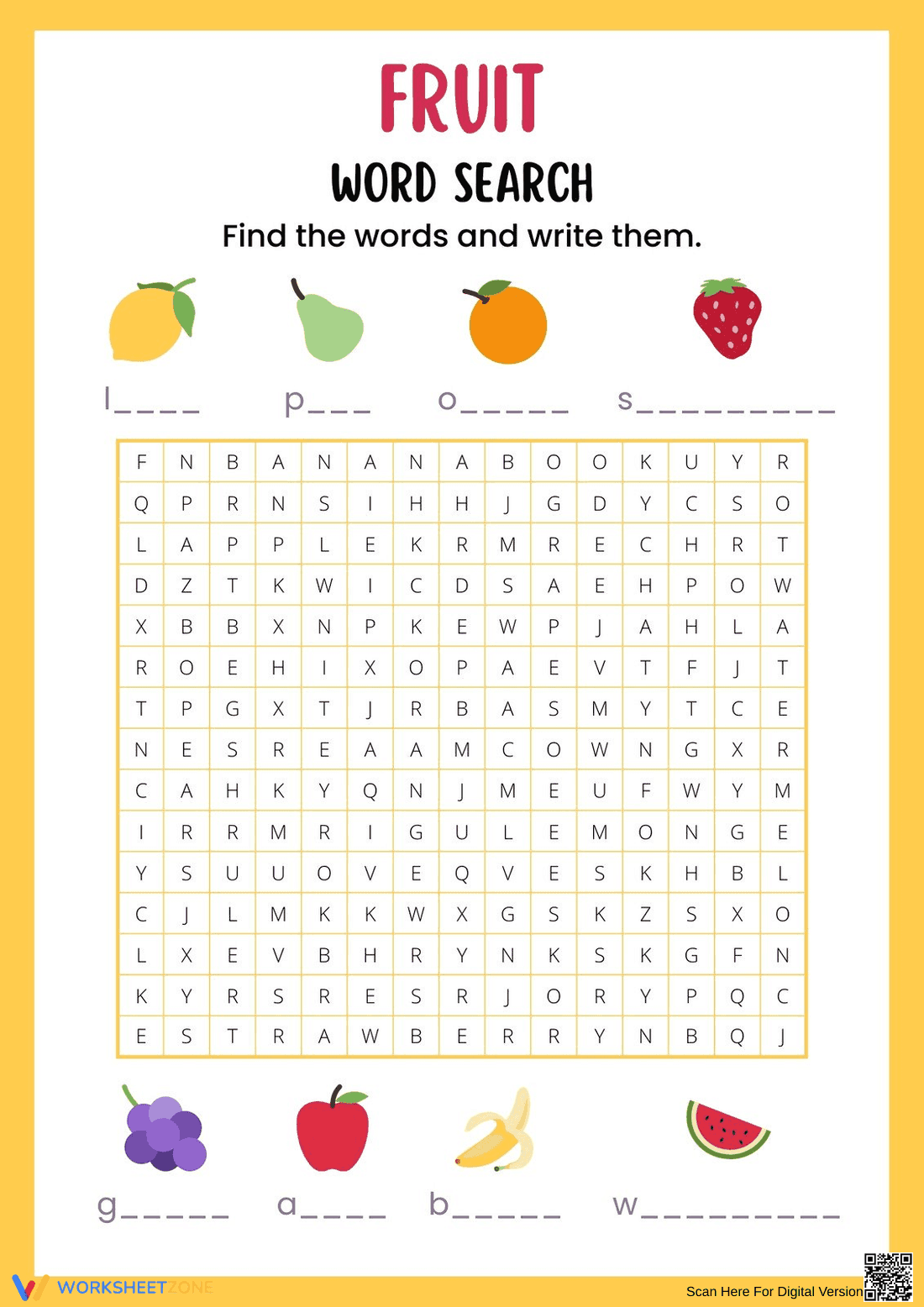

Fruit Word Search Worksheet | Grade 1 Essential
Paste this activity's link or code into your existing LMS (Google Classroom, Canvas, Teams, Schoology, Moodle, etc.).
Students can open and work on the activity right away, with no student login required.
You'll still be able to track student progress and results from your teacher account.
This Grade 1 fruit word search worksheet strengthens foundational spelling and vocabulary through an engaging puzzle format. Students identify eight common fruits, locate them within the letter grid, and practice handwriting by transcription. This dual-task approach ensures that learners connect visual representations of objects with their written forms, reinforcing orthographic mapping and word recognition skills essential for early literacy development.
At a Glance
- Grade: 1 · Subject: ELA
- Standard:
CCSS.ELA-LITERACY.L.1.2— Demonstrate command of the conventions of standard English spelling when writing- Skill Focus: Fruit vocabulary and spelling
- Format: 1 page · 8 problems · Answer key included · PDF
- Best For: Morning work or literacy centers
- Time: 15–20 minutes
The worksheet features a vibrant, illustrative design with high-quality graphics of eight different fruits: lemon, pear, orange, strawberry, grapes, apple, banana, and watermelon. Below each image is a scaffolded writing line with the first letter provided to guide student spelling. The central word search grid contains all eight terms hidden horizontally and vertically. A full answer key is included to facilitate quick grading or student self-correction.
This resource is designed for a zero-prep classroom environment. To implement, simply print the single-page PDF (30 seconds), distribute it to students during a transition period (1 minute), and review the completed spelling words as a whole group (5 minutes). The total teacher preparation time is under 2 minutes, making it an ideal choice for emergency sub plans, rainy day activities, or supplemental vocabulary practice.
The primary focus is CCSS.ELA-LITERACY.L.1.2, which requires students to demonstrate command of standard English spelling. By requiring students to find and then write the words, the worksheet supports CCSS.ELA-LITERACY.L.1.1.A regarding legible printing. Both standard codes can be copied directly into lesson plans, IEP goals, or district curriculum mapping tools.
Use this worksheet as a formative assessment after a lesson on healthy eating or food groups. Observe students as they search for words to identify those struggling with letter sequencing or visual scanning. It also serves as an excellent early finisher task during literacy blocks. Expected completion time ranges from 15 to 20 minutes depending on the student's familiarity with the vocabulary.
This resource is tailored for first-grade students but is also highly effective for Kindergarteners ready for a challenge or English Language Learners (ELL) building basic noun vocabulary. It pairs naturally with a fruit-themed picture book or a hands-on taste test science lesson to provide a literacy-based extension to sensory learning.
Word search puzzles are more than just entertainment; they are effective tools for developing pattern recognition and orthographic processing. According to a Fisher & Frey (2014) study on literacy instruction, providing students with multiple exposures to high-frequency vocabulary in varied formats—such as visual puzzles and transcription tasks—significantly improves long-term retention. This worksheet aligns with the CCSS.ELA-LITERACY.L.1.2 standard by requiring students to accurately spell common nouns. Research from the NAEP suggests that early mastery of spelling conventions is a strong predictor of later writing fluency. By integrating visual cues with letter-grid navigation, this resource supports the cognitive load requirements of Grade 1 learners. The inclusion of 8 specific tasks ensures focused practice without overwhelming the student, facilitating a successful independent work session that builds confidence in spelling and word identification.


