


























Views
Downloads
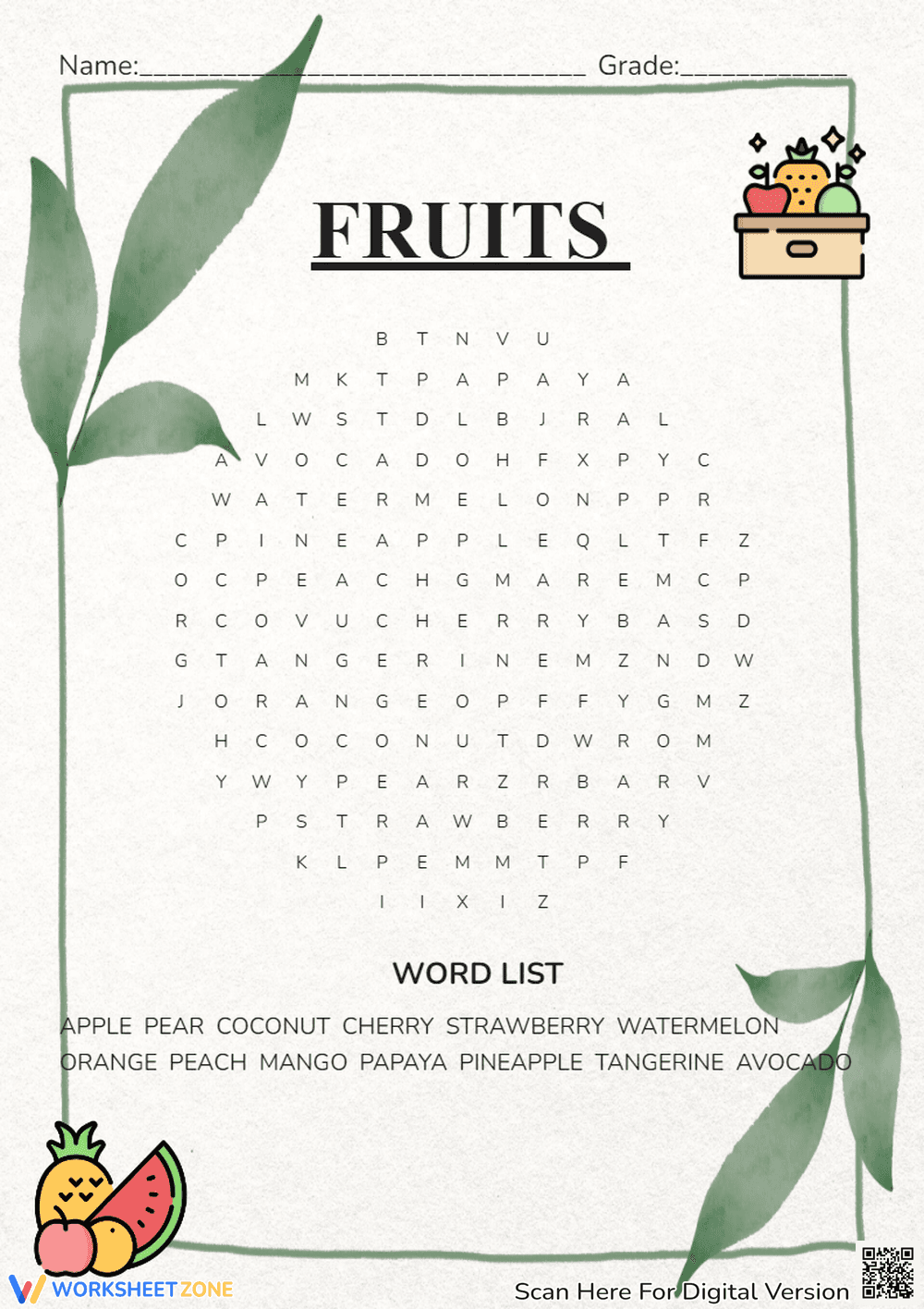

Fruits Word Search Worksheet | Grade 5 Essential
Paste this activity's link or code into your existing LMS (Google Classroom, Canvas, Teams, Schoology, Moodle, etc.).
Students can open and work on the activity right away, with no student login required.
You'll still be able to track student progress and results from your teacher account.
This Grade 5 fruits word search worksheet helps students master spelling and vocabulary through an engaging puzzle format. By identifying 14 distinct fruit names within the grid, learners strengthen their pattern recognition and orthographic processing skills. It provides a focused, low-stakes environment for students to interact with complex multi-syllabic words like tangerine and pineapple.
At a Glance
- Grade: 5 · Subject: ELA
- Standard:
CCSS.ELA-LITERACY.L.5.4— Determine or clarify the meaning of unknown and multiple-meaning words- Skill Focus: Vocabulary & Spelling
- Format: 1 page · 14 problems · Answer key included · PDF
- Best For: Morning work or early finishers
- Time: 10–15 minutes
Inside this resource, you will find a single-page, high-contrast word search grid featuring a curated list of 14 fruit-themed vocabulary words. The layout includes a clear word bank at the bottom to support student tracking. The PDF is designed for high-quality printing and includes a full answer key for rapid grading or student self-correction.
The zero-prep workflow is designed for maximum efficiency. First, print the single-page PDF (30 seconds). Second, distribute the sheets to students as they enter the room or finish primary tasks (1 minute). Third, review the completed puzzles or allow students to check their own work using the provided key (1 minute). Total teacher preparation time is under 2 minutes, making it an ideal sub-plan addition.
This worksheet aligns with CCSS.ELA-LITERACY.L.5.4, focusing on vocabulary acquisition and the ability to recognize correctly spelled academic and domain-specific words. It also supports general literacy development by reinforcing letter-string patterns. Both standard codes can be copied directly into lesson plans, IEP goals, or district curriculum mapping tools.
Use this worksheet as a bell-ringer activity to settle the class during transitions or as a rewarding task for early finishers who have completed their core ELA assignments. For a formative assessment, observe which students struggle with diagonal or reverse word patterns, as this can indicate a need for additional visual processing or orthographic support. Completion typically takes 10 to 15 minutes.
This resource is ideal for Grade 5 general education students, English Language Learners (ELL) building basic noun vocabulary, and students in special education settings requiring fine-motor and visual-scanning practice. It pairs naturally with a nutrition unit or a descriptive writing lesson focused on sensory details of food.
According to the RAND AIRS 2024 report, structured word-play activities like word searches contribute significantly to orthographic mapping, which is the process the brain uses to store words for immediate retrieval. By engaging with the 14 specific terms in this worksheet, students reinforce the connection between phonemes and graphemes in a non-threatening context. Fisher & Frey (2014) emphasize that vocabulary exposure across multiple formats—including puzzles—increases the likelihood of long-term retention compared to rote memorization alone. This Grade 5 worksheet provides the necessary repetition for students to internalize the spelling of common and academic fruit names. The alignment with CCSS.ELA-LITERACY.L.5.4 ensures that the activity serves a clear pedagogical purpose within a broader literacy framework. Educators can confidently integrate this tool into daily routines to support foundational literacy and cognitive scanning skills without increasing their administrative burden.


