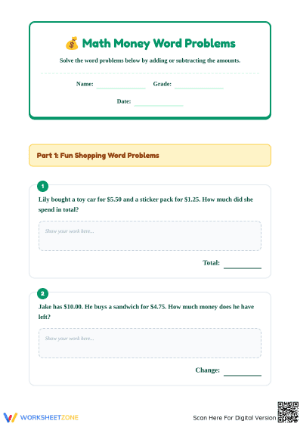
These subtracting money worksheets give teachers a sequenced, print-ready set that moves students from simple cent subtraction through multi-digit regrouping across the decimal point — the full arc of what grades 2 through 4 need to build real fluency with money math. The skills here aren't abstract; they're the same calculations students will use when making change, comparing prices, and managing a budget for the rest of their lives. Each worksheet targets a specific layer of this progression rather than mixing levels arbitrarily.
The Specific Skills Targeted
The set moves through a deliberate sequence. Early worksheets keep students working entirely in cents — amounts under $1.00 using the ¢ symbol — so they can settle into two-digit subtraction before the decimal point enters. From there, worksheets introduce whole dollar subtraction (problems like $12 − $5), which isolates place value without the added cognitive weight of decimal alignment. The middle tier adds mixed dollar-and-cent amounts without regrouping, where the work is learning to align the decimal before touching a digit. The most demanding worksheets require borrowing across the decimal — the step where grades 3 and 4 consistently struggle most.
Beyond straight computation, the set includes making-change word problems framed in shopping and allowance scenarios, and a short run of error-analysis worksheets where students examine worked problems, identify what went wrong, and rewrite the solution correctly. Both vertical and horizontal formats appear throughout, since students encounter money subtraction in both arrangements and need to recognize the structure in either orientation.
Mistakes Students Make That These Worksheets Help You Catch
Decimal misalignment is the error that shows up first and most often. Students learn to right-justify whole numbers, and that habit carries over — so a student will line up the 5 in $3.45 with the 5 in $1.05 by the rightmost digit rather than the decimal, producing an answer that is off by orders of magnitude. Worksheets with grid formatting or pre-printed decimal guides interrupt this pattern before it calculates into a habit.
Regrouping across the decimal point produces a different but equally consistent error. Many students treat the decimal as a hard boundary — they recognize that the cents column needs more, but they don't borrow from the dollars column because the decimal feels like a wall. In $5.20 − $1.85, they'll either skip the borrow entirely or produce a negative cents column they don't know what to do with. Scaffolded worksheets that break the regrouping step into labeled sub-steps make the crossing visible and manageable.
Two quieter errors also deserve attention: the notation switch (writing $0.75 correctly in one problem, then writing $75 the next time they mean seventy-five cents) and placeholder zero confusion. When a problem involves $3.40 − $1.05, a surprising number of students read $3.40 as $3.4 and drop the zero entirely, which distorts their alignment and their answer. The worksheets include problems with zeros in both the tenths and hundredths positions specifically because those cases reveal the misunderstanding in ways round numbers never will.
How to Build These Worksheets Into Your Lesson Plans
The sequence matters as much as the content. During initial instruction, projecting a worksheet and solving the first three problems aloud — narrating every alignment decision — gives students a model they can replicate before they work independently. The Monday warm-up block (the ten minutes after morning meeting before the formal lesson begins) is a reliable home for a short worksheet focused on the previous week's skill. That low-stakes repetition is where spaced retrieval does its work.
For guided practice, pull a small group with a scaffolded regrouping worksheet while the rest of the class works independently on a no-regrouping sheet. You're giving the group that needs support the most direct access to you during the most difficult part of the learning sequence — and you're doing it without stopping instruction for the whole class. Error-analysis worksheets work particularly well in pairs: when students have to explain out loud why a sample problem is wrong, they surface reasoning that a standard drill never reveals. A student who writes the correct answer without understanding the alignment rule will still get the partner discussion wrong, and that tells you something important.
Exit tickets drawn from a single problem on the next day's worksheet give you formative data before the lesson begins. If half the class misses the same step, you have your opening five minutes planned already.
Why Regrouping Across the Decimal Is Worth Slowing Down
There's a reason this skill appears explicitly in the grade 3 and 4 progression and not earlier. Cognitively, borrowing across a decimal point requires students to hold two things simultaneously: the mechanical procedure of regrouping and the conceptual understanding that a decimal separates wholes from parts without disrupting the base-ten structure. That's a significant load for a third grader who is still consolidating multi-digit subtraction with whole numbers. Rushing into regrouping before alignment is automatic adds a third demand on top of those two, and that's where the errors compound into confusion rather than errors into learning. The worksheets build alignment fluency first — deliberately, over several problems — so that when regrouping appears, students have one fewer variable to manage.
Standard Alignment
The core of this set aligns to 2.MD.C.8, which asks second graders to solve word problems involving dollar bills, quarters, dimes, nickels, and pennies using $ and ¢ symbols appropriately. The no-regrouping and coins-only worksheets map directly to this standard. The regrouping worksheets and decimal-alignment work extend into 4.NF.C.6 and 4.NF.C.7, where students use decimal notation for fractions with denominators of 10 and 100 — a standard most teachers address through money precisely because the context makes the hundredths place concrete. Connecting money subtraction to those fourth-grade standards is not a stretch; it is one of the clearest instructional on-ramps to decimal notation that elementary math offers.
Adapting the Set for Mixed-Ability Classrooms
For students still working on two-digit whole-number subtraction, the cents-only worksheets function as a bridge — the math is familiar, the ¢ notation is new, and success on those problems builds the confidence to move forward. Keeping a few of those sheets accessible without making them feel like remediation (pairing them with manipulatives like real coins) helps students who need the on-ramp without signaling that they're behind.
For students who move through the standard sequence quickly, the error-analysis worksheets offer a genuine extension rather than more of the same. Writing an explanation of another student's mistake — and then creating a correctly aligned version — asks for a level of metacognitive precision that goes well beyond computation. It's also, practically speaking, a good preparation for the kind of mathematical communication standardized assessments increasingly require.
Frequently Asked Questions
What grade levels do these worksheets fit?
The set works across grades 2 through 4. Second graders use the coins and cents-only worksheets; third graders move into mixed dollar-and-cent subtraction with and without regrouping; fourth graders connect the decimal work to broader place-value concepts. Keeping differentiated stacks by grade band makes it easy to assign the right entry point without editing problems on the fly.
Should students use grid paper or lined worksheets?
Grid formatting helps most during the regrouping stage, when misalignment errors peak. For coins-only or whole-dollar problems, standard lined formatting is sufficient. If a student is making consistent alignment errors on a lined worksheet, switching that student to a grid-formatted version of the same problem set often resolves the issue without reteaching the underlying concept — the structure does the corrective work.
How do making-change word problems differ from straight subtraction problems?
Making-change problems require students to identify what is being subtracted from what — a step that straight computation problems skip. Students have to parse "Mia paid $5.00 for a book that cost $3.47. How much change did she receive?" and recognize that the cost is subtracted from the payment. Students who can solve $5.00 − $3.47 on a computation worksheet sometimes freeze on the word problem version because the operation isn't labeled. Including both formats in the same practice cycle closes that gap.
How do I know when a student is ready to move from no-regrouping to regrouping problems?
Accuracy alone isn't the signal — speed and confidence are. A student who answers no-regrouping problems correctly but slowly, or who checks the decimal column repeatedly before writing each digit, is still building automaticity. Wait until alignment feels routine before introducing the added demand of borrowing. Two or three sessions of clean, unprompted no-regrouping work is a reasonable threshold for most third graders.
















 Interactive Worksheet Maker
 Quiz Maker
 Word Search Maker
 Crossword Puzzle Maker
 Word Scramble Generator
 Sentence Scramble Generator
 Handwriting Worksheet Generator
 Name Tracing Generator
 Fill In The Blank Generator