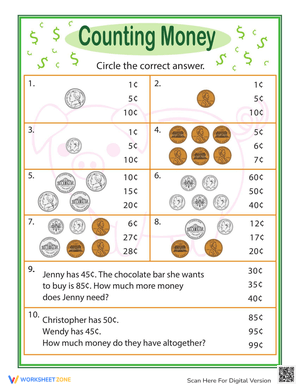
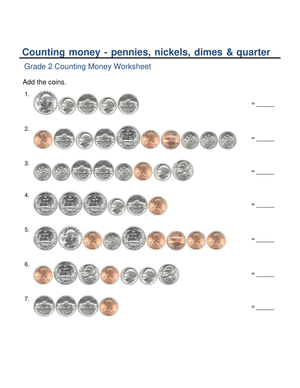
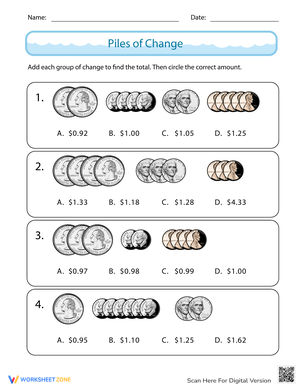
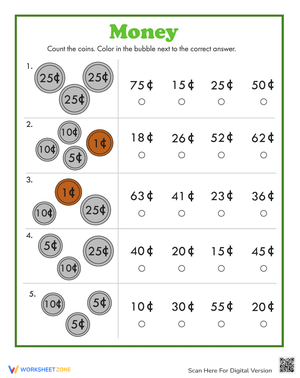
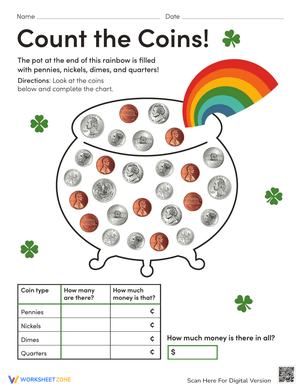
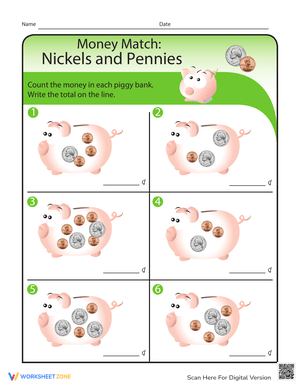
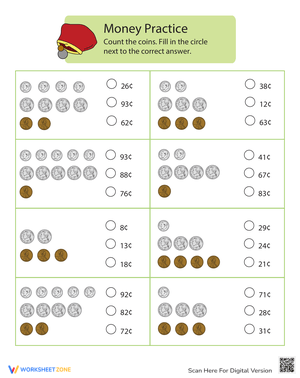
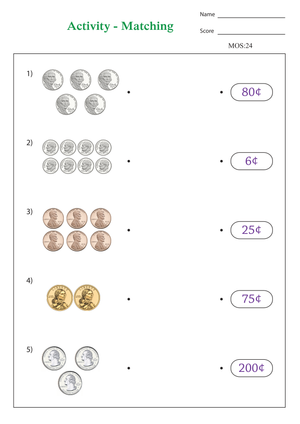
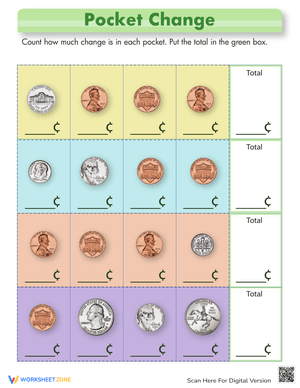
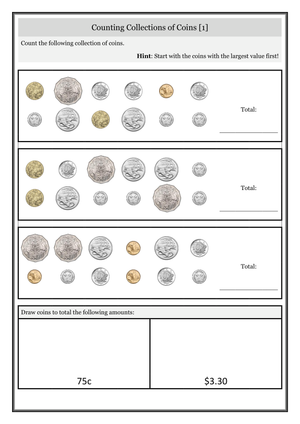
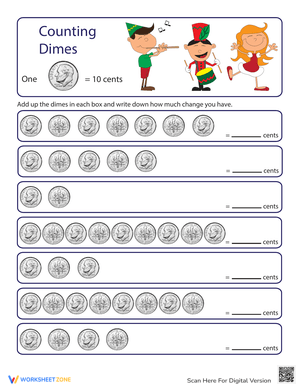
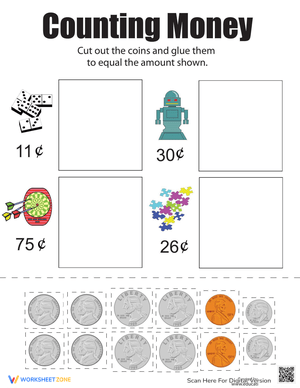
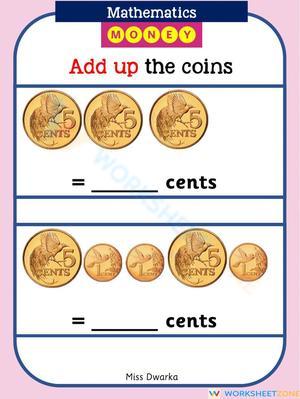
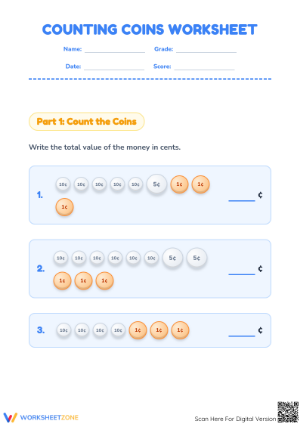
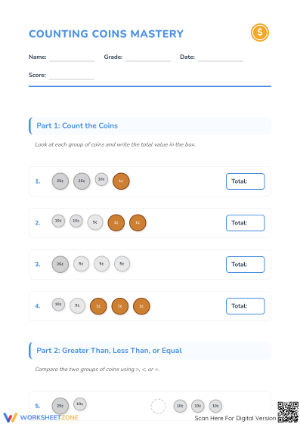
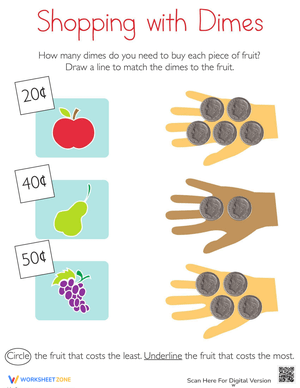
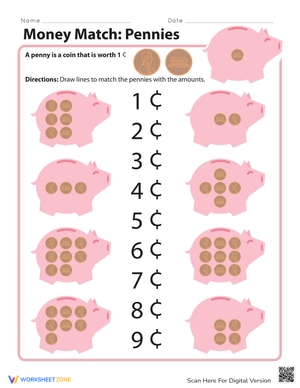
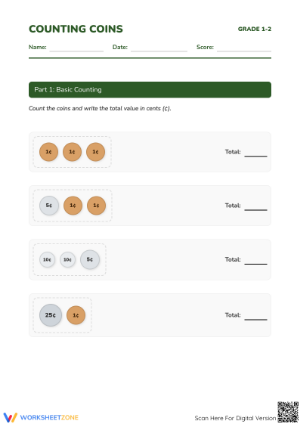
These adding groups of coins worksheets give 2nd grade teachers a structured, sequenced way to move students from coin identification toward fluent mixed-coin addition — the specific cognitive bottleneck that trips up most 7-year-olds when money math begins. Each worksheet targets a defined stage of that progression, so practice builds on itself rather than jumping students into mixed-denomination problems before they are ready.
What's Inside the Set
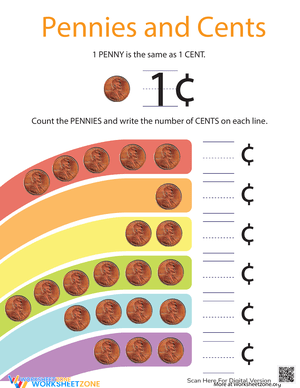
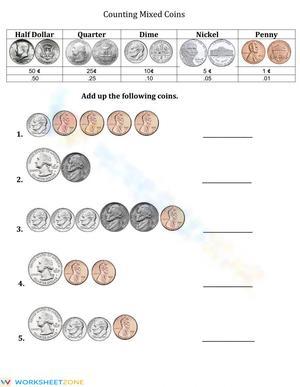
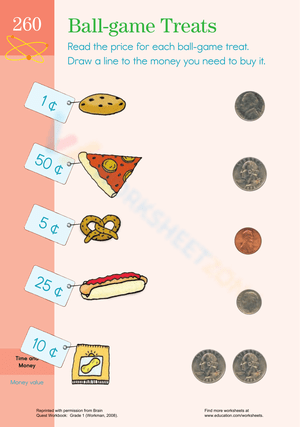
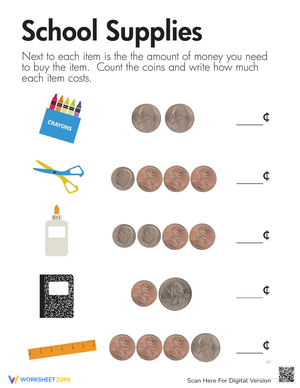
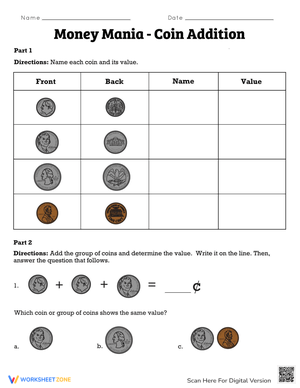
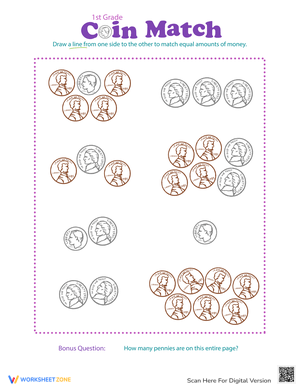
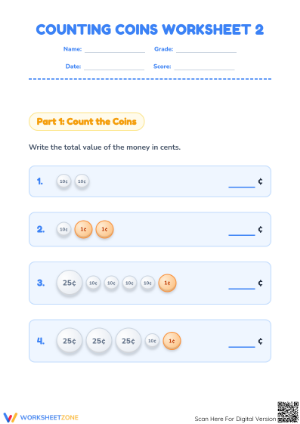
The worksheets span the full arc of second-grade coin work. Early worksheets focus on single-denomination counting — a row of dimes, a row of nickels — so students build skip-counting rhythm before denomination-switching is introduced. Mid-set worksheets introduce two coin types, then three, with coin images arranged in descending value order so students can count directly across the page rather than reorganizing first. Later worksheets present mixed groups without predetermined order, requiring students to sort, label each coin's value, and track a running total. That last format is where most classroom assessments fall, and students who have worked through the earlier stages get there without the paralysis that comes from skipping steps.
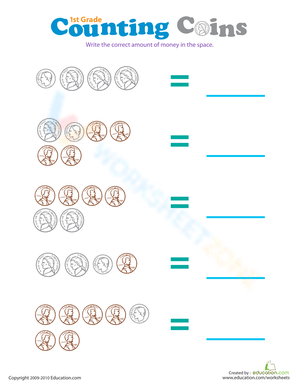
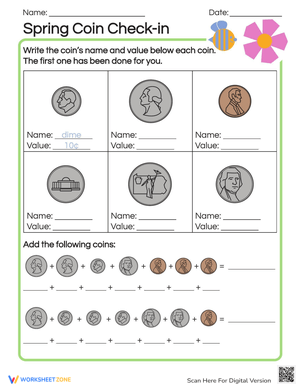
Coin images are printed large enough to show identifying detail — edge texture, portrait scale, the relief difference between a quarter and a nickel — because in black-and-white printouts those distinctions disappear quickly when images are small or low-resolution. Several worksheets include a running-total scaffold: a blank beneath each coin where students record the cumulative count as they go. This single structural feature substantially reduces the error type where a student correctly identifies every coin but loses the thread mid-sequence.
Standard Alignment
These worksheets align to 2.MD.C.8, which asks second graders to solve word problems involving dollar bills, quarters, dimes, nickels, and pennies using dollar and cent symbols appropriately. Instructionally, this standard sits at the intersection of skip-counting fluency (2.NBT.A.2), place value reasoning, and the measurement-and-data strand — which is why money math is more demanding than it looks when reduced to "counting coins." A student who can add 25 + 10 abstractly may still struggle when those numbers are embedded in coin images requiring identification and sorting first. The worksheets address all three layers: identification, counting strategy, and symbolic notation.
The Specific Skills Targeted
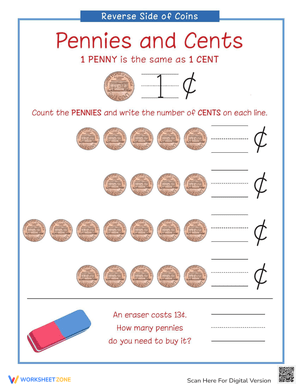
- Instant identification of quarters, dimes, nickels, and pennies from heads and tails orientations — worksheets include both, because real coins don't always land face-up
- Skip-counting by 25s, 10s, 5s, and 1s, practiced first in isolation and then in combination
- Dynamic switching between skip-counting intervals mid-sequence, the executive-function demand that makes mixed-coin addition harder than it looks on paper
- Sorting a coin group from greatest to least before counting — a procedural habit that reduces calculation errors across every problem type
- Writing totals using the cent symbol and, in later worksheets, the dollar sign with decimal notation
How to Build These Worksheets Into Your Lesson Plans
The highest-leverage use is the daily warm-up. Five minutes at the start of your math block — projecting a coin group, counting aloud as a class, then having students verify on an individual worksheet — builds the retrieval habit that a once-a-week coin unit never does. Spaced retrieval across several weeks outperforms massed practice every time with automaticity skills like this one, and coin identification is fundamentally an automaticity skill before it becomes an addition skill.
For the lesson itself, the worksheets work best after physical manipulation, not instead of it. Let students sort plastic coins at their desks, then move to the worksheet version of the same problem. The transition from three-dimensional object to printed image is a genuine cognitive step for 7-year-olds, and bridging it deliberately — rather than assuming it transfers automatically — prevents a category of errors that looks like carelessness but is actually a representation problem. The worksheets also serve as clean formative data: a student whose running totals go wrong at the dime-to-nickel transition is telling you something specific about where the skip-counting switch breaks down, which is more actionable than a circled wrong answer on a quiz.
Mistakes Students Make That These Worksheets Help You Catch
The most persistent error is counting every coin as one unit regardless of value — a student who counts four coins and writes "4 cents" is still operating in object-counting mode rather than value mode. These students need more time with single-denomination sets before mixed groups are introduced. The worksheets' sequenced structure makes this regression easy to manage: move the student back one tier rather than reteaching the entire concept.
A subtler error appears with quarters specifically. Students who have solid 10s and 5s rhythm will often count a quarter as "10" because it is the largest coin they see and they anchor to the dime's value. The problem surfaces in mixed problems that lead with a quarter: a student writes "10, 20, 25, 26" instead of "25, 35, 40, 41." Catching this requires looking at running-total work, not just the final answer — which is exactly why the running-total scaffold earns its space on the worksheet.
Nickel-quarter confusion in grayscale printouts is a real classroom problem, not a theoretical one. Teaching students to check relative size — and, with real coins, to feel the smooth nickel edge versus the ridged quarter edge — before they begin a worksheet takes thirty seconds and eliminates a category of identification errors entirely.
Adjusting the Worksheets for a Range of Learners
Students who are not yet reliable on coin identification work best with the early worksheets, with one modification: before counting begins, have them write the cent value beneath each coin image as a labeling pass. That one step separates identification from addition and prevents the two skills from compounding into a single error.
For students who have coin-value fluency but lose accuracy on longer sequences, the running-total scaffold is the right support — it externalizes working memory and keeps the calculation visible across every step. This is not remediation; it is a load-management tool. Cognitive load theory is directly applicable here: when identification, value recall, skip-counting, and running total all compete for working memory simultaneously, accuracy collapses. The scaffold reduces that competition.
Students who finish accurately and quickly benefit from the set's later worksheets, which flip the task: given a target amount, draw or list a coin combination that reaches it. This reversal requires the same knowledge applied compositionally, and it produces the kind of flexible thinking that shows up in word problems and real transactions rather than in timed computation tasks alone.
Frequently Asked Questions
At what point in 2nd grade are these worksheets typically introduced?
Most teachers introduce coin identification in the first quarter, often tying it to an existing unit on skip-counting. Mixed-coin addition — the main focus of this set — typically begins mid-year, once students have solid 5s and 10s fluency. The foundational worksheets in the set work earlier; the mixed-group worksheets work better after February for most classes.
Can these worksheets be used in 1st grade or 3rd grade?
The identification and single-denomination worksheets are appropriate for late 1st grade, particularly for students who are ahead in their number sense development. The 3rd-grade use case is targeted intervention — students who did not consolidate coin addition in 2nd grade benefit from the set's sequenced structure rather than jumping straight to dollar-and-cent decimal work.
How do I handle students who know the answers but can't show their work on the running-total scaffold?
Some students do the counting in their heads accurately but resist writing intermediate steps, which makes the scaffold feel punitive rather than supportive. Frame it as a checking strategy rather than a requirement: "Write the totals so you can catch your own mistakes." Students who are genuinely accurate will write the scaffold quickly; students who are guessing will reveal that in the work. The distinction is worth having.
Do the worksheets include word problems or only visual coin groups?
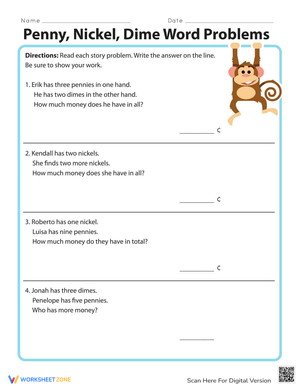
The set focuses primarily on visual coin groups — images to identify, count, and total — which is the foundational format before word problems are introduced. Word problems embed the same skill inside a reading-comprehension layer, which is a separate instructional challenge. These worksheets isolate the coin-addition skill deliberately.













 Interactive Worksheet Maker
 Quiz Maker
 Word Search Maker
 Crossword Puzzle Maker
 Word Scramble Generator
 Sentence Scramble Generator
 Handwriting Worksheet Generator
 Name Tracing Generator
 Fill In The Blank Generator