




























Views
Downloads

Essential Grade 3 Weight Comparison & Ordering Worksheet

Paste this activity's link or code into your existing LMS (Google Classroom, Canvas, Teams, Schoology, Moodle, etc.).
Students can open and work on the activity right away, with no student login required.
You'll still be able to track student progress and results from your teacher account.
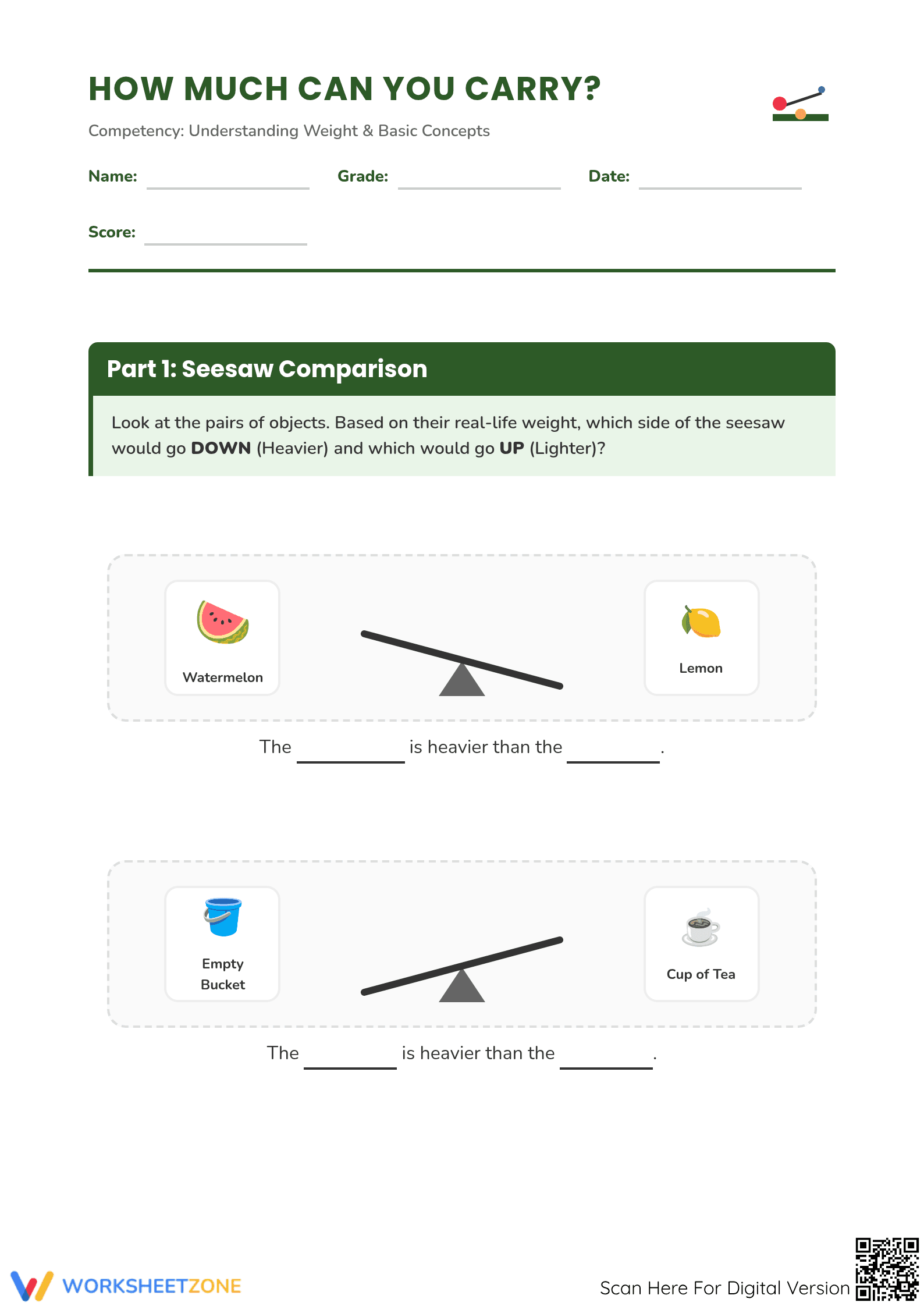
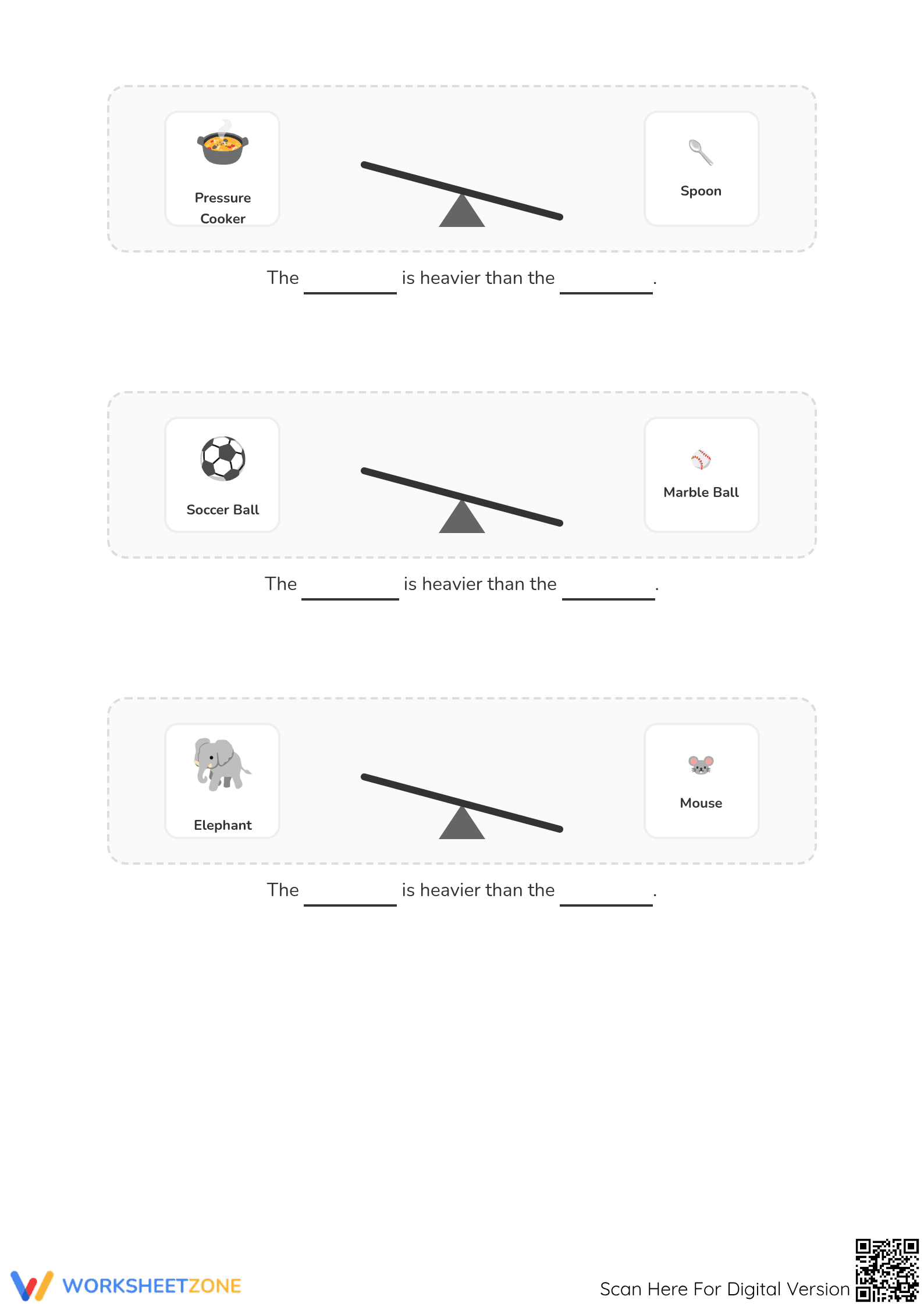
Students often struggle to conceptualize weight without physical scales, making qualitative estimation a critical early numeracy skill. This essential math worksheet enables Grade 3 learners to compare and order objects by mass through engaging visual models and real-world logic. By completing these eight tasks, students demonstrate a clear understanding of relative weight properties.
At a Glance
- Grade: 3 · Subject: Math
- Standard:
CCSS.MATH.CONTENT.3.MD.A.2— Estimate and measure the mass of objects using logical reasoning and units- Skill Focus: Qualitative weight comparison and sequencing
- Format: 3 pages · 8 problems · Answer key included · PDF
- Best For: Intro lesson or quick formative assessment
- Time: 15–20 minutes
What's Inside
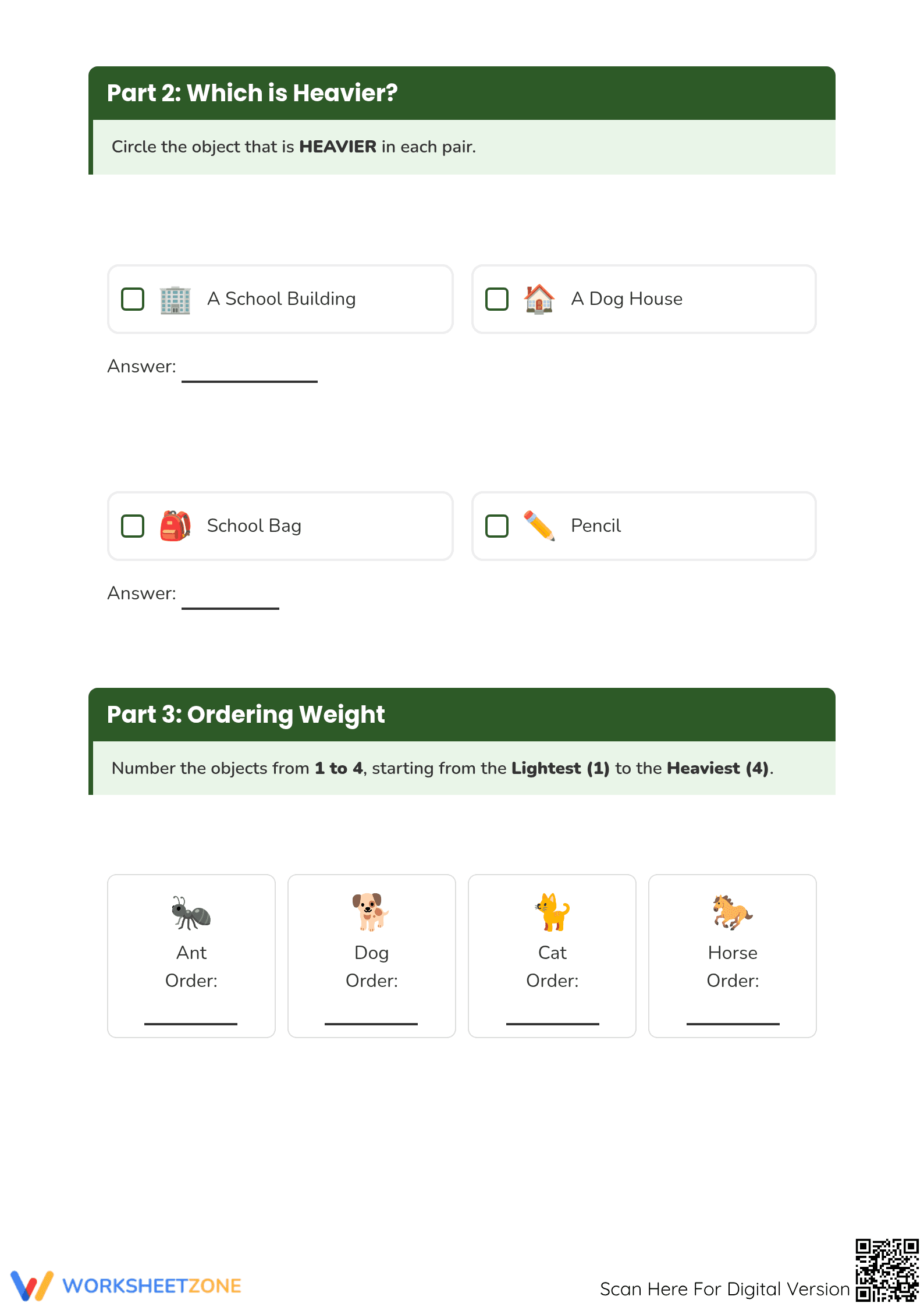
This comprehensive three-page packet includes three distinct parts designed to build conceptual mastery. Students begin with five seesaw comparison tasks, followed by two real-life logic problems requiring them to identify the heavier object between pairs like a school building and a dog house. The final page features a multi-object sequencing task where students order four animals from lightest to heaviest.
Zero-Prep Workflow
Implementing this activity requires zero teacher preparation, making it an ideal choice for busy mornings or unexpected substitute plans. Follow these three simple steps: First, print the three-page PDF (30 seconds). Second, distribute the packets to students for independent or partner work (15 minutes). Third, use the included answer key for immediate self-correction or whole-class review (2 minutes). The entire workflow takes less than 20 minutes from printer to gradebook.
Standards Alignment
The primary alignment is `CCSS.MATH.CONTENT.3.MD.A.2`, which requires students to measure and estimate liquid volumes and masses of objects. While this resource focuses on qualitative estimation rather than gram-specific measurement, it builds the prerequisite logical framework. This standard code can be copied directly into lesson plans, IEP goals, or district curriculum mapping tools to track student progress toward measurement mastery.
How to Use It
Use this worksheet as a warm-up activity before introducing standard units of mass like grams and kilograms. It serves as an excellent formative assessment tool; observe students during Part 3 to see if they can logically sequence four distinct animals based on size and biology. Expected completion time ranges from 15 to 20 minutes depending on whether students work independently or in guided small groups.
Who It's For
This resource is designed for Grade 2 through Grade 4 students who are beginning their measurement units. It is particularly effective for English Language Learners (ELLs) due to the heavy reliance on visual cues and familiar icons. For differentiation, pair this worksheet with a physical balance scale and common classroom items to provide a tactile experience that mirrors the digital seesaw models.
The mastery of measurement concepts, specifically the estimation and qualitative comparison of mass, serves as a foundational bridge to more complex physical science applications. According to Fisher & Frey (2014), instructional materials that utilize familiar real-world objects—such as elephants, mice, and school buildings—help students construct mental schemas for abstract mathematical values. This worksheet, aligned to CCSS.MATH.CONTENT.3.MD.A.2, requires students to apply logical reasoning to determine relative weight through three distinct cognitive tasks: visual seesaw analysis, direct selection, and multi-object sequencing. By progressing from binary comparisons to a four-point ordinal scale, the resource reinforces the ability to estimate masses effectively. Research indicates that this gradual increase in cognitive demand supports long-term retention of measurement standards. Educators can utilize these eight structured problems to assess prerequisite knowledge or provide focused intervention, ensuring students achieve the conceptual clarity required for future quantitative measurement tasks in upper elementary grades.


