


























Views
Downloads

Printable Quadrilaterals Worksheet: Classification for Grades 5-6
Paste this activity's link or code into your existing LMS (Google Classroom, Canvas, Teams, Schoology, Moodle, etc.).
Students can open and work on the activity right away, with no student login required.
You'll still be able to track student progress and results from your teacher account.
This comprehensive quadrilaterals worksheet provides Grade 5 and 6 students with a structured pathway to mastering the hierarchy of 4-sided polygons. By analyzing properties of sides, angles, and diagonals, learners move beyond simple naming to deep conceptual understanding. It is an essential tool for building the geometric reasoning required for middle school math success.
At a Glance
- Grade: 5–6 · Subject: Geometry
- Standard:
CCSS.MATH.CONTENT.5.G.B.4— Classify two-dimensional figures in a hierarchy based on properties- Skill Focus: Quadrilateral properties and classification
- Format: 4 pages · 16 tasks · Answer key included · PDF
- Best For: Independent geometry practice or formative assessment
- Time: 25–35 minutes
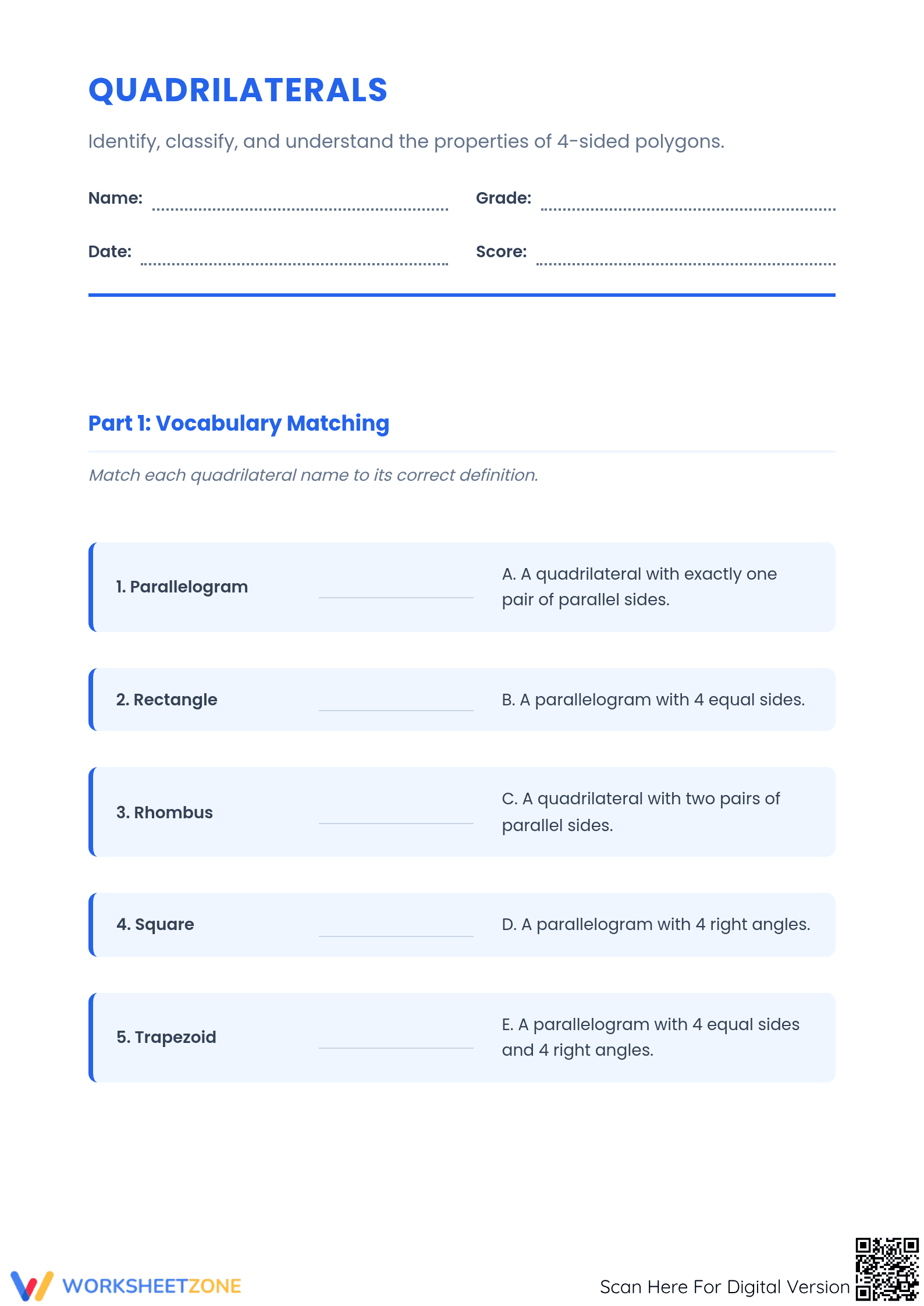
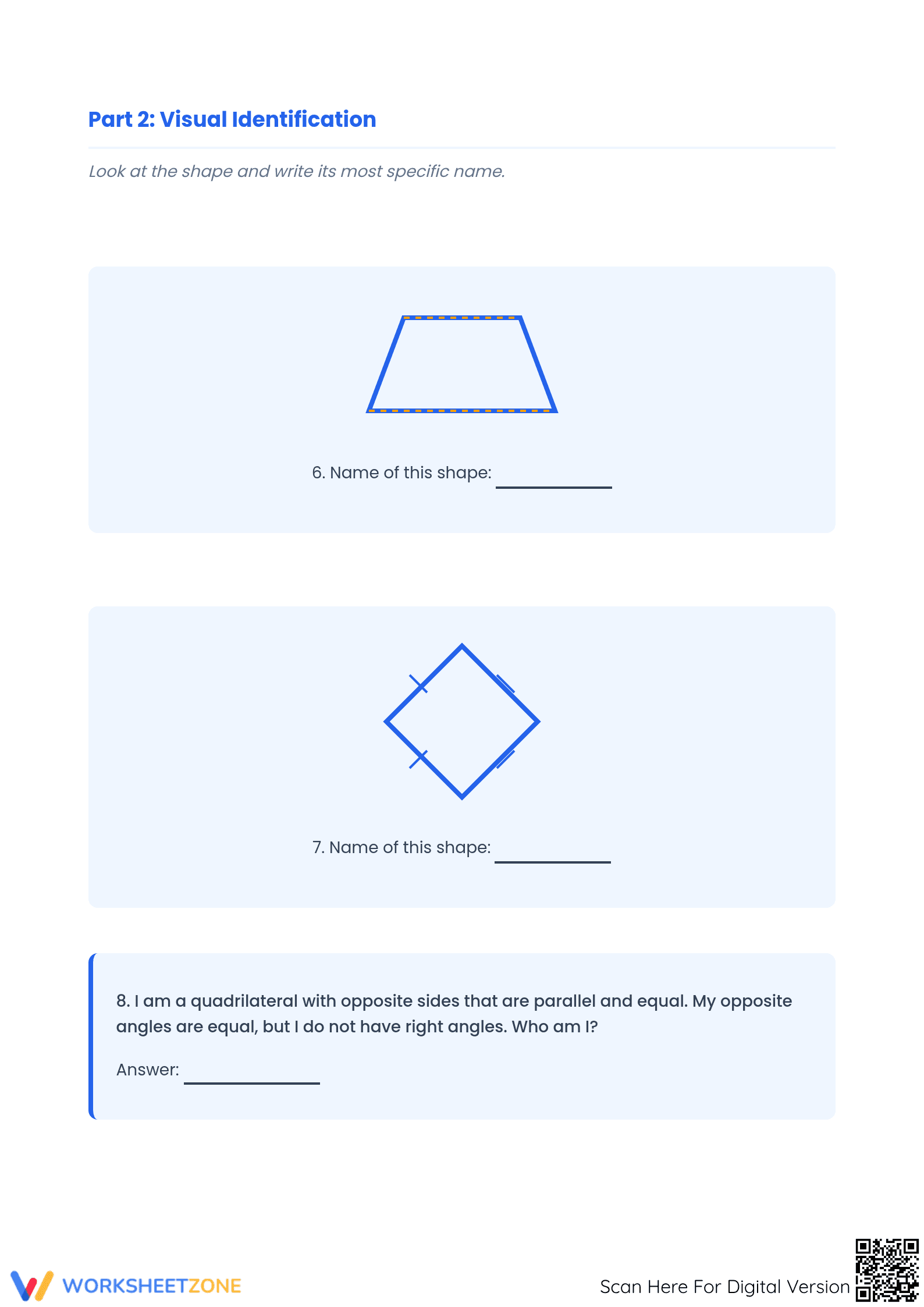
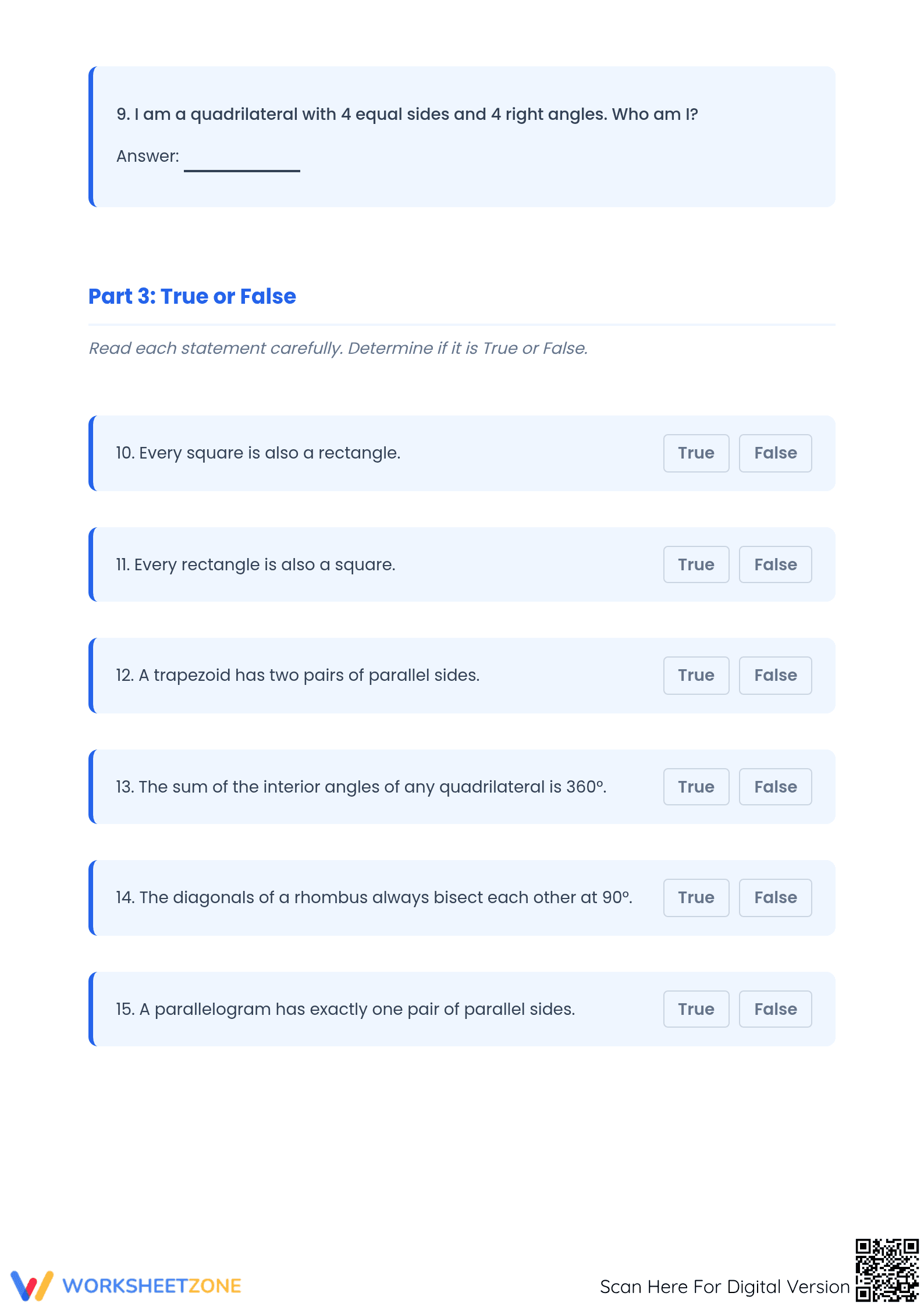
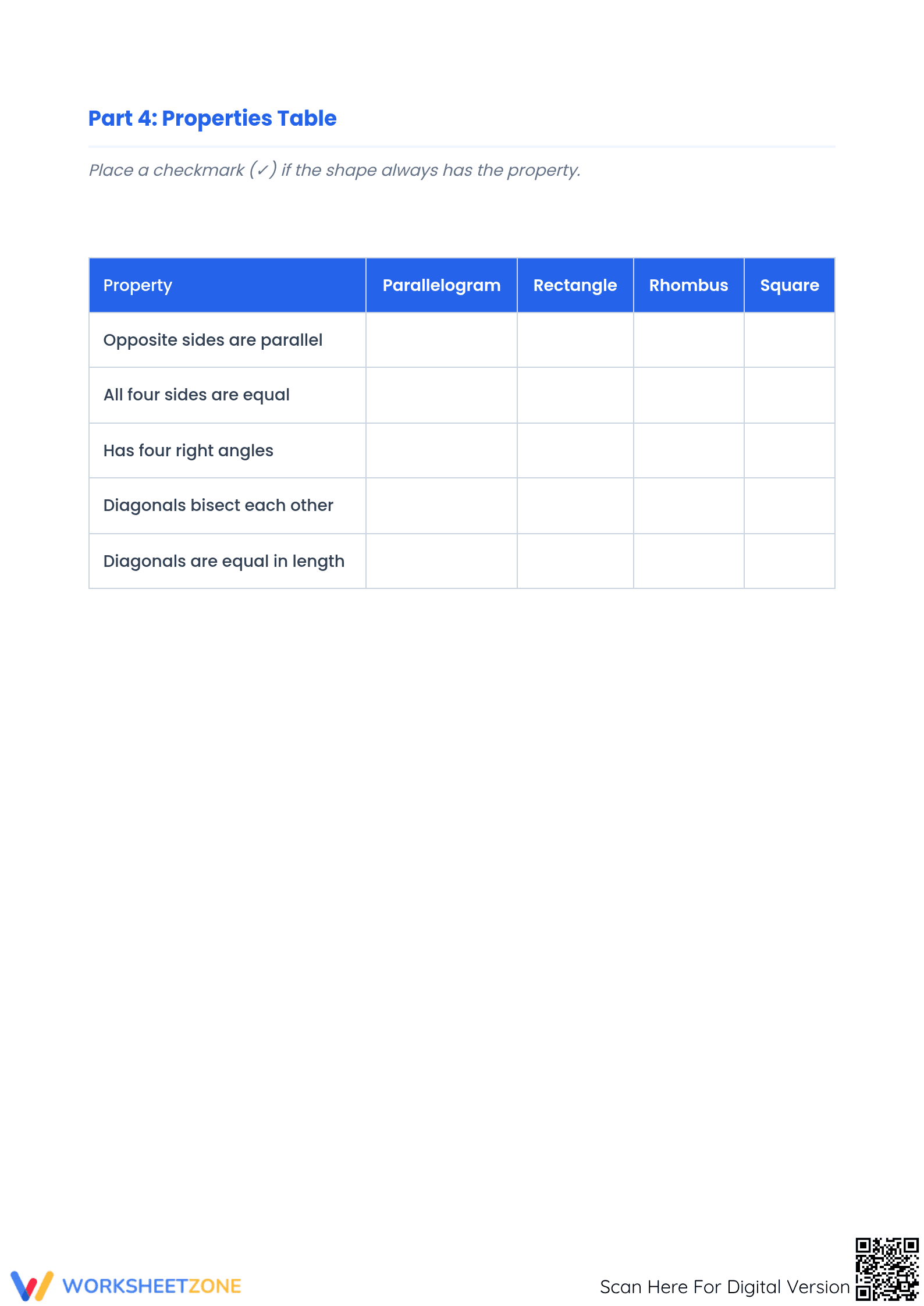
The 4-page PDF contains 16 diverse tasks designed to challenge and verify student comprehension. It begins with vocabulary matching for core terms like rhombus and trapezoid, followed by visual identification and property-based riddles. The third page features rigorous true/false statements to address common misconceptions, while the final page provides a comprehensive properties table for systematic analysis of parallel sides, equal lengths, and diagonal behaviors.
Skill Progression
- Guided practice: 5 matching tasks introduce students to formal definitions, allowing them to anchor their understanding of specific quadrilateral traits before applying them to visual models.
- Supported practice: 4 identification and riddle tasks require students to interpret visual diagrams and descriptive clues, bridging the gap between abstract definitions and concrete geometric representations.
- Independent practice: 7 true/false questions and a detailed properties matrix demand high-level analysis and comparison across multiple shape categories.
This "I Do, We Do, You Do" structure ensures students build confidence as the cognitive demand increases from recall to synthesis.
Standards Alignment
The primary focus is CCSS.MATH.CONTENT.5.G.B.4, which requires students to classify two-dimensional figures in a hierarchy based on properties. This resource also supports CCSS.MATH.CONTENT.5.G.B.3 by helping students understand that attributes belonging to a category of two-dimensional figures also belong to all subcategories. Both standard codes can be copied directly into lesson plans, IEP goals, or district curriculum mapping tools.
How to Use It
Use this worksheet as a concluding activity after a direct instruction lesson on the hierarchy of quadrilaterals. It serves as an excellent formative assessment tool; observe students during the True/False section to identify those struggling with subcategory relationships (e.g., why a square is always a rectangle). Expect most students to complete the full 16-item set within 30 minutes.
Who It's For
Designed for 5th and 6th-grade math classrooms, this resource is ideal for general education students and those needing targeted geometry intervention. It pairs naturally with an interactive geometry notebook or a physical sorting activity using attribute blocks. The clear formatting also makes it a reliable resource for special education teachers working on specific IEP geometry benchmarks.
Mastering the hierarchical classification of quadrilaterals, as defined in CCSS.MATH.CONTENT.5.G.B.4, is a critical milestone in geometric reasoning. Research from EdReports (2024) indicates that high-quality instructional materials must explicitly link definitions to visual properties to foster long-term retention of spatial concepts. This worksheet addresses that need by requiring students to move from matching definitions to populating a complex property matrix. This progression aligns with the van Hiele model of geometric thought, specifically transitioning students from the level of analysis to informal deduction. By requiring students to evaluate the relationships between parallel sides, right angles, and diagonal bisection across 16 varied tasks, this resource ensures that the "all-some-none" relationships inherent in geometry are explored deeply. The inclusion of a comprehensive answer key allows for immediate feedback, which has has been shown to significantly improve accuracy in identifying non-prototypical shapes.


