


























Views
Downloads

5.G.B.4 Aligned Worksheet: Quadrilateral Diagonals — Grade 5
Paste this activity's link or code into your existing LMS (Google Classroom, Canvas, Teams, Schoology, Moodle, etc.).
Students can open and work on the activity right away, with no student login required.
You'll still be able to track student progress and results from your teacher account.
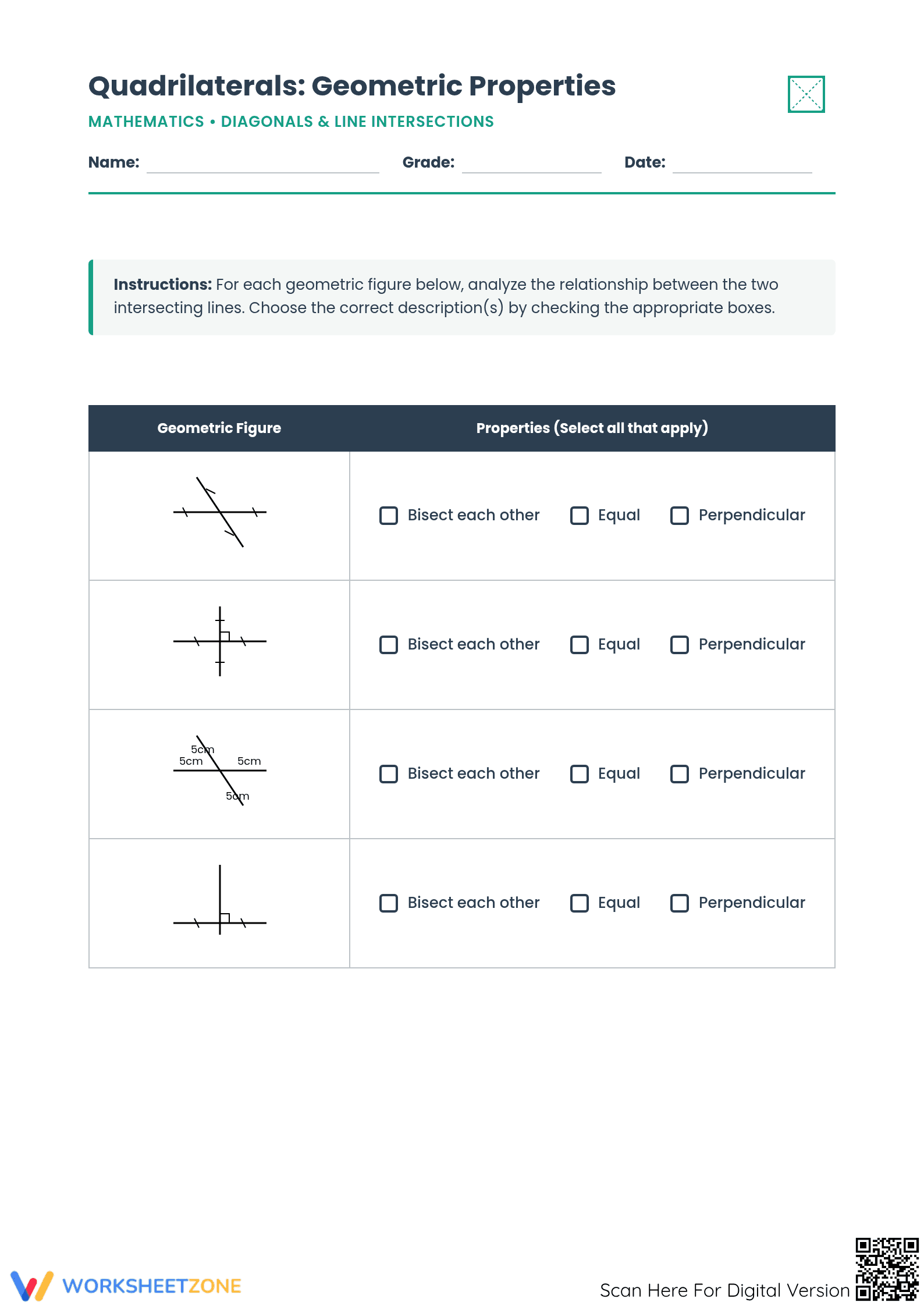
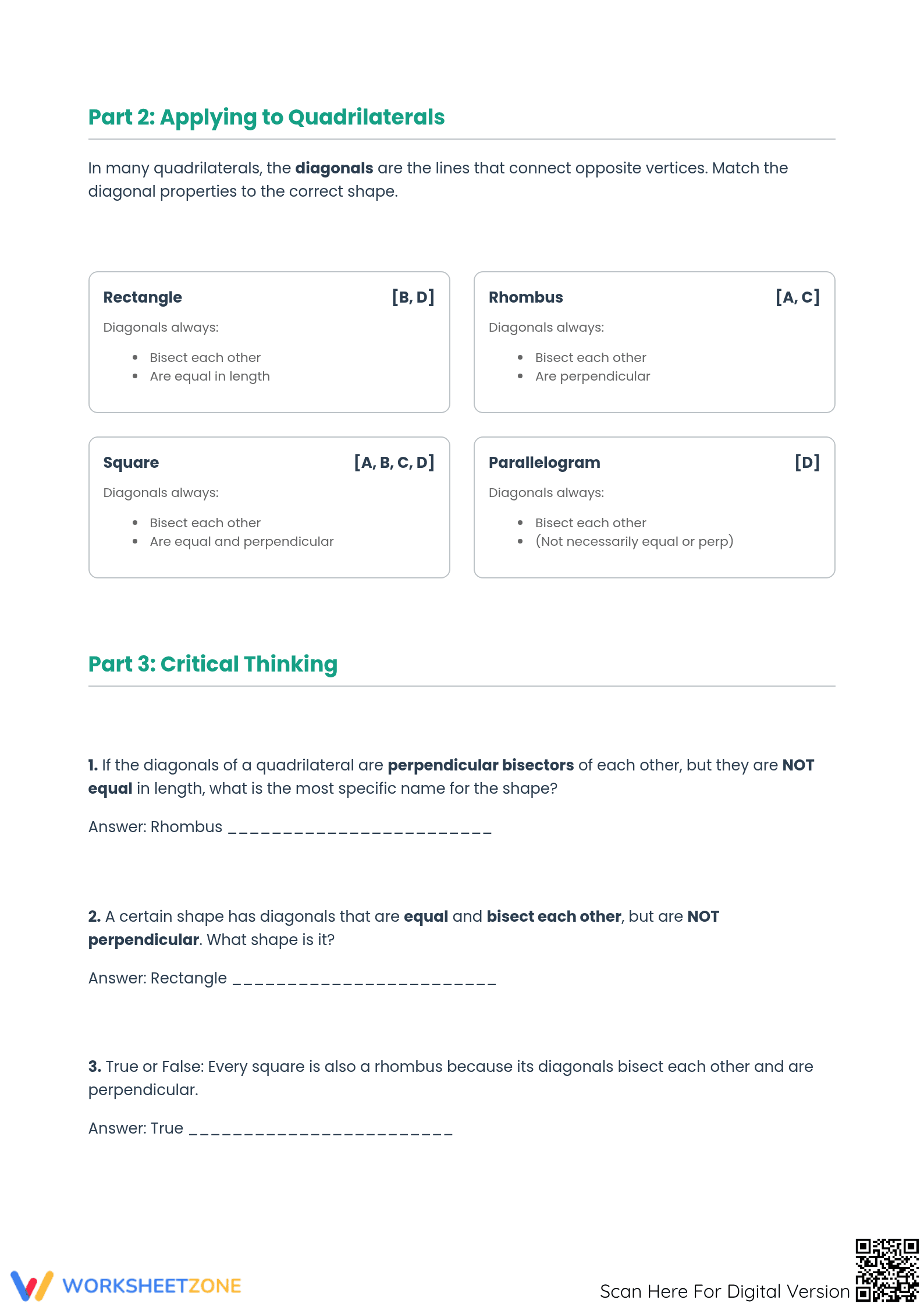
Classify quadrilaterals with precision using this specialized Grade 5 geometry worksheet. Students analyze diagonals to identify squares, rectangles, rhombuses, and parallelograms based on intersection properties. By focusing on bisection, equality, and perpendicularity, learners move beyond surface-level shapes to understand the geometric logic of figure classification and hierarchical relationships within the quadrilateral family.
At a Glance
- Grade: 5 · Subject: Math
- Standard:
CCSS.MATH.CONTENT.5.G.B.4— Classify two-dimensional figures in a hierarchy based on properties- Skill Focus: Quadrilateral diagonal properties
- Format: 2 pages · 11 problems · Answer key included · PDF
- Best For: Geometry unit assessment or guided practice
- Time: 20–30 minutes
What's Inside
This comprehensive two-page PDF includes a scaffolded 11-task progression designed for mastery of geometric properties. Page one features a visual analysis table where students check boxes for specific intersection behaviors. Page two transitions to shape-specific matching and critical thinking word problems that require students to apply their knowledge to identify figures like rhombuses and rectangles based on constrained property sets.
Mastery Evidence
The worksheet aligns tasks to the specific mastery levels required by CCSS.MATH.CONTENT.5.G.B.4. Initial identification tasks map to "Approaching" benchmarks, while the matching section targets "Meeting" standards for property recognition. The final critical thinking section provides evidence for "Exceeding" mastery, as students must synthesize multiple properties to name specific shapes. Results from these sections can be entered directly into gradebooks or used for IEP goal progress monitoring.
Standards Alignment
The primary focus is CCSS.MATH.CONTENT.5.G.B.4: "Classify two-dimensional figures in a hierarchy based on properties." This resource explicitly requires students to use diagonal relationships—a key defining property—to distinguish between subcategories of parallelograms. It also supports `5.G.B.3` by demonstrating how properties like bisecting diagonals are shared across the hierarchy. Both standard codes can be copied directly into lesson plans, IEP goals, or district curriculum mapping tools.
How to Use It
Assign this worksheet during the "You Do" phase of a geometry lesson on quadrilateral attributes. It serves as an excellent formative assessment tool; teachers should observe if students can distinguish between "bisecting" and "perpendicular" in the visual table. Expected completion time is approximately 25 minutes, making it suitable for a focused classwork session or a rigorous homework assignment following direct instruction.
Who It's For
Designed for Grade 5 students mastering the geometry domain, this resource is particularly effective for those needing concrete visual representations of abstract properties. It pairs naturally with physical geoboards or interactive software to help students visualize why diagonals in a rectangle must be equal while those in a rhombus must be perpendicular for proper classification.
This Grade 5 math resource targets CCSS.MATH.CONTENT.5.G.B.4 through a rigorous analysis of quadrilateral diagonal properties, including bisection and perpendicularity. By structuring tasks from visual identification to abstract critical thinking, the worksheet facilitates the cognitive shift from descriptive to analytic geometry. According to the RAND AIRS 2024 report on mathematical instructional materials, the use of structured property-based classification significantly improves student retention of hierarchical figure relationships compared to rote memorization of shape names. The inclusion of complex intersection diagrams ensures that students develop the visual-spatial reasoning necessary for middle-school coordinate geometry. This evidence-based approach aligns with EdReports 2024 criteria for instructional depth and standards-based rigor. Teachers can utilize these findings to justify instructional time spent on complex geometric proofs, ensuring that students meet the high expectations of college and career readiness standards.


