


























Views
Downloads

Printable Quadrilaterals Reference & Practice | Grade 5 Math
Paste this activity's link or code into your existing LMS (Google Classroom, Canvas, Teams, Schoology, Moodle, etc.).
Students can open and work on the activity right away, with no student login required.
You'll still be able to track student progress and results from your teacher account.
Classifying 2D shapes is a vital geometry skill requiring students to distinguish figures based on specific properties. This Grade 5 quadrilaterals worksheet helps students recognize the characteristics of squares, rectangles, rhombuses, and trapezoids. By analyzing side lengths and angle measures, students learn to accurately categorize 2D figures in a mathematical hierarchy.
At a Glance
- Grade: 5 · Subject: Math/Geometry
- Standard:
CCSS.MATH.CONTENT.5.G.B.4— Classify two-dimensional figures in a hierarchy based on properties- Skill Focus: Quadrilateral identification and property analysis
- Format: 2 pages · 4 problems · Answer key included · PDF
- Best For: Geometry unit introduction or independent practice
- Time: 15–20 minutes
What's Inside
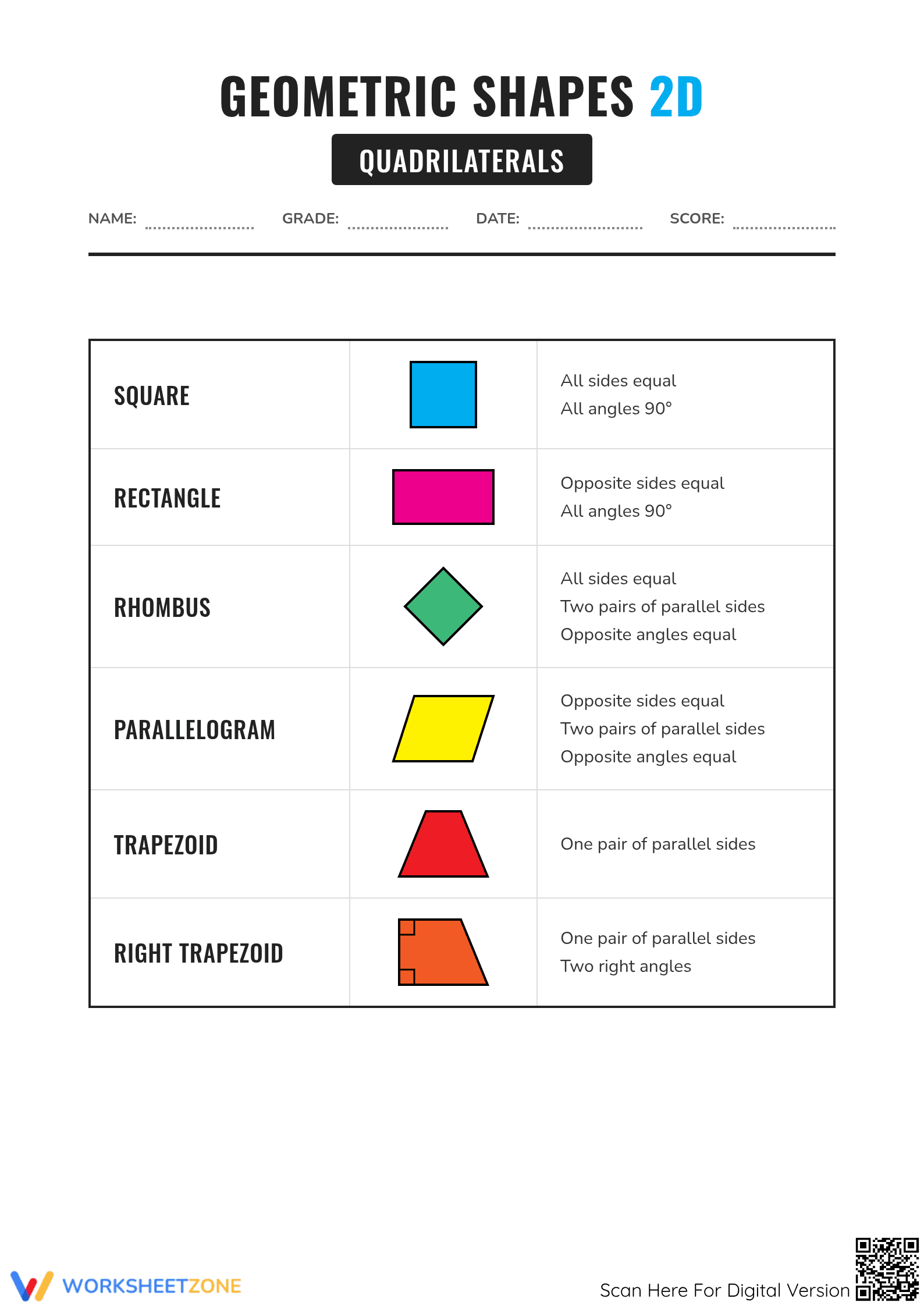
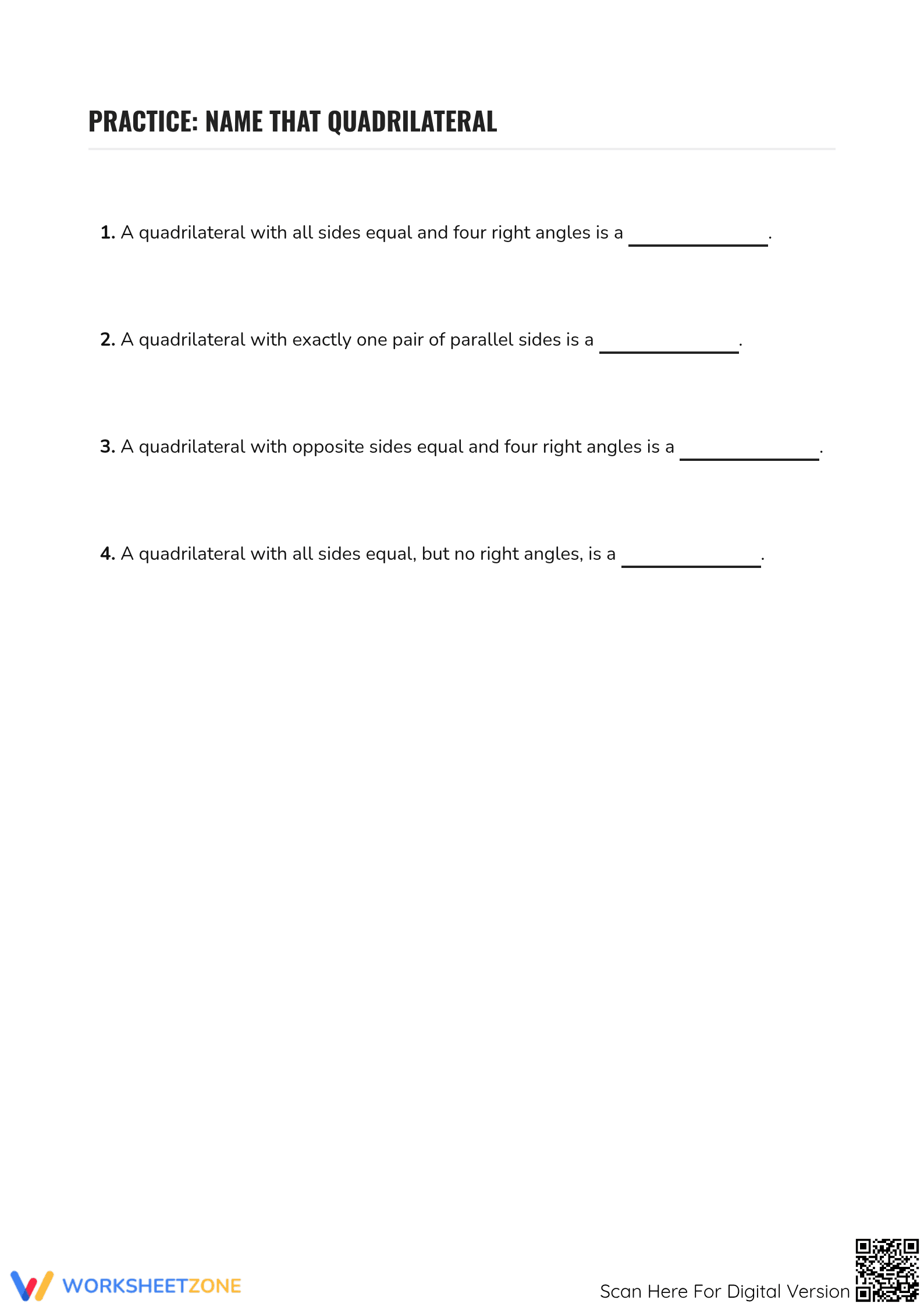
This two-page resource features a visual reference chart and a targeted practice set. The first page provides a guide to six quadrilaterals, listing attributes like "all sides equal" or "parallel sides." The second page transitions students to independent work with four problems where they name shapes based on specific geometric criteria.
Skill Progression
- Guided observation: Students use the reference chart to learn formal definitions and visual representations.
- Supported practice: Students compare verbal descriptions to the visual models to build attribute recognition.
- Independent practice: Students complete the four practice questions without direct scaffolds.
This gradual-release approach follows the "I Do, We Do, You Do" instructional model, ensuring student confidence before independent application.
Standards Alignment
This resource aligns with CCSS.MATH.CONTENT.5.G.B.4, requiring students to "Classify two-dimensional figures in a hierarchy based on properties." It also supports CCSS.MATH.CONTENT.5.G.B.3 regarding subcategory attributes. These standard codes can be copied directly into lesson plans, IEP goals, or district curriculum mapping tools to track student progress effectively.
How to Use It
Use the reference page during direct instruction as a visual anchor. Assign the second page as a quick check for understanding or formative assessment. Observe if students can differentiate between "exactly one pair" and "two pairs" of parallel sides to identify trapezoid misconceptions. The expected completion time is under 20 minutes.
Who It's For
This worksheet is designed for fifth graders but serves as a review for middle schoolers or a challenge for fourth graders. It is effective for visual learners requiring clear definitions. Pair this resource with a geometry passage or pattern blocks to create a multisensory station that reinforces shape recognition.
Effective geometric classification relies on spatial reasoning and the ability to distinguish defining attributes. According to the RAND AIRS 2024 report, instructional materials providing visual anchors—like the reference chart in this CCSS.MATH.CONTENT.5.G.B.4 worksheet—significantly improve a student’s ability to apply properties during independent tasks. By moving from a concrete visual model to abstract descriptions, this resource supports the transition to higher-order thinking required in secondary mathematics. Educators can utilize these four structured problems to measure progress toward the plain-English skill: classifying 2D figures in a hierarchy based on properties. Research from NAEP suggests that consistent exposure to property-based definitions is a key indicator of long-term success in geometry. This PDF provides the essential tools needed for students to master complex quadrilateral relationships while providing teachers with immediate data for instructional adjustments.


