


























Views
Downloads




Grade 5 Geometry & Angles — Printable No-Prep Worksheet
Paste this activity's link or code into your existing LMS (Google Classroom, Canvas, Teams, Schoology, Moodle, etc.).
Students can open and work on the activity right away, with no student login required.
You'll still be able to track student progress and results from your teacher account.
This comprehensive Grade 5 math worksheet evaluates student mastery of two-dimensional geometry and angle measurement. By working through these structured exercises, students will classify quadrilaterals based on their unique properties, identify angle types, and demonstrate proficiency in using a protractor to measure and draw specific angles.
At a Glance
- Grade: 5 · Subject: Math
- Standard:
CCSS.MATH.CONTENT.5.G.B.4— Classify two-dimensional figures based on properties- Skill Focus: Quadrilaterals and Angle Measurement
- Format: 5 pages · 15 problems · Answer key included · PDF
- Best For: End-of-unit assessment or review
- Time: 30–45 minutes
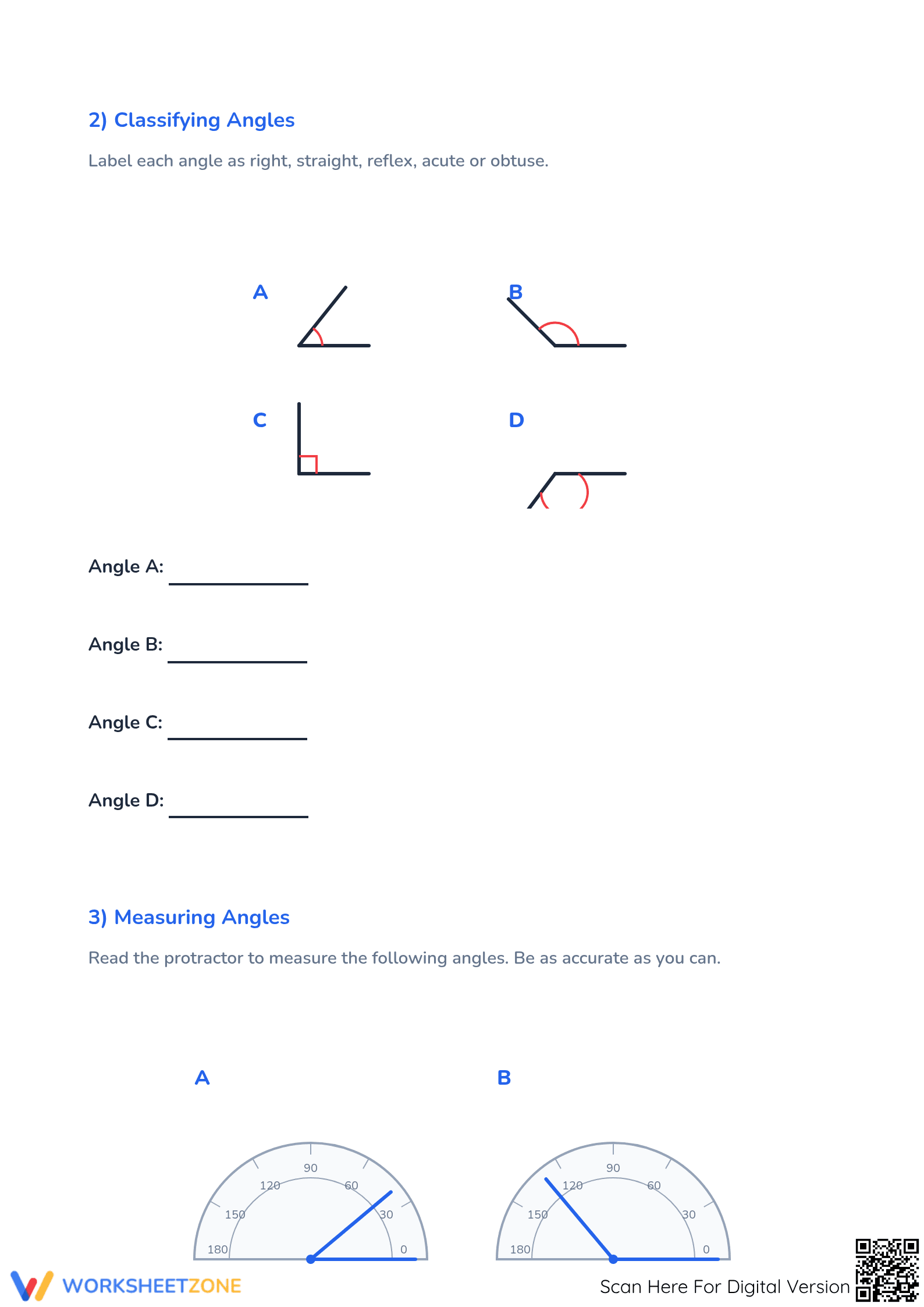
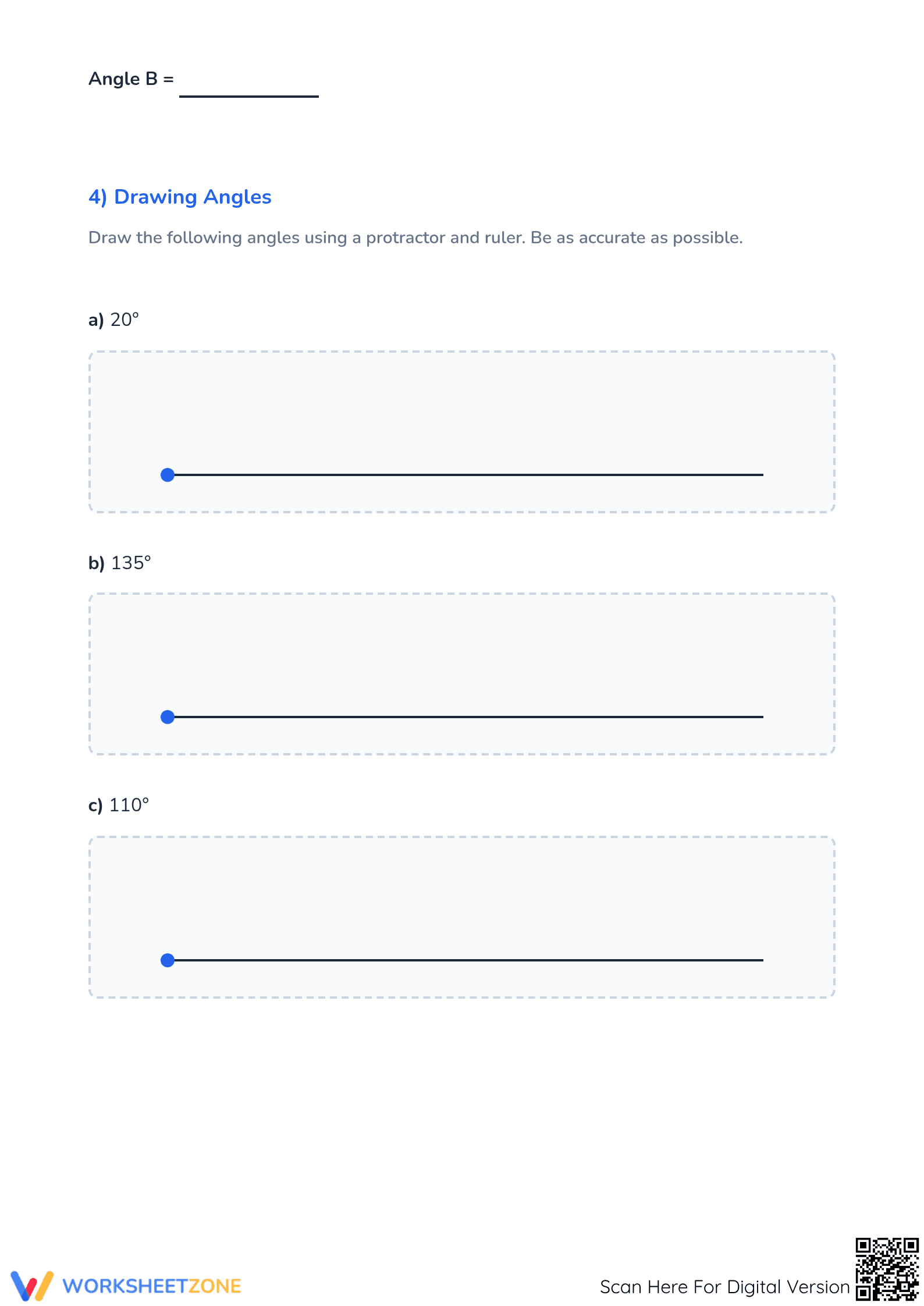
This five-page assessment features multiple task types. The first section includes a word bank and property table where students identify quadrilaterals like rhombuses and trapezoids based on side and angle descriptions. Subsequent pages require learners to classify angles as acute, obtuse, right, straight, or reflex. Finally, students apply hands-on skills by reading protractors to find exact measurements and constructing their own angles from given degrees. A complete answer key is provided.
Zero-Prep Workflow
Follow these simple steps to implement the activity:
- Print (1 minute): Download and print the five-page PDF.
- Distribute (1 minute): Hand out packets, protractors, and straightedges.
- Review (3 minutes): Use the included answer key to quickly grade submissions.
With under five minutes of total teacher prep, this packet serves as an excellent emergency sub plan.
Standards Alignment
This resource is strictly aligned to CCSS.MATH.CONTENT.5.G.B.4, requiring students to classify two-dimensional figures in a hierarchy based on properties. It also reinforces foundational measurement skills by having students measure and sketch angles in whole-number degrees. Both standard codes can be copied directly into lesson plans, IEP goals, or district curriculum mapping tools.
How to Use It
Deploy this packet as an end-of-unit geometry quiz or independent practice during math centers. As a formative assessment observation tip, watch how students align the vertex and baseline of their protractors during drawing exercises; this reveals if they truly understand angle orientation. Expect completion in 30 to 45 minutes.
Who It's For
Ideal for fifth-grade students, this also serves as a review for sixth graders. For differentiation, allow students to keep a geometry anchor chart visible while completing the quadrilateral classification table. Pair this resource with a direct instruction lesson on protractor usage.
Mastering the ability to classify two-dimensional figures based on properties, as outlined in CCSS.MATH.CONTENT.5.G.B.4, is a critical milestone in elementary mathematics. When students transition from simply naming shapes to analyzing their defining attributes—such as parallel lines, congruent sides, and specific angle measurements—they develop the spatial reasoning required for advanced geometry. According to EdReports 2024, instructional materials that integrate hands-on measurement tasks, like using a protractor to construct angles, significantly improve long-term retention of geometric concepts compared to rote memorization alone. By combining quadrilateral classification with practical angle drawing exercises, this resource provides a comprehensive approach to spatial mathematics. This dual focus ensures learners not only memorize definitions but also physically interact with the geometric properties they are studying, building a robust foundation for middle school math expectations.


