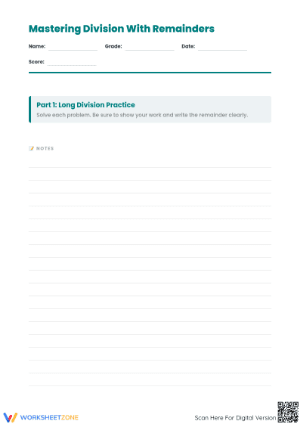
These division with remainders worksheets give fourth and fifth grade teachers a structured path from the first awkward moment a student discovers that 17 ÷ 3 doesn't come out even, all the way through interpreting what the leftover actually means in a real situation. Each page targets a specific point in that progression, so you're not handing students a mixed bag and hoping something sticks.
What's on Each Page
The set moves through three distinct phases of difficulty. Early pages use single-digit divisors with two-digit dividends — the kind of problem a student can still verify by drawing grouping circles or tally marks alongside the computation. That visual option matters at the beginning; students who can't yet trust the algorithm need a way to check themselves. Middle pages step up to three-digit dividends, which forces students to apply the full divide-multiply-subtract-bring-down sequence and keep columns aligned. Later pages drop into applied territory: word problems where the student must decide what to do with the remainder, not just calculate it.
Within the word problem pages, problems are sorted by interpretation type. Some situations call for dropping the remainder entirely (17 beads, 3 per bracelet — the leftover bead doesn't make another bracelet). Others require rounding the quotient up (30 students, 4 per car — you need a ninth car for the remaining two kids, not eight cars and two students standing in the parking lot). A smaller group of problems introduce remainder-as-fraction, appropriate for Grade 5 work where 3 friends split 7 sandwiches and each person's share has to be stated precisely.
Where This Sits in the Standards
The computational work aligns to 4.NBT.B.6, which asks students to find whole-number quotients and remainders with up to four-digit dividends and one-digit divisors. The word problem pages address 4.OA.A.3, which requires students to interpret remainders in context as part of multi-step problem solving. These two standards are often taught in the same unit but require very different things from students: 4.NBT.B.6 is procedural fluency, while 4.OA.A.3 is judgment about what a number means in a situation. A common instructional mistake is treating them as the same skill. The worksheet pages keep them separated until students have the procedure solid enough to think about interpretation without also worrying about the arithmetic.
Where Students Struggle Most
The error that shows up most consistently in student work isn't a computation error — it's a remainder that's larger than the divisor. A student divides 43 by 6, gets a quotient of 6, subtracts 36, and writes remainder 7. They don't pause to notice that 7 is bigger than 6, which means they could have made another group. The number doesn't feel wrong to them because they followed the steps. Several pages in this set include a dedicated check step that has students write the verification sentence: (quotient × divisor) + remainder = dividend. Requiring that written check — not just doing it mentally — catches the oversized-remainder problem before students move on.
The second pattern appears specifically in word problems: students who solve the arithmetic correctly and then pick the wrong interpretation. Asked how many buses are needed to transport 53 people if each bus holds 8, they write "6 remainder 5" and stop, or worse, write 6 as their answer. They've done the division; they haven't read the situation. The word problem pages include an interpretation prompt after each problem — a single sentence frame — that pushes students to explain in writing what they did with the remainder and why.
How Teachers Use These Pages
The computational pages work well as morning warm-ups, especially in the two or three weeks after a division unit opens. Five problems takes about eight minutes and gives you a quick read on who has the algorithm and who's still guessing at partial quotients. The word problem pages are better suited to the guided practice portion of the lesson, where you can pause mid-page and ask a student to explain their reasoning before they commit to an answer.
Error analysis is another strong use: take one of the computation pages, work five or six problems incorrectly using the two most common mistakes (remainder larger than the divisor; subtraction error in the middle step), and ask students to locate and explain each error before solving the problems correctly themselves. That task runs longer than a standard practice page and generates more discussion than almost anything else in a division unit.
Adjusting for Different Learners
Students who are still shaky on multiplication facts hit a wall on these pages because the multiply-and-subtract step requires quick fact recall under working memory load. For those students, a multiplication chart alongside the worksheet isn't cheating — it offloads the fact retrieval so they can actually practice the division procedure. Once the procedure is automatic, you pull the chart.
On the other end, students who breeze through the computation pages benefit from a constraint: ask them to write a word problem that uses a specific equation, then write it three ways — once where the remainder gets dropped, once where the quotient rounds up, and once where the remainder becomes a fraction. Writing all three versions for the same equation (say, 22 ÷ 5) forces them to think about context rather than just cranking through more problems. It's a harder task than adding digits to the dividend.
Frequently Asked Questions
1. Can these pages work for fifth graders who missed the concept in fourth grade?
Yes. The early pages don't signal a grade level, and the problem sizes are modest enough that a fifth grader reviewing the concept won't feel like the material is babyish. The transition to two-digit divisors and remainder-as-fraction is covered in the later pages, which is where fifth grade work typically extends the skill.
2. What's the best sequence if I'm using these alongside a textbook unit?
Lead with manipulatives and the textbook introduction, then bring in the early computation pages once students have seen at least one concrete model (counters, grouping circles, or arrays). Hold the word problem pages until students can get through a computation page with reasonable accuracy — otherwise they're juggling interpretation and a procedure they haven't automated, which is too much at once.
3. How do I handle students who keep forgetting the verification step?
Put the formula — (Q × D) + R = Dividend — in the top margin of every page, and require students to write it out for every problem, not just the ones they're unsure about. After a week or two of that routine, most students internalize it. The ones who still skip it are usually the ones who also have the largest-remainder error showing up in their work.
















 Interactive Worksheet Maker
 Quiz Maker
 Word Search Maker
 Crossword Puzzle Maker
 Word Scramble Generator
 Sentence Scramble Generator
 Handwriting Worksheet Generator
 Name Tracing Generator
 Fill In The Blank Generator