What Polynomial Long Division Worksheets Practice
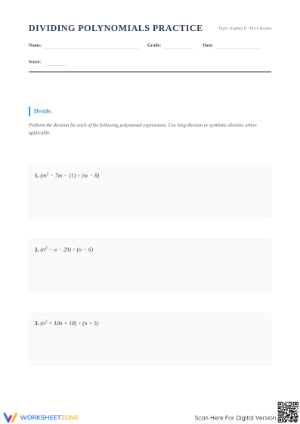
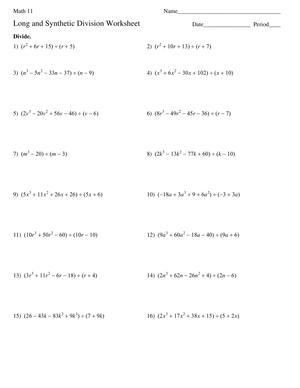
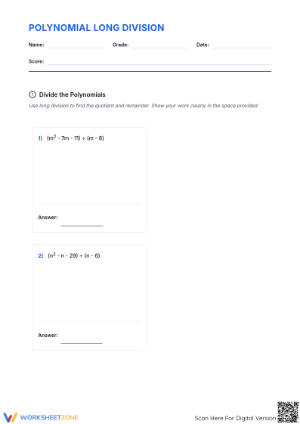
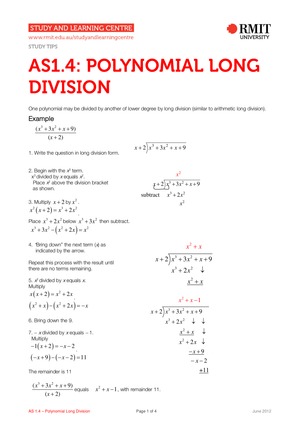
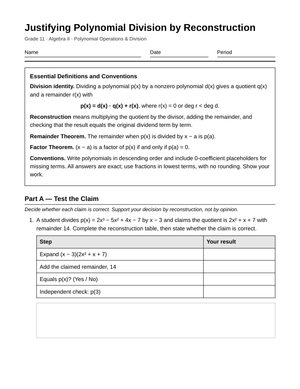
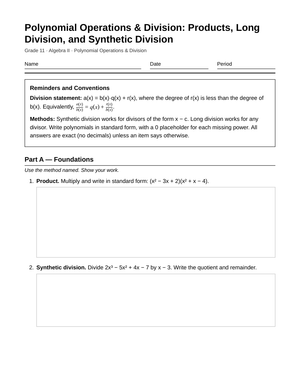
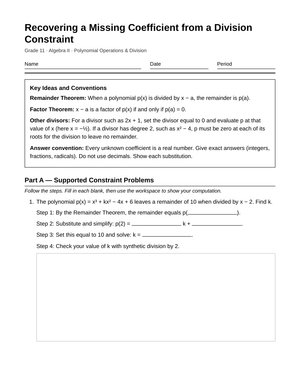
These polynomial long division worksheets give Algebra 2 and Pre-Calculus students structured repetition of the full division algorithm, from setting up the dividend in descending order to writing a clean quotient plus remainder. Each set targets the specific steps where students lose points: aligning like terms, subtracting signed polynomials, and bringing down the next term. Instead of one-off examples on the board, you get a sequence you can assign for guided practice, homework, or a focused intervention block.
The problems move deliberately. Early items divide by a monomial so students internalize the divide-multiply-subtract rhythm. Later items use binomial divisors and produce non-zero remainders, which forces students to track degree carefully and stop at the right point. That progression gives you a ready supply of problems for every stage of a unit, so you're not hunting for the next appropriate example mid-lesson.
Where Polynomial Long Division Fits in the Algebra Sequence
Polynomial long division usually lands in Algebra 2, and it resurfaces in Pre-Calculus when students study rational functions and end behavior. It builds directly on integer long division, so students who already understand numeric long division have a familiar mental model to lean on. That bridge matters. The algorithm looks intimidating once variables are attached, but the underlying moves are the same ones students practiced with whole numbers in earlier grades.
Because the method works for any divisor, it comes before synthetic division in most course maps. Synthetic division only handles linear divisors of the form (x - c), so long division is the more general tool students need first. Teaching it in that order keeps the sequence honest and gives students a method they can fall back on when a divisor is quadratic or higher.
How These Worksheets Align to Common Core
Polynomial long division maps cleanly onto a single standard, which makes these worksheets easy to justify in a lesson plan or a standards-based gradebook.
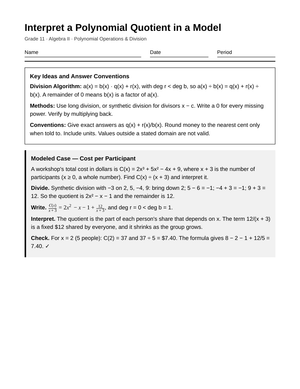
According to the Common Core State Standards Initiative, standard HSA-APR.D.6 asks students to rewrite a(x)/b(x) as q(x) + r(x)/b(x) using inspection, long division, or a computer algebra system, and it requires the degree of the remainder r(x) to stay less than the degree of the divisor b(x).
That degree condition is where most student errors surface, so worksheets that end in a genuine remainder are doing the standard's real work. HSA-APR.D.6 sits inside the Arithmetic with Polynomials and Rational Expressions domain of the High School Algebra standards. Framing your practice around that domain helps when you document instruction or explain to an evaluator why a procedural drill earns class time.
Sequencing Practice to Build Procedural Fluency
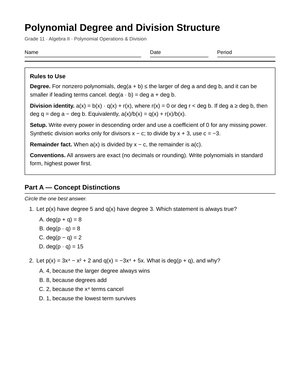
Fluency with this algorithm comes from repetition at the right grain size. A workable progression moves through three levels. First, divide a polynomial by a monomial so students see the pattern without the complication of a multi-term divisor. Second, divide by a binomial that leaves no remainder, which reinforces the check that the quotient times the divisor returns the original dividend. Third, divide by a binomial that leaves a remainder, so students have to write the answer in q(x) + r(x)/b(x) form.
Assigning problems in that order lets you catch misconceptions early. A student who mishandles signs on the subtraction step will fail every level, so spotting the error at level one saves frustration later. Mixing a few missing-term problems into the set is worth it too. When a dividend skips a degree, students who forget to insert a zero placeholder will misalign columns, and a couple of deliberate examples make that habit stick.
Polynomial Long Division vs. Synthetic Division
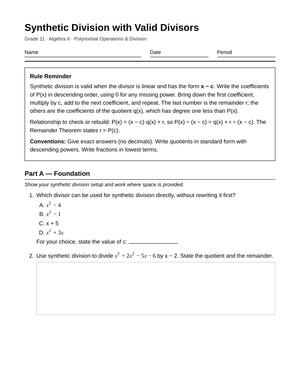
Students often ask why they can't just use synthetic division for everything. The honest answer is that synthetic division is faster but narrower. It only works when the divisor is linear, written as (x - c). Polynomial long division handles any divisor, including quadratics and cubics, which is why it stays useful in Pre-Calculus and beyond.
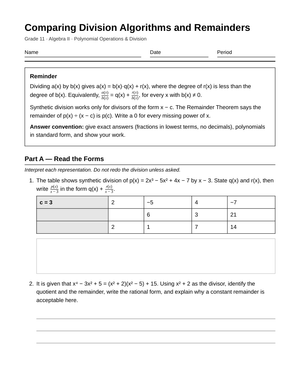
A useful classroom framing: long division is the general method, and synthetic division is the shortcut for one common case. When you introduce synthetic division later, have students solve the same problem both ways so they see the equivalence. That comparison reinforces the structure of the algorithm rather than treating the two methods as unrelated tricks, and it gives stronger students a reason to check their work with a second approach.
Classroom Implementation
For whole-class instruction, work one problem live with a visible column setup, then release students to a short worksheet set of three to five problems while you circulate. Keep the first assigned problem parallel to your worked example so students have a template within reach. For small-group intervention, pull the monomial-divisor and no-remainder sets and slow the pace, narrating each divide-multiply-subtract cycle aloud until students can narrate it back to you.
These worksheets also work well as formative assessment. Use a two-problem exit ticket to decide who needs reteaching before the next lesson. Error-analysis tasks are especially efficient: hand students a worked division that contains one sign or alignment mistake and ask them to find and fix it. That flips the cognitive load from computation to reasoning and often exposes misconceptions faster than assigning more problems. A quick tally of which step students flag tells you exactly where to aim tomorrow's warm-up.
Frequently Asked Questions
1. What grade level or course typically covers polynomial long division?
It's usually an Algebra 2 topic in US high schools, often revisited in Pre-Calculus when students study rational functions. Some accelerated Algebra 1 courses touch it, but most students meet it after they're comfortable with polynomial multiplication and factoring.
2. How is polynomial long division different from synthetic division?
Polynomial long division works for any divisor, while synthetic division only works for linear divisors of the form (x - c). Long division is the general method; synthetic division is a faster shortcut for that single linear case.
3. How can teachers use these worksheets for small-group intervention versus whole-class instruction?
For whole-class work, model one problem and assign a short parallel set while you circulate. For intervention, pull the monomial and no-remainder problems, slow the pace, and have students narrate each divide-multiply-subtract step until the routine is automatic.
4. What prerequisite skills should students have first?
Students should be fluent with integer long division, combining like terms, multiplying polynomials, and subtracting signed expressions. Comfort with writing polynomials in descending order and inserting zero placeholders for missing terms also prevents the most common alignment errors.
5. How do these worksheets align with Common Core Algebra standards?
They target CCSS HSA-APR.D.6, which asks students to rewrite a rational expression as a quotient plus a remainder over the divisor, keeping the remainder's degree below the divisor's. The standard lives in the Arithmetic with Polynomials and Rational Expressions domain.













 Interactive Worksheet Maker
 Quiz Maker
 Word Search Maker
 Crossword Puzzle Maker
 Word Scramble Generator
 Sentence Scramble Generator
 Handwriting Worksheet Generator
 Name Tracing Generator
 Fill In The Blank Generator