




























Views
Downloads

Telling Time to 5 Minutes | Printable Grade 2 Math

Paste this activity's link or code into your existing LMS (Google Classroom, Canvas, Teams, Schoology, Moodle, etc.).
Students can open and work on the activity right away, with no student login required.
You'll still be able to track student progress and results from your teacher account.
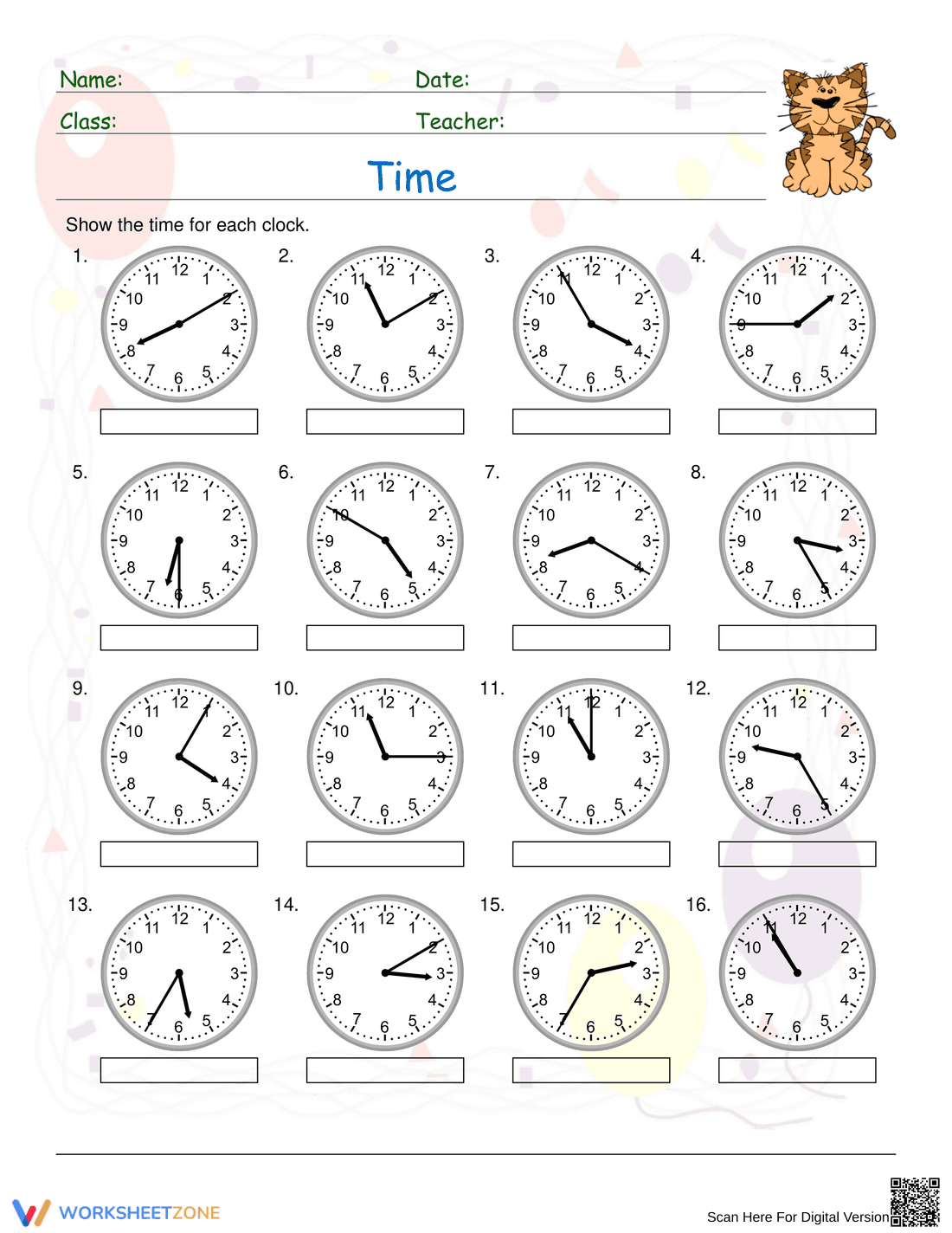
This Grade 2 math worksheet gives students focused practice reading analog clocks and writing the exact time. By interpreting the hour and minute hands to the nearest five minutes, learners build essential time-telling fluency. This straightforward activity reinforces foundational measurement skills required for daily scheduling.
At a Glance
- Grade: 2 · Subject: Math
- Standard:
CCSS.MATH.CONTENT.2.MD.C.7— Tell and write time to the nearest five minutes- Skill Focus: Reading analog clocks
- Format: 1 page · 16 problems · Answer key included · PDF
- Best For: Independent practice and review
- Time: 10–15 minutes
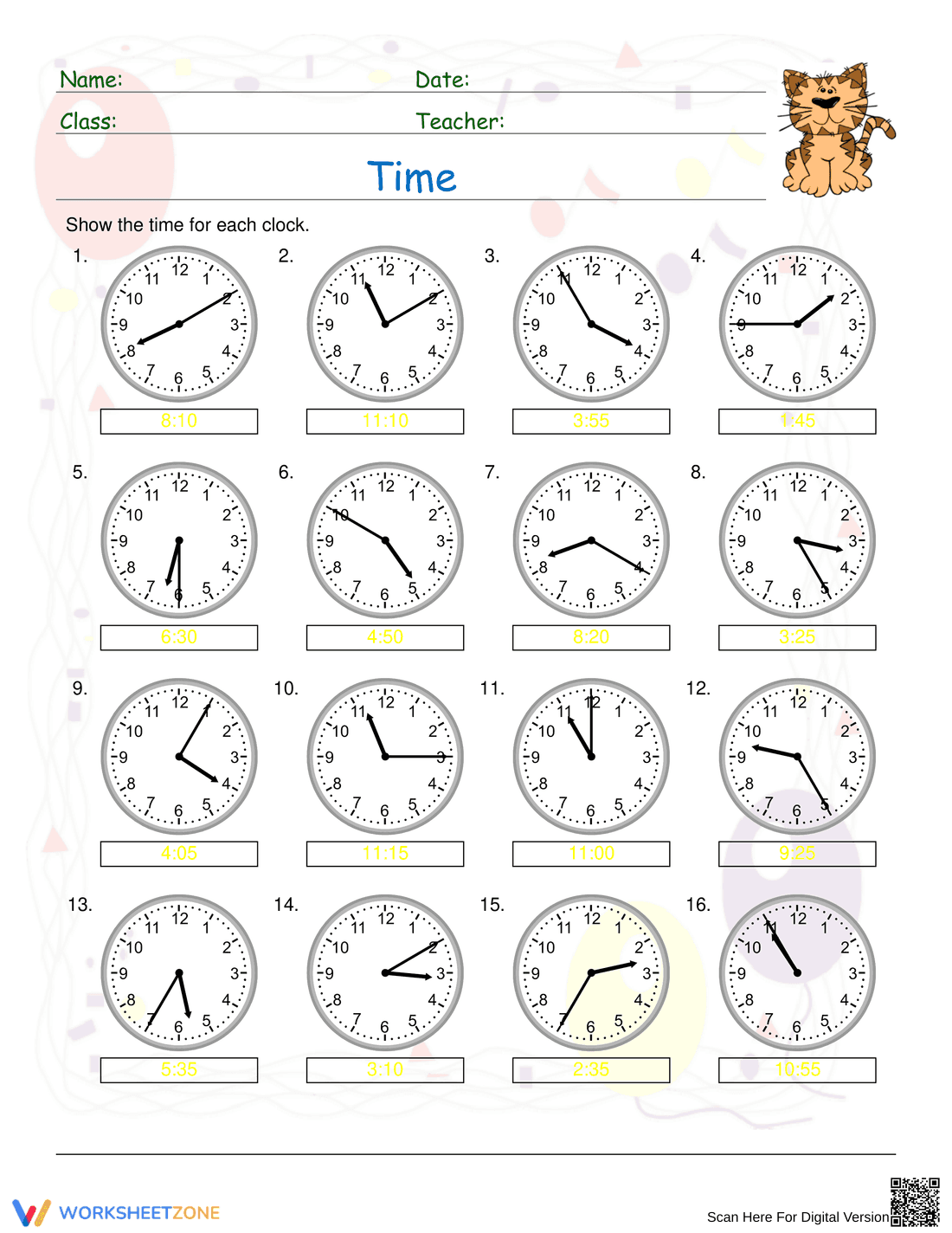
Inside this resource, educators will find a single-page worksheet featuring 16 illustrated analog clocks. Each clock displays a distinct time set to a five-minute interval. Students use the blank box beneath each clock face to write the corresponding digital time. A complete answer key facilitates quick grading.
Zero-Prep Workflow
This worksheet is designed for immediate classroom deployment:
- Print (1 minute): Download the PDF and print.
- Distribute (1 minute): Hand out during math centers or morning work.
- Review (2 minutes): Use the answer key to check responses rapidly.
With prep time under two minutes, this resource is perfect for sub plans.
Standards Alignment
This activity is directly aligned to CCSS.MATH.CONTENT.2.MD.C.7, which requires students to tell and write time from analog and digital clocks to the nearest five minutes, using a.m. and p.m. It also supports Grade 3 review for students needing foundational reinforcement before moving to one-minute intervals. Both standard codes can be copied directly into lesson plans, IEP goals, or district curriculum mapping tools.
How to Use It
Deploy this worksheet after direct instruction on the function of the minute hand. It serves as an excellent independent practice activity while the teacher pulls small groups for targeted support. Alternatively, assign it as a brief homework task to keep parents informed of current math topics. For a formative assessment observation tip, watch how students determine the hour when the minute hand is past the "6" (30-minute mark); students often struggle with the hour hand approaching the next number. Expected completion time ranges from 10 to 15 minutes.
Who It's For
This resource is primarily designed for second-grade students mastering basic time-telling concepts. It is also highly effective for third-grade students who require remediation or special education learners working on functional life skills. To differentiate, provide struggling learners with a physical geared clock to manipulate alongside the worksheet. Pair this activity with a visual anchor chart detailing the five-minute increments around the clock face for maximum impact.
Mastering the ability to tell and write time to the nearest five minutes is a critical functional skill outlined in CCSS.MATH.CONTENT.2.MD.C.7. When students practice reading analog clocks, they develop spatial reasoning and a concrete understanding of elapsed time. According to Fisher & Frey (2014), providing students with targeted, independent practice opportunities following explicit instruction significantly increases skill retention and automaticity. This worksheet offers exactly that type of focused repetition, allowing learners to solidify their understanding of the minute hand's movement in five-minute increments. By translating the visual representation of an analog clock face into a written digital format, students bridge the gap between abstract measurement concepts and practical, real-world application. Consistent engagement with these visual models ensures that foundational measurement competencies are firmly established before introducing more complex intervals.


