


























Views
Downloads


Essential Grade 2-4 Time Worksheet: 5-Minute Intervals
Paste this activity's link or code into your existing LMS (Google Classroom, Canvas, Teams, Schoology, Moodle, etc.).
Students can open and work on the activity right away, with no student login required.
You'll still be able to track student progress and results from your teacher account.
This comprehensive three-page Math packet provides students with essential practice in telling time to the nearest five minutes. By transitioning through reading clocks, drawing hands, matching formats, and solving word problems, learners develop the fluency needed to master analog timekeeping. This resource ensures students can accurately translate between digital and analog representations in a variety of contexts.
At a Glance
- Grade: 2–4 · Subject: Math
- Standard:
CCSS.MATH.CONTENT.2.MD.C.7— Tell and write time from analog and digital clocks to the nearest five minutes- Skill Focus: 5-Minute Intervals
- Format: 3 pages · 17 problems · Answer key included · PDF
- Best For: Independent practice or comprehensive sub plans
- Time: 25–35 minutes
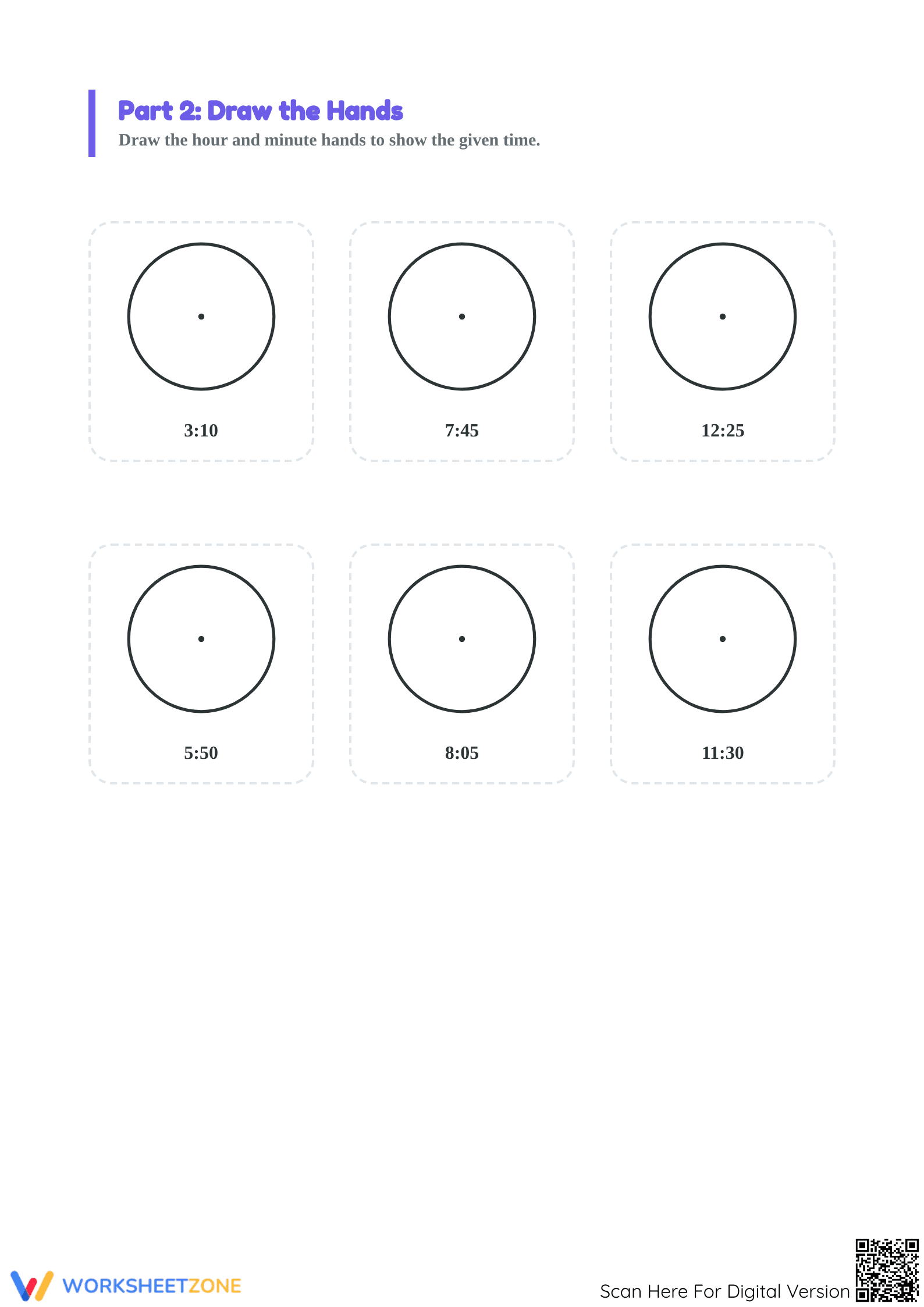
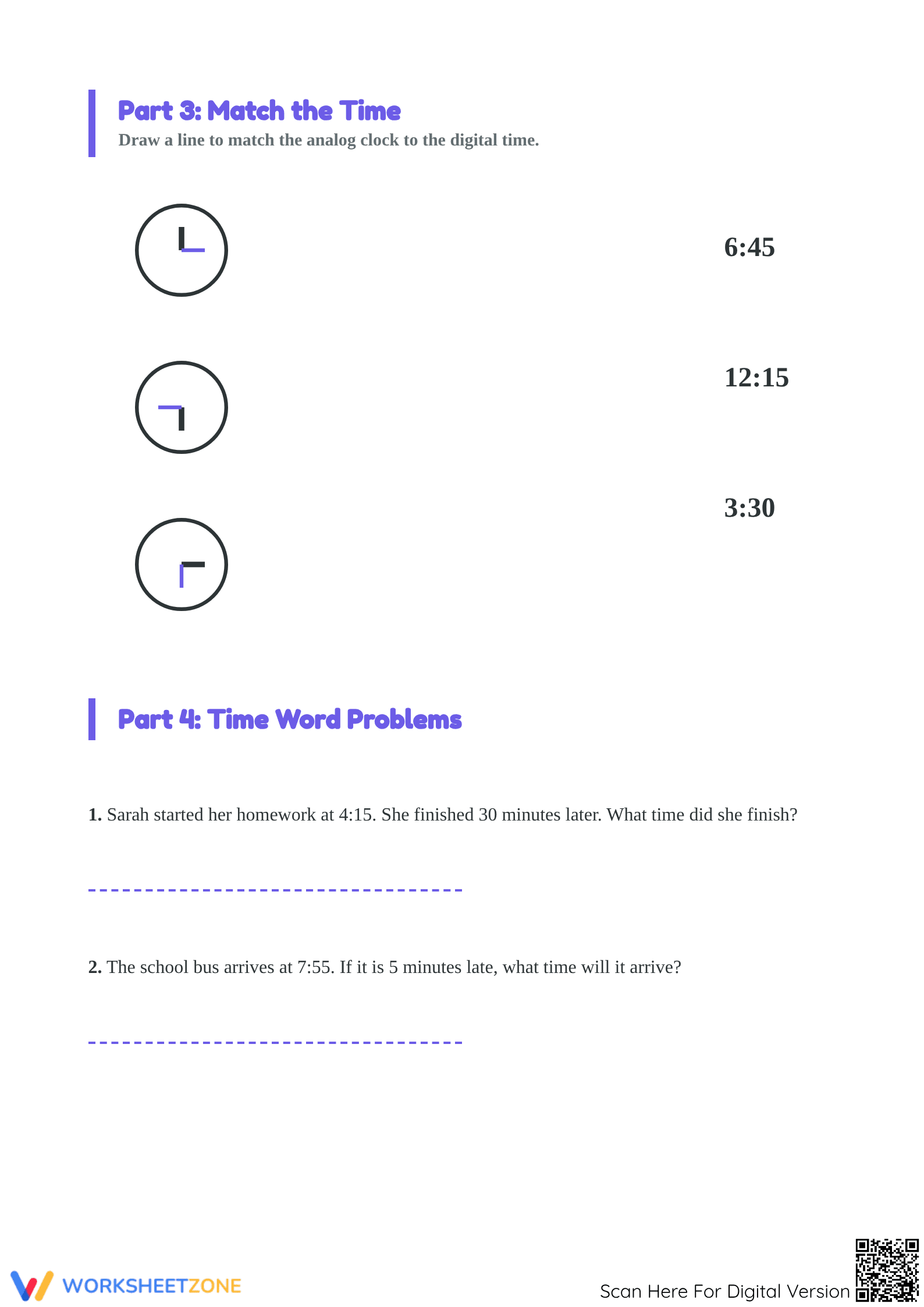
What's Inside: This 3-page printable collection features four distinct parts designed to build mastery. Part 1 includes 6 analog clocks for reading and digital entry. Part 2 provides 6 blank faces for drawing hour and minute hands based on digital prompts. Part 3 utilizes matching for quick recognition, and Part 4 challenges students with 2 realistic time-based word problems. A full answer key is included for immediate feedback.
Zero-Prep Workflow: 1. Print the packet (30 seconds). 2. Distribute to students for independent work or as a guided math center (1 minute). 3. Review the word problem strategies and matching accuracy using the included key (5 minutes). Total teacher preparation time is less than two minutes, making this an ideal choice for last-minute sub plans or morning work routines.
Standards Alignment: This worksheet is strictly aligned to `2.MD.C.7`. The standard requires students to "Tell and write time from analog and digital clocks to the nearest five minutes, using a.m. and p.m." This resource focuses on the numerical translation and mechanical skills of clock manipulation. This standard code can be copied directly into lesson plans, IEP goals, or district curriculum mapping tools.
How to Use It: Use this packet after an initial direct instruction lesson on the five-minute counting patterns around a clock face. For a formative assessment observation, watch how students handle the hour hand placement in Part 2 when the time is near the end of an hour (e.g., 7:45). Completion typically takes 30 minutes, allowing it to fit perfectly within a standard math block.
Who It's For: This resource is designed for Grade 2 through Grade 4 students who are working toward time fluency. It provides necessary scaffolding for second graders while serving as a valuable review for fourth graders. It pairs naturally with a physical classroom clock or an interactive digital clock tool for students who need tactile support during the drawing phase.
Mastering the ability to tell and write time to five-minute intervals is a foundational numeracy skill that bridges simple measurement with complex scheduling and elapsed time concepts. Research from Fisher & Frey (2014) emphasizes that moving students through varied task modalities—such as the reading, drawing, and problem-solving sections in this worksheet—is critical for shifting knowledge into long-term memory. By engaging with 17 distinct tasks, students internalize the visual relationship between the minute hand's position and its digital value. This 2.MD.C.7 aligned resource provides the structured repetition necessary to eliminate common clock-reading errors. As a classroom-ready tool, it allows educators to assess student progress efficiently while providing a high-quality, professional document that integrates smoothly into any elementary math curriculum or intervention program. This approach ensures that students leave the lesson with a functional and durable understanding of timekeeping standards.


