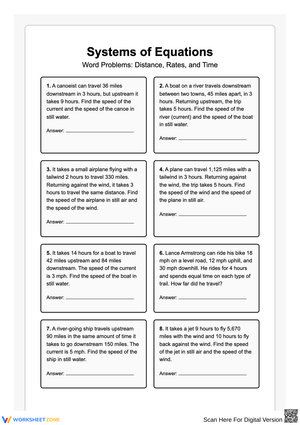
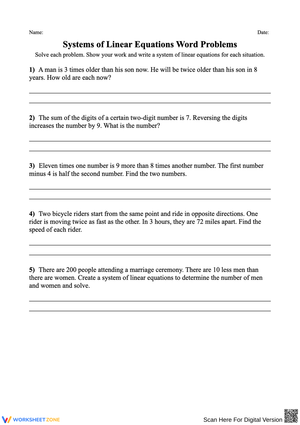
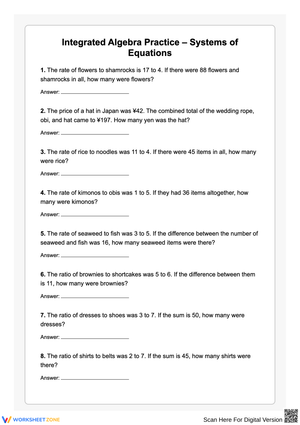
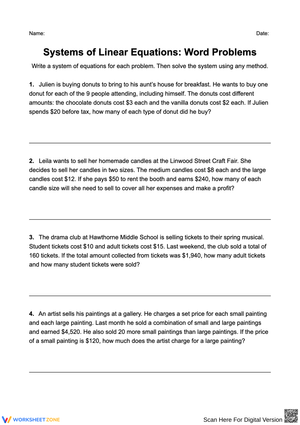
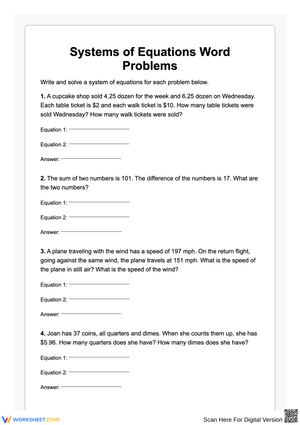
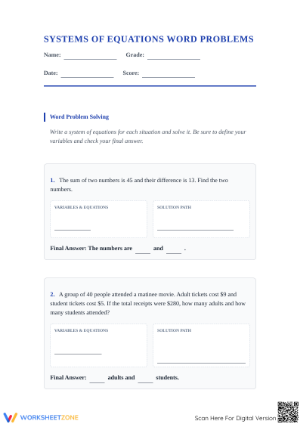
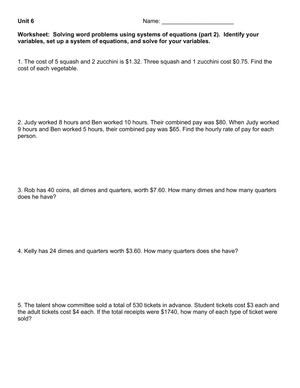
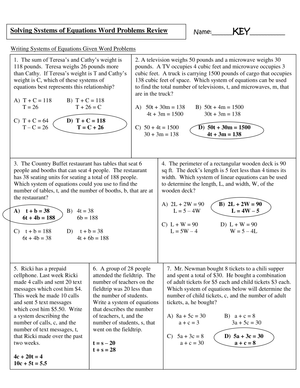
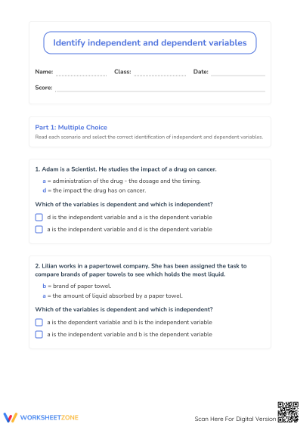
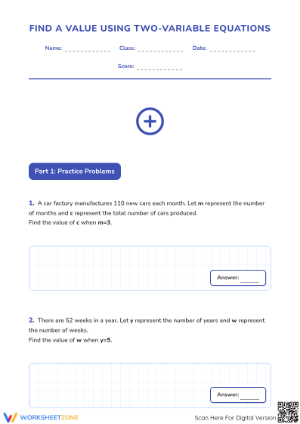
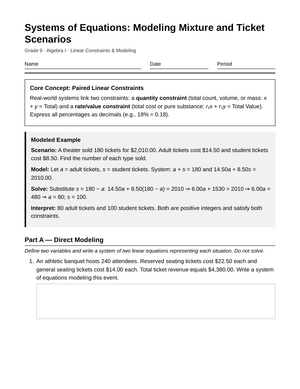
Systems of equations word problems worksheets sit at the point where algebra stops feeling abstract and starts describing money, distance, and everyday decisions students recognize. For grade 8 and Algebra 1 classes, the real skill is not only solving a system—it is reading a short scenario, defining two variables, and writing two equations that must hold at the same time. A page that hands students a ready-made system skips the hardest part of the standard. The strongest practice sets ask students to translate first, solve second, and interpret the answer last.
Get these worksheets when you are building toward 8.EE.C.8.c, running small-group intervention, or planning enrichment for students who finished the mechanics early. Because one scenario can be solved by graphing, substitution, or elimination, a single problem can stretch across three ability levels in the same class period without you writing three separate assignments.
Sequence Translation Before You Ask Students to Solve
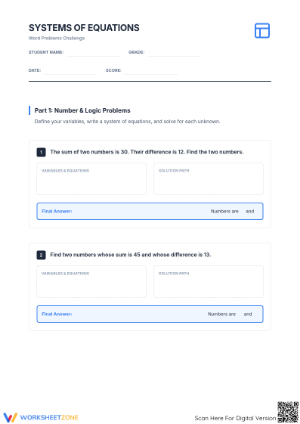
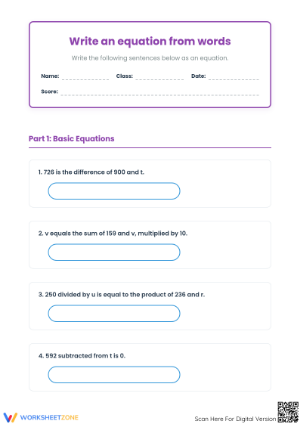
Most setup errors happen before any solving begins. Students who can run elimination flawlessly still stall when a paragraph gives them nothing to plug in. A worksheet that opens with pure translation practice—turn these two sentences into two equations, no solving required—removes that bottleneck. Give students a fundraiser scenario and ask only for the variable definitions and the two equations. Once that is automatic, add the solve step.
A workable progression across a worksheet set looks like this:
- Define the variables. Students write what x and y stand for, including units, before touching numbers.
- Write both equations. One equation usually counts items; the other tracks a total such as cost, distance, or value.
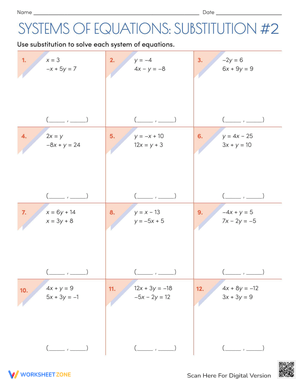
- Solve with any method. Students choose graphing, substitution, or elimination.
- Interpret the result. Students answer the original question in a full sentence, not just x equals 4.
Pages that keep these four steps visible give strugglers a checklist and give you a clean way to see exactly where a breakdown happened.
Classroom Implementation
Drop these worksheets into a unit at three predictable moments. Early on, use translation-only pages as a warm-up or exit ticket while students are still shaky on defining variables. Mid-unit, assign mixed pages that require a full solve and interpretation, and use them as a formative quick check on 8.EE.C.8.c before the test. Late in the unit, pull error-analysis versions—problems with a worked setup that contains one planted mistake—for students who need a stretch.
For small-group intervention, cut a page to three problems and sit with students through the variable-definition step only, releasing them to solve independently once the setup is sound. For enrichment, ask early finishers to write their own word problem for a given system, then trade with a partner. Writing a problem that produces a specific solution forces a deeper grasp than solving ten pre-written ones. A quick station rotation—translate at one table, solve at another, interpret and check at a third—keeps a mixed-ability class moving without three separate handouts.
Common Student Errors to Watch For
A handful of mistakes show up on nearly every class set, and naming them ahead of time heads off the most frequent point losses. Watch for these:
- Vague variables. Writing x equals tickets instead of x equals the number of adult tickets, which makes the equations ambiguous.
- One equation, not two. Students capture the total but forget the count, or the reverse, leaving the system underdetermined.
- Dropped units in the answer. Reporting x equals 12 without saying twelve adult tickets, so the interpretation step is lost.
- Mismatched conditions. Adding a cost and a count in the same equation because the numbers sit near each other in the paragraph.
Recognizing whether a setup yields one solution, no solution, or infinitely many is part of the standard too, so include a few problems where parallel or coincident lines force students to explain why no single answer exists.
Frequently Asked Questions
1. What grade level or course covers systems of equations word problems?
This skill lands in grade 8 and Algebra 1. Grade 8 introduces it under CCSS 8.EE.C.8, and Algebra 1 revisits it with heavier algebraic technique. Intervention and enrichment specialists also use these worksheets to reteach students who missed the setup step or to extend students who mastered the mechanics early.
2. What is the best way to teach students to translate word problems into equations?
Separate translation from solving. Have students define both variables with units, then write the two equations, before any solving happens. Practicing setup as its own step—no answer required—builds fluency faster than jumping straight to substitution or elimination, and it makes the source of an error obvious when one appears.
3. How can I differentiate these worksheets for a mixed-ability class?
Use one scenario at three depths. Give strugglers the variable definitions and ask only for the equations. Give on-level students the full solve and interpretation. Ask advanced students to write an original problem for a given system or to fix a setup that contains a planted error. The shared context keeps the class together while the demand shifts.
4. How do these worksheets align with CCSS 8.EE.C.8?
They target 8.EE.C.8.c, which asks students to solve real-world problems leading to two linear equations, and 8.EE.C.8.b, which covers solving systems algebraically and estimating solutions by graphing. Word problems that require translation, a solution method, and interpretation cover the standard more completely than bare equation drills.
5. What are the most common student errors when setting up systems?
Defining variables without units, writing only one equation, mixing a count and a total in the same equation, and forgetting to interpret the final answer in context. Building a quick self-check—define, write two, solve, interpret—into every page catches most of these before they cost points on an assessment.













 Interactive Worksheet Maker
 Quiz Maker
 Word Search Maker
 Crossword Puzzle Maker
 Word Scramble Generator
 Sentence Scramble Generator
 Handwriting Worksheet Generator
 Name Tracing Generator
 Fill In The Blank Generator