


























Views
Downloads


Printable Mixture & Ticket Worksheet | Grade 9 Algebra I
Paste this activity's link or code into your existing LMS (Google Classroom, Canvas, Teams, Schoology, Moodle, etc.).
Students can open and work on the activity right away, with no student login required.
You'll still be able to track student progress and results from your teacher account.
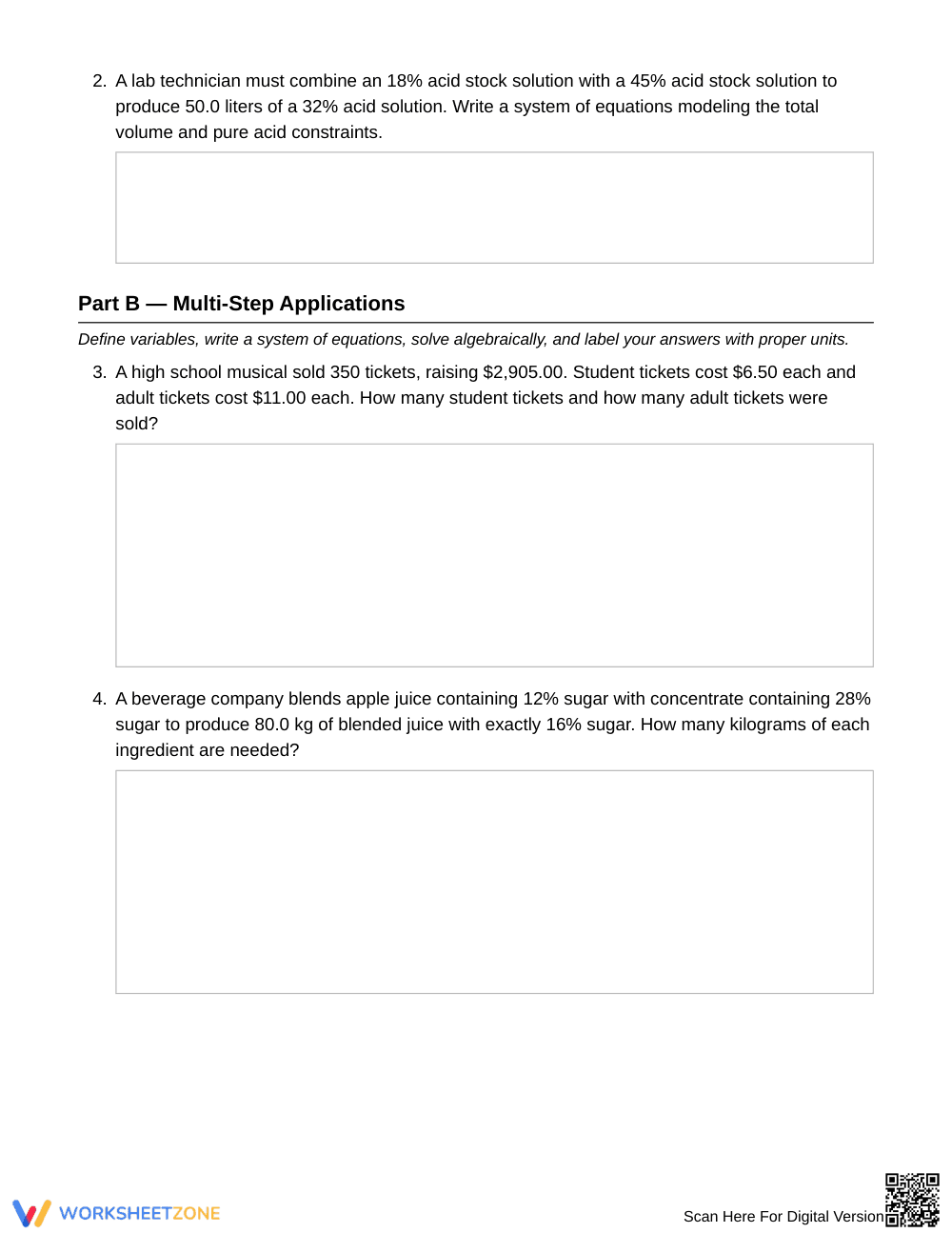
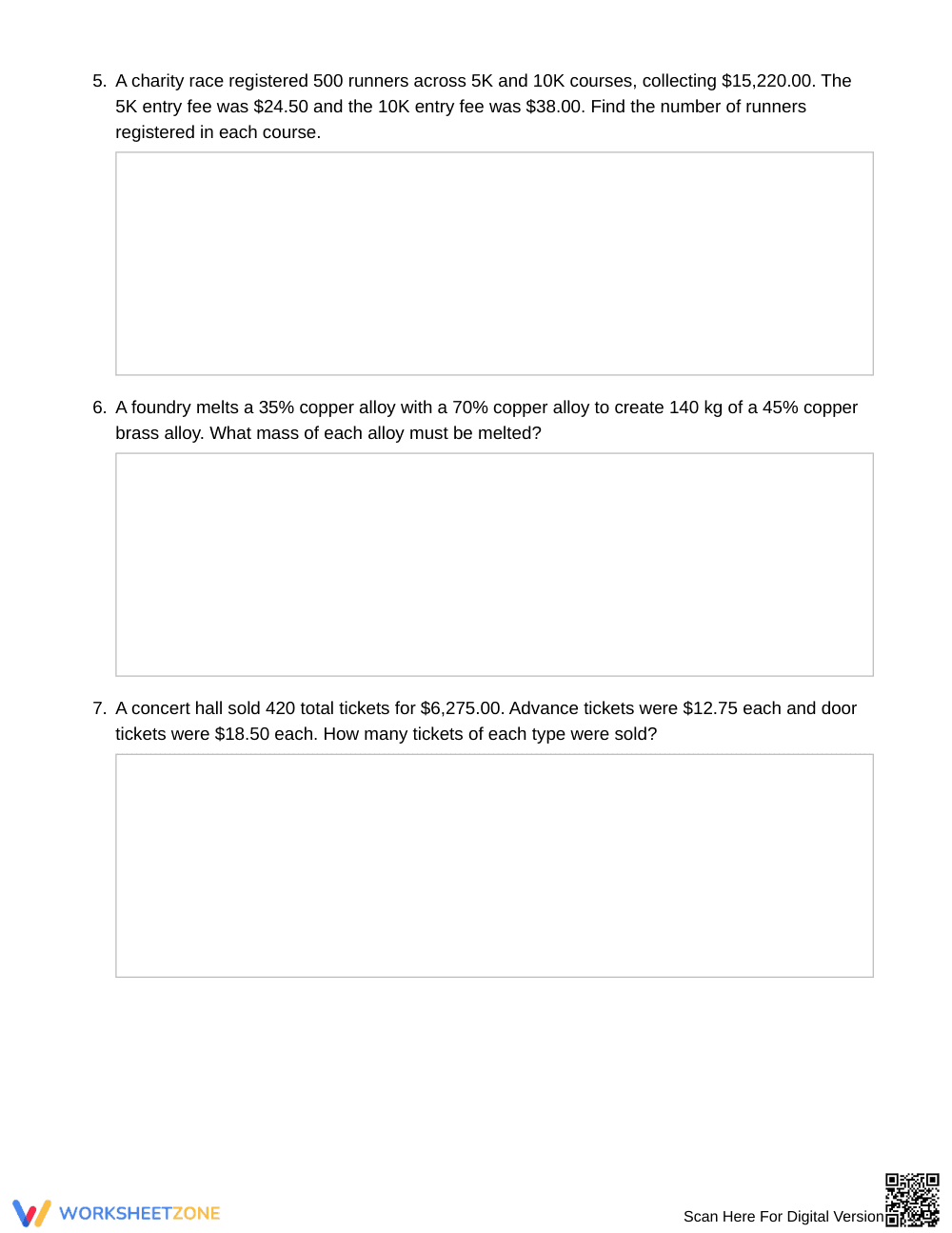
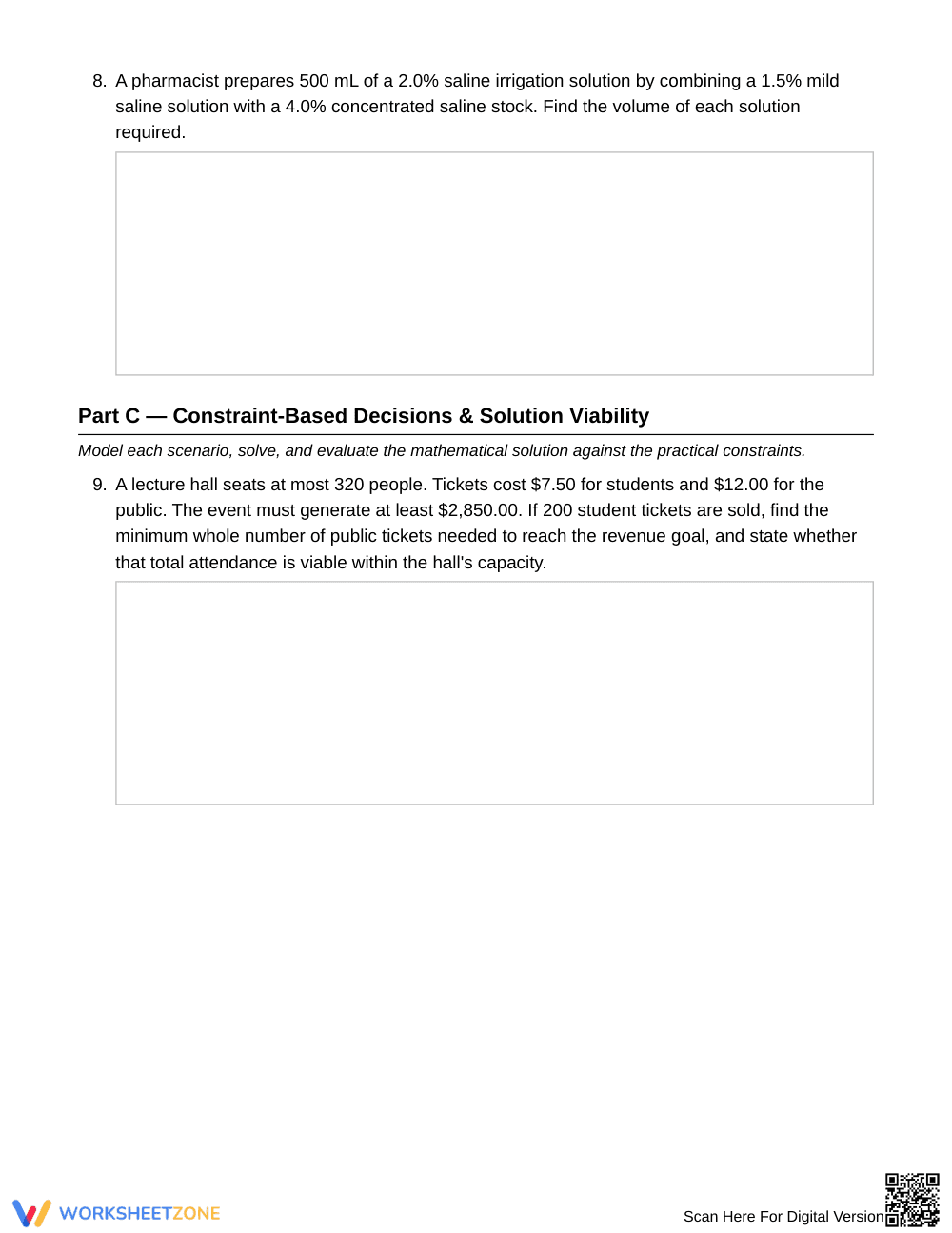
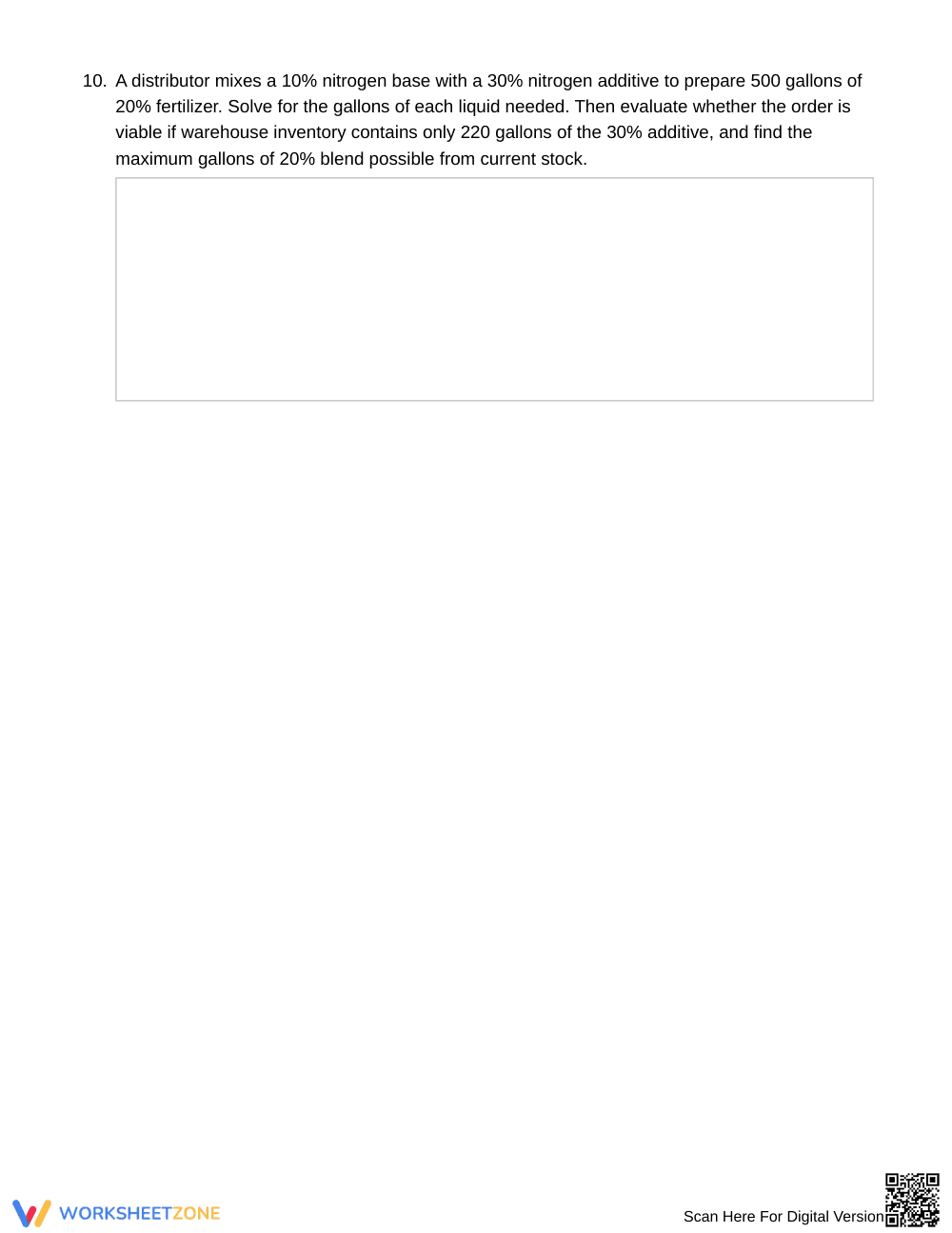
This Algebra I worksheet guides Grade 9 students in modeling real-world mixture and ticket scenarios with linear systems. Students define variables, construct paired quantity and value constraints, solve algebraically, and evaluate solution viability against real physical constraints like room capacity and chemical inventory.
At a Glance
- Grade: 9 · Subject: Algebra I
- Standard:
HSA-CED.A.3— Model real situations with linear systems and evaluate viable solutions- Skill Focus: Model a Mixture or Ticket Scenario
- Format: 5 pages · 10 problems · Answer key included · PDF
- Best For: Linear systems modeling practice
- Time: 40–50 minutes
What's Inside
This 5-page printable PDF features 10 modeling problems centered on dual linear constraints. It includes a core concept reference box and a worked theater ticket example. Students progress from writing equations to algebraic solving and viability analysis. A complete 2-page answer key provides worked solutions and contextual interpretations.
Skill Progression
- Guided practice (Part A — Direct Modeling): 2 problems where students define variables and write paired linear equations without solving, supported by the modeled example.
- Supported practice (Part B — Multi-Step Applications): 6 word problems requiring students to write systems, solve algebraically, and label units.
- Independent practice (Part C — Constraint Decisions): 2 complex scenarios testing calculated solutions against seating capacities and stock limits.
This sequence implements the gradual-release model to build lasting problem-solving competence.
Standards Alignment
This worksheet aligns to HSA-CED.A.3: Represent constraints by equations or systems and interpret solutions as viable options in a modeling context. It also supports HSA-REI.C.6 through algebraic solving. Both standard codes can be copied directly into lesson plans, IEP goals, or district curriculum mapping tools.
How to Use It
Use this worksheet following direct instruction on linear systems to connect algebraic techniques with word problems. During independent practice, check that students convert percentages to decimals accurately. Expect completion in 40 to 50 minutes of instructional time.
Who It's For
Designed for Grade 9 Algebra I students learning system applications. Pair this worksheet with direct instruction on solving systems by substitution or elimination.
Aligned with standard HSA-CED.A.3, this worksheet targets the skill of modeling real-world mixture and ticket scenarios using systems of linear equations. According to research by Fisher & Frey (2014) on the gradual release of responsibility framework, structuring mathematical practice through explicit modeled examples, scaffolded equation formulation, and independent contextual problem solving substantially accelerates both conceptual understanding and procedural fluency. By explicitly distinguishing between total quantity constraints and rate-based value constraints, Grade 9 students build durable algebraic schemas for analyzing complex systems. The included tasks require learners not only to calculate precise numerical solutions but also to evaluate solution viability against physical seating capacities and chemical inventory limitations. This dual emphasis ensures high school Algebra I students master abstract algebraic manipulation while developing rigorous mathematical reasoning habits essential for standardized assessments and future STEM coursework.


